
The moment for Indian art: artists and collectives at the Kochi Biennale
From the event in Kerala to the exhibition at Pac in Milan, eyes on a growing scene with a solid market

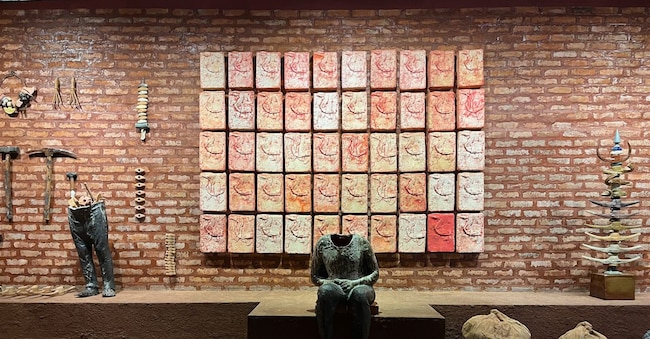
The current focus on contemporary Indian art is high. In Milan it is on show at the PAC, in the exhibition entitled 'India. Di bagliori e fughe" (until 8 February), with 28 artists focusing on the complexities and transformations of the present. While in Kerala, at the southernmost tip of the Indian peninsula, a historical place of exchange of spices, but also of cultures and religions, the sixth Kochi-Muziris Biennial has opened (12 December to 31 March 2026). With 66 artists from 25 countries, the Biennial is the most important art event in South Asia. It was initiated in 2012 by a group of artists who formed a foundation, including Bose Krishnamachari, President of the Biennial, and Shwetal A Patel, responsible for international partnerships and programmes, with the desire to create a non-commercial event in the local art context, which was dominated at the time by galleries and the market. To this day, it remains a biennial that focuses on artists and the sense of community and mutual support to create an artistic ecosystem. This is emphasised by the curator of this edition, an artist well known to the international art world, Nikhil Chopra, born in 1974, also known in Italy, where he has been represented by Galleria Continua since 2012.
The Biennial Theme
His choice for the Kochi-Muziris Biennial, whose name recalls the legendary port on the Malabar coast, was to take on the curatorship of the event together with the collective he has been a member of for ten years, called HH ArtSpaces, based in Goa, also known in Italy from the exhibition that opened the Milanese spaces of the Fondazione Elpis in 2023. Entitled 'For The Time Being', the Biennial sets out not to be a static exhibition, but an event in the making, made up of workshops, performances and encounters. "At the centre is the body and experience," explained Nikhil Chopra. "We invite the audience to activate all their senses and participate in the event, sharing the here and now, immersing themselves in materiality, in the climate, considering the exhibition as a living organism in transformation. At the centre is the human being behind the work of art. It is a place of friendship, made by artists for artists'.
The artists
It is therefore not a white cube, but a place of learning, where to discuss, to ask questions - even uncomfortable ones - in a fragile global context, characterised by political and climatic crises. Special attention is given to untold stories, for example, those of the seasonal migrant workers in the brick kilns in Mirzapur, Uttar Pradesh, the focus of the work of Birender Yadav, born in 1992, caught in a circle of extraction and exploitation. Or, the life on the margins lived by the Dalit communities (the definition used today for those who were once called the 'untouchables'). Particularly significant is the choice to include some artists from these communities - a reality that continues to exist. For example, Kirtika Kai, born in 1990 in New Delhi but raised in Australia, in her works speaks of the Dalit heritage in the Indian diaspora through traditional materials and an abstract language, while another artist, Prabhakar Kamble, born in 1986, investigates the aesthetic, social, political, historical and cultural architectures of the caste system in large installations with materials and objects from the agricultural world. Represented by Jhaveri Contemporary, their prices range from €10,000 to €20,000 for paintings and €20,000 to €50,000 for installations. Moonis Ahmad Shah, born in Kashmir in 1992, is exhibited both in Kochi and at Pac in Milan. In his installations, he evokes the posthumous lives of the dead as a means to combat established states of power (he works with Vadhera Contemporary, his works exhibited in Kochi range from one thousand to six thousand dollars). Other artists present at both the Biennale and Pac are the 14 members of the Panjeri Artists' Union collective, whose work is a form of political resistance and collection of the material traces of collective memory. Shiraz Bayjoo, an artist from Mauritius based in London, born in 1979, puts the Indian Ocean at the centre of his research to talk about stories of sea trade and colonialist extraction. There is also an Italian in the Biennale, Piero Tomassoni, who works with Palestinian artist Dima Srouji on the theme of refuge in both a personal and political sense, while a parallel exhibition to the Biennale organised by the Ishara Foundation includes two installations by Michelangelo Pistoletto.
Funding
Spread over 29 locations in and around Kochi, the biennale succeeds in revitalising abandoned historical places and also having an impact on the local economy. Just for a driver of the tuk tuk, the Ape that serves as an urban taxi, the daily earnings rise from 800-1,000 rupees per day to 1,500-3,000 rupees. The budget to organise the Biennial is USD 3.3 million, which includes resources from the state of Kerala (decreasing, according to some sources) and private donors (increasingly important). The most prominent private donors this year, who contributed between 5 and 10 million rupees (about 55 thousand-110 thousand dollars) were Yusuff Ali, founder and chairman of LuLu Group International, global retail giant, philanthropist Minal Bajaj, collector and patron Aarti Lohia and Mariam Ram, managing director of TNQ Technologies and owner TNQ Books and Journals Private Limited. This year a new category of donors, called Benefactors, was introduced to support the Biennial in the long term.
This year's 'Platinum Benefactors' have pledged to donate 10 million rupees to the Kochi Biennial Foundation over the next five years. They are philanthropist Sangita Jindal, collector and patron Kiran Nadar, the aforementioned Mariam Ram,Shabana Faizal of the eponymous foundation, Shefali Verma of The Ardee Group, Anu Menda, Managing Trustee of RMZ Foundation, and Adeeb and Shafina Ahmed.

