
The museum gets a makeover: how design transforms the cultural experience
From Warsaw to Turin and on to Schengen, Ico Migliore and Mara Servetto are designing increasingly immersive and participatory museums, where the digital and the analogue intertwine to bring new audiences closer to culture

Key points
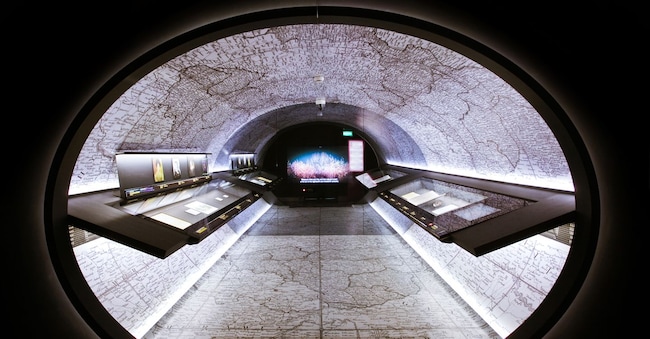
The museum of the future exists and is spreading. It is not a place to visit but a laboratory of ideas where anyone, of any age and from different cultural backgrounds, has the opportunity to engage, interact and get to know one another better. The museum of the future bears the signature of Ico Migliore and Mara Servetto, who explain: ‘Design means a project. Anyone who enters a temporary or permanent museum exhibition space must leave transformed; design creates the atmosphere of the space to give every visitor a tangible experience and, however overused the term may be, the museum must stir the emotions.” No longer ‘conservative’ museums that make the artwork inaccessible, but – through new digital technologies – the opportunity to move through spaces, touching materials and objects, listening to sounds and smelling scents.
New projects bridging the digital and analogue worlds
By blending digital and analogue elements, the designer enables visitors to have a hands-on, rather than passive, experience of the museum. The younger generations (Millennials and Gen Z) are well aware of this, and it is confirmed by specific data: 80 per cent of visitors under 35 visit interactive museums featuring integrated technologies, whilst 42 per cent of young people check social media and the museum’s website before visiting to understand how the venues utilise technology. The philosophy of this Milanese architectural and design duo is encapsulated in the concept of ‘Museum Seed’: ‘A place of culture, like a seed, must take root in the urban and social fabric of its surrounding area to become a catalyst for new behaviours. Today’s value lies in divergence, the ability to move between different worlds. Interior design is a convergence of the arts; we must not forget that.”
The start in Warsaw
It all began in 2010 when the Migliore+Servetto architectural practice designed the Fryderyk Chopin Museum in Warsaw, housed within the Ostrogski Palace, which was conceived as a sequence of eleven captivating and evocative spaces. Among these is the room dedicated to the period when the composer lived with George Sand in Nohant; divided into two sections, the left-hand wall displays paintings relating to the location and letters written by Chopin in which he describes it, revealing his delight in living in the countryside. On the right-hand wall, Migliore+Servetto have created drawers: ‘Each one reveals a sound; when opened together, it sounds like a cacophony, but it is the soundscape generated by the music and the rustling of the wind that the composer used to hear’. Opening a drawer releases an intense scent of violets; the sound accompanies the surprise of discovering Chopin’s favourite flower. Design makes a powerful statement through the design of the drawers and the black, anechoic cube that symbolises Chopin’s death.
From Milan to the Schengen Museum
At the Natural History Museum in Milan, Migliore+Servetto designed the ‘Sala dell’Uomo’ in collaboration with Anna Alessandrello, curator of the palaeontology section, who oversaw the scientific aspects and highlighted the main themes: ‘We have transformed them into four towers, which serve as focal points for the narrative of the space; the timeline guides visitors through each area, providing information. The artefacts are displayed in display cases within the towers, which visitors can enter; as they approach the pieces, they discover new narratives.” The museum is evolving; the exhibition system devised for the ‘Sala dell’Uomo’ has been designed with a view to being applied to other galleries in the future.
‘Museums are more successful today because they manage to appeal to a wider audience; in the past, you had to be well-prepared to visit one – you had to know the artists and the themes,’ continues Migliore. Tourists visiting a city want to see its museum; that is why design is fundamental to any innovative cultural approach. ‘We should take a more scientific and less humanistic approach to our museums; people want to interact with the works to learn new things, just as happens in Anglo-Saxon museums.’
Brand connect


Newsletter RealEstate+
La newsletter premium dedicata al mondo del mercato immobiliare con inchieste esclusive, notizie, analisi ed approfondimenti
Abbonati