
Entering the myth alongside the hero of two worlds
2' min read
2' min read
Ana Maria de Jesus Ribeiro da Silva, known to everyone as Anita Garibaldi, met the hero of two worlds in 1839 on her own land, in Brazil, where Garibaldi was fighting for the independence of the state of Santa Caterina, in the south of the country. A meeting in the midst of a revolution could only be fatal for the two. She had a husband of whom she had no news and did not hesitate to leave South America, following her new love and the father of her children.
However, fate was to be cruel, inflicting her death from malaria fever - while pregnant - during her escape with Giuseppe Garibaldi after the failure of the Roman Republic. Weak and exhausted, Anita died on 4 August 1849, although lovingly cared for by the people of Ravenna. A death, at only 28 years of age, that immediately made her part of the Risorgimento myth, the only woman in the epic of freedom alongside Garibaldi, who was forced to leave her at the Guiccioli farm and continue his escape, helped by the organisation of the people of Romagna.
Loading...
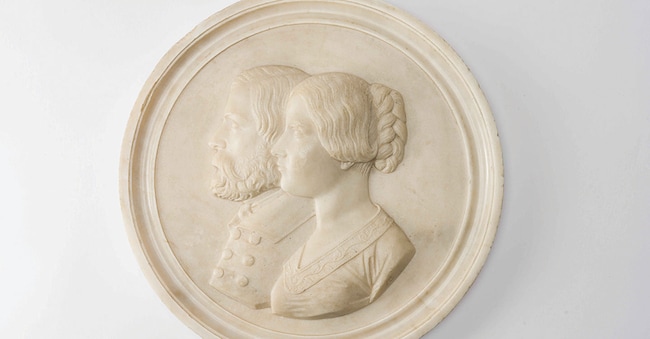
Garibaldi's last direct presence in Ravenna is linked to her, on 20 September 1859. Having returned to the city to recover his wife's remains, the hero praised his 'liberators' and the 'people of Ravenna' from the government palace. It was the women who had come to Anita's rescue, as we read in the dedicated room, 'whose names, today painstakingly reconstructed, have known no celebration, unlike the 'saviours''. The cult is developed without many objects and portraits of the Brazilian woman: on display are the uniform of the doctor who tried to save her, a coral bracelet, a perfume vial, a shawl, the medallion in which she appears with Joseph (here at the end of the article) and little else.
In Ravenna, a few decades after his death, his memory was remembered and became important for the city also 'through the sacralisation of the places of agony, death, burials and personal objects'.
Her figure can be explored in a fine volume written by historian Silvia Cavicchioli, Anita. Storia e mito di Anita Garibaldi (Einaudi, 2017) reviewed in the Domenicale by Roberto Balzani.
Copyright reserved ©


Brand connect
Loading...
