Training

The Navy Basin for Engineers and Professionals

Years of study and in-depth courses create skills suitable for both defence and civil life tasks
by Raoul de Forcade

4' min read

4' min read

In its 144 years of existence, the Livorno Naval Academy has trained more than 44,200 officers, including those in the normal courses, those in the auxiliary and complementary courses, and those on direct appointment; it also hosts around 500 students and participants in supplementary and professional courses each year. The officer's career is perhaps the most coveted within the Navy but, from a training point of view, it is only one of the paths that can be taken by those who decide to join the armed force dedicated to the defence and security of the sea, the coasts and the underwater world. Because even those who do voluntary service as non-commissioned officers, graduates or simple sailors are subjected to a meticulous training course that enables them to develop professional skills that can then also be applied in civilian life. We will make an excursus precisely on the professional openings offered by the various roles within the Navy, starting with those in command roles and ending with the troops.

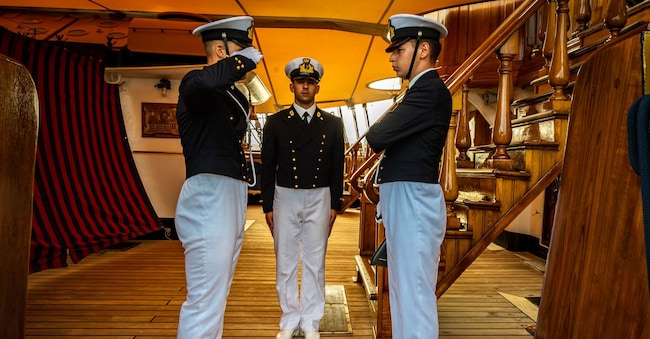
Addestramento allievi all’Accademia di Livorno e sulla Vespucci

Photogallery41 foto

Officers and Managers

.

Officers are the future leaders of the armed forces who attain the necessary training to lead men and vehicles. They are divided into various roles and corps, ranging from junior officers to admirals. They all begin their careers at the Naval Academy in Livorno (founded in 1881); the length of the course varies depending on the specialisation and includes master's degrees in collaboration with universities such as Pisa, Genoa, Naples and Trieste.

Loading...

Officers in the normal ranks can reach the highest posts within the Navy and Defence without career restrictions. To take part in the Academy competition, you must be between 17 and 22 years old, an Italian citizen, have a high school diploma and be psychophysically and aptitude fit. The selection tests also include general culture, English language and a 30-day internship. At the end of the training, trainees attain the rank of second lieutenant.

The main specialisation corps are the General Staff (which includes command roles, with a 5-year degree in Maritime and Naval Science), the Naval Engineers (which includes maintenance of naval units and a 6-year degree in Naval Engineering), the Infrastructure Engineers (design and maintenance of infrastructure, with a 6-year degree in Civil Engineering), Health (for shipboard doctors and militia health centres, which includes a 7-year degree in Medicine and Surgery), Commissariat (which focuses on financial and logistical management, with a 5-year degree in Law) and, finally, Harbour Master's Office (which focuses on safety of navigation and maritime domain and requires a 5-year degree in Law).

Other routes to becoming an officer are the 30-month Advanced Placement Trainee (Aufp), who attends an 11-week course at the Academy, and is then assigned either on board ships or in shore-based bodies (and the career can then be consolidated by taking part in an internal competition); the direct-appointment officer (who is selected through a competition, based on qualifications and examinations, from among young people already in possession of a master's degree) and is trained for specific roles based on the degree held; finally, the complementary pilot (Aupc), who is an auxiliary with a 12-year prefixed term of service and, after a very tough initial course, continues with flying courses, in national schools or in the USA: this is how naval pilots are trained.

NCOs and supervisors

NCOs, on the other hand, are called upon to play a supervisory, management and staff training role. The training of cadet marshals takes place entirely at Mariscuola in Taranto. The training process consists of a three-year course: two years of basic course and one year of application course. During this period, trainees also attend university courses to obtain specific three-year degrees in collaboration with the University of Bari (Uniba) or the Bari Polytechnic (Poliba), depending on their specialisation. The minimum requirements to enter are an age between 17 and 26 (28 for those who have already served in the military), a secondary school diploma and the unfailing psychophysical and aptitude suitability.

Then there are the directly-appointed marshals, who are competition winners, who already have a university degree provided for in the notice and attend a training course, lasting about 12 months, to acquire the necessary technical-professional, ethical-military and personnel management skills.

The marshals undertake courses of study that lead them to become helmsmen and harbourmasters (two years of basic course and one year of application course with a degree in Maritime Science and Management at Uniba), or combat systems specialists and technicians (with a degree in Computer Science and Digital Communication at Uniba) or platform system specialists (i.e. motor engineers, with a degree in Industrial and Naval Systems Engineering at Poliba) or, again, nurses (with a degree in Nursing at Uniba).

Then there are the sergeants, who are the reference point between the graduates and the marshals. A role that is only accessible to those who have already been in the Navy as graduates and take an internal competition to move up the ranks. Graduates, on the other hand, are professionals on permanent duty who are in charge of operations and training activities, from ship control to more specialised tasks. Their career begins as volunteers in initial fixed-term (Vfi), continues as volunteers in three-year fixed-term (Vtf) and is consolidated through an internal competition to obtain the permanent role.

Professional troop

.

Graduates can belong to different categories: combat system specialists (including radio telegraphists, radarists and electronic researchers), combat system technicians (including torpedo and weapon mechanics), platform system specailists (with machine technicians and electricians), administrative and logistical support and service personnel (including furiers and kitchen masters), as well as raiders, riflemen, divers and helmsmen.

The initial prefixed service volunteer, on the other hand, represents the first step for those who want to join the Navy. To take part in the competition, you need Italian citizenship, an age between 17 and 22, a high school diploma and, as always, psychophysical and aptitude suitability. Vfi take part in a course lasting about two months (which will become four months from 2026) at Mariscuola Taranto or La Maddalena.

Volunteers on a three-year fixed-term contract, on the other hand, are the veterans from the ranks of the Vfts, who take part in a competition to continue their career in the Navy with a three-year contract. During this period, Vfts take advanced courses to perfect their skills. This prepares them for the transition to permanent service and for filling the graduated role.

Copyright reserved ©
Loading...

Brand connect

Loading...

Newsletter

Notizie e approfondimenti sugli avvenimenti politici, economici e finanziari.

Iscriviti