Bike

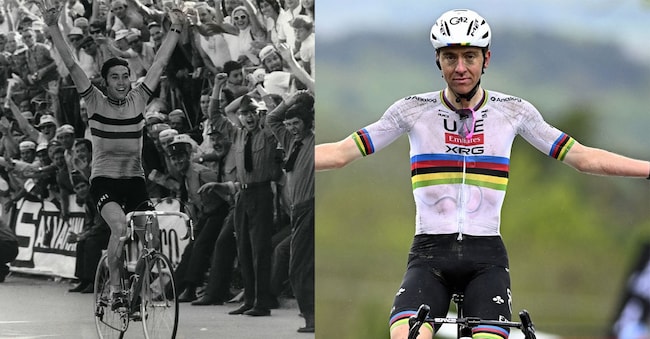
The never-ending challenge between Eddy Merckx and Tadej Pogacar

7' min read

7' min read

This is it. After the great classics of the North, and with the 108th Giro d'Italia approaching (starting from Durres in Albania next nine May and finishing on 1 June in Rome), cycling enters its most exciting season, that of the great stage races, the most important university of a sport that continues to offer new protagonists and new challenges.

Challenges that, at times, do not end in the present but even recur between champions from different eras despite the profound changes of recent decades, from technology to nutrition, from training to globalisation. From the days of Eddy Merckx in the sixties and seventies, and the present of Tadej Pogacar, not only has half a century passed, which is no small thing. But everything has really changed. And in such a disruptive way that making comparisons is a game more academic than productive. A game that, besides amusing us, has one merit: that of exercising our memory to understand, even in sport, how we were and what we have become.

Loading...

The Eighty Years of the Cannibal

.

This preamble, in order to return to a theme - the challenge in time between two giants of cycling - that with the latest extraordinary exploits of Tadej Pogacar, and the approach of Eddy Merckx's 80th birthday (17 June), is becoming increasingly intriguing. Both because of the extraordinary growth of the still young (26 years old) Slovenian champion, and because his own overwhelming ride - unexpected in a sport that seemed condemned to computerised specialism - has brought us back to the cycling of exceptional feats, that of Eddy Merckx, known as the 'Cannibal' for his insatiable hunger for victories (525) that made him invincible but also obnoxious and arrogant. A devastating fury that never apologised to anyone. Not even to a domestique, whom he was capable of taking away even the fleeting joy of a day's achievement.

Now, with years and growing pains, the Belgian has mellowed. And he points out, as his colleague Cosimo Cito wrote, that he never liked the nickname Cannibal ('I didn't eat children and people, I just raced and won'). It should be remembered, however, that Merckx, to those who criticised him for his competitive ferocity, always replied unrepentantly: 'I don't care. That's how I am. I win for the public. They always want the best to win...'.

Let the best man win, yeah. At the time of Merckx, despite the combative resistance of a few (Gimondi, Ocana, Thevenet, De Vlaeminck) the best was Eddy, nothing to say. A phenomenon without weaknesses: he won in sprints, time trials, downhill, on the pass and even uphill despite his mighty physique. With a physical recovery that allowed him any feat, even the most reckless.

A hurricane always on the attack

.

In 1968, at the age of 23, wearing the Faema jersey, Eddy arrived at the Giro d'Italia after having already won two Milano-Sanremo and a World Championship. Vittorio Adorni, his captain, described him as follows: 'A hurricane! If it were up to him, he would have sprinted to every flying finish. He had crazy energy but didn't know how to manage it. So I explained to him that he should only move on my signal. He quivered like a thoroughbred. I unleashed him on the Tre Cime di Lavaredo and he took off. In the end it was a triumph: Merckx first, me second, Gimondi third by over nine minutes. In one month Eddy learned what another rider would have learned in ten years'.

This was the Cannibal and with this phenomenon of nature (525 races won, 5 Tours, a Vuelta, three World Championships, 19 monumental classics, plus the hour record) Felice Gimondi had to reckon. Said the Bergamasque 'It took me more than two years to understand that Eddy was stronger than me, but in the end this rivalry was good for both of us. To Merckx because it humanised him; to me because I was always indicated as Eddy's strongest rival, the strongest rider of all time, if you can explain it to me".

It was the rule: in Merckx's time, first there was the Cannibal' (a nickname coined by former teammate Christian Raymond) and then everyone else. A kind of brutal dictatorship in which Merckx reigned as an absolute ruler. Only in one thing was he democratic: that he exercised his power over everyone. Indistinctly. There were no preferences, no particular sympathies. He respected some opponents (Gimondi in particular), but never a favour, an under-the-table agreement, a quid pro quo to reciprocate.

It was so looming that many got used to racing no longer to win but to be on the podium every now and then. When the young Francesco Moser in 1975, with the courage of the predestined, won the yellow jersey at the Tour for the first week, Raphael Géminiani, Jacques Anquetil's historic sporting director, described Francesco as follows: 'Here is one who has not been marked by Eddy Merckx. One who does his own thing. We will hear more about him'.

The Decline of the Invincible

.

Even the Cannibals decline. Merckx began to lose steam in 1976 when Felice Gimondi managed to snatch his third Giro d'Italia from him. The Belgian's last flare-up, also in 1976, was when he won his seventh Milano-Sanremo with a downhill breakaway. At the 1977 World Championships, won by Moser, he finished last. "I did my duty to the end, many others are already in the shower,' Eddy commented immediately after the finish.

This was Merckx, brutal even to himself, whose strength was fuelled by endless rage. Even though he did not come from a poor family, but was the son of a Belgian shopkeeper from Meensel Kiezgem, a small town on the outskirts of Brussels, Eddy seemed to be consumed by the sacred fire of the last, who win to redeem humiliation and poverty. No poverty, Merckx was just the way he was: a serial goal hunter who never gave anyone a break.

The character differences

.

Also because of these character edges, it is not easy to compare Merckx with Pogacar, the champion with the easy smile. The Slovenian, like Eddy, has infinite class, as he also demonstrated this past spring. At the races in which he has participated he has always been on the podium: first at the Strade Bianche and third at Sanremo. Then first at Flanders, second at Roubaix, second at Amstel, first at the Fleche Wallonne and at Liège Bastogne Liège, which he had already won in 2023 and 2021. With the ninth monumental classic, Pogacar joined Coppi, Girardengo and Kelly.

Like Merckx, the Slovenian wins (95 victories, 3 Tours, 1 Giro d'Italia, 1 World Championship, 9 monumental classics) but always maintaining his gentle approach. He hugs his opponents with a smile, jokes with children, and never loses his cool in front of the microphones. Although he is hard as steel in substance (his progressions are almost always unbearable), the Slovenian conveys a cheerful lightness that makes him lovable to anyone. He wins with a smile, with a humanity that if it were not true would be the product of consummate theatrical skill. Even when he exults, Tadej never exaggerates. Always posed, careful not to hurt his rivals more than necessary or to make a nice gesture as when at the last Liège he dedicated his victory to the mother of his fiancée, Urska Zigart, who died three years ago.

But who is the Best?

Inevitable question: but is Pogacar even stronger than Merckx? One could deflect, saying that comparisons between different eras are meaningless because every champion is a child of his time. And that Pogacar is only 26 years old. It is therefore too early to draw conclusions. A conclusive one will have to be made when his career is over. However, Merckx is right about one thing: that in his time people raced a lot more. Or at least Eddy raced most of the time. 'We were busy 180 days a year, twice as busy as today,' says the Belgian when asked to compare him with Pogacar. 'I used to struggle a lot, and you could see it in my face,' cuts Eddy short.

Here, another singular diversity. The Slovenian does not know fatigue. On the contrary, he seems to enjoy himself, to go on merry-go-rounds, as if he had been dipped in magic potion as a child or had arrived as Superman from another planet. Never out of it, never sweating, even when he gets a puncture or goes off the road.

His opponents change: there are those from the historic classics, such as Van der Poel and Evenepoel, and then those from the big Tours, such as Vingegaard, Thomas and Roglic, but he hardly faces them all together. He is there, his rivals take turns.

The Martian with a Human Face

.

The great thing about Pogacar, his most fascinating side, is that he springs into action at the very moment we are all waiting for him. He does not hide, he does not elaborate complicated strategies. His plan is elementary: attack where the road is hardest, most selective,. Sometimes, like Van der Poel and Ganna in the Sanremo, someone resists him. Most of the time, however, everyone resigns themselves to their role as comprimari. And he smiles, kisses his girlfriend, tells us that life is beautiful and cycling a magnificent sport.

Even Tadej, the matador with a human face, however, does his calculations. Spring has drained him a little. He will not participate in the next Giro d'Italia, which he already won in 2024. He will return in June to the Dauphiné, where he will meet again the Dane Jonas Vingegaard, one of the few who, at least at the Tour de France, when he sprints, does not go into depression.

+++++++++++++++

Eddy Merckx's 80th birthday celebrations

From Saturday 3 May at the Ghisallo Museum in Magreglio, above Bellagio (Como) an exhibition dedicated to the Belgian champion, born on 17 June 1945, is open. The exhibition will be open until 30 September 2025 (info on the website museodelghisallo.it)

On Thursday 8 May (10.30 pm) Raisport will air Franco Bortuzzo's docufilm 'I tre sarti del Re' (The King's three tailors) dedicated to the three great bicycle craftsmen - Faliero Masi, Ernesto Colnago, Ugo De Rosa - who made almost all the Belgian champion's winning bicycles. A document full of images from the RAI archives to understand who Eddy Merckx was and why he chose Italian technology to achieve his most important successes. A replay is also scheduled on Friday 9 May on Raidue at 2.30.

Copyright reserved ©
Loading...

Brand connect

Loading...

Newsletter

Notizie e approfondimenti sugli avvenimenti politici, economici e finanziari.

Iscriviti

Tutto mercato WEB