
The never random sign of Andrea Pazienza
At the Maxxi Museum in L'Aquila, the exhibition dedicated to the cartoonist and cartoonist can be visited until 26 April

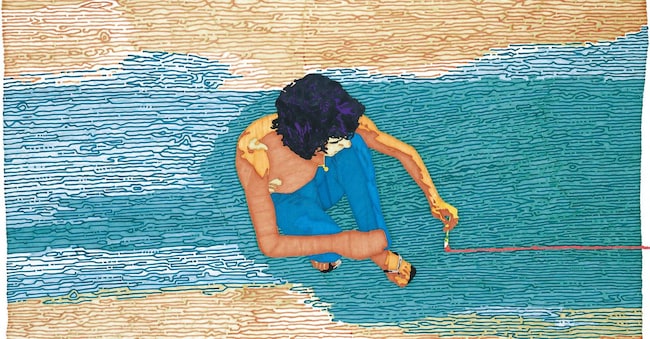
This is not a celebratory exhibition, nor is it a posthumous homage constructed according to an iconic accumulation. Andrea Pazienza. "The Mathematics of the Sign" - inaugurated at MAXXI L'Aquila, neo-Italian Capital of Culture, in the spaces of Palazzo Ardinghelli and open until 6 April - chooses to enter into the inner workings of a language that has always given the impression of improvisation, but instead obeys a rigorous logic. The title does not allude to a theoretical exercise, but to an operating system, because in Pazienza (San Benedetto del Tronto 1956/Montepulciano 1988) the sign is never random, but moves according to proportions, accelerations and sudden imbalances that remain controlled.
Imagination that is organised in sequences
The exhibition, curated by Giulia Ferracci and Oscar Glioti, reconstructs this system starting from the beginnings, surprising in their density and awareness. The adolescent self-portraits and early texts are not unripe notes, but already structured attempts at self-representation, in which drawing acts as an instrument of analysis even before narration. The albums of his childhood and early youth reveal an imagination that is organised in sequences, anticipating an idea of comics as an autonomous space, derived neither from literature nor painting. It was simply a crucial passage for him where the sign became a vehicle for thought, not a simple illustration. His high school art school years in Pescara consolidated this aptitude to the extent that naturalistic observation coexisted with a deformation that was not caricature, but an interpretation with figures that elongated, that stiffened and that seemed to bend to a graphic will that went beyond anatomy.
The heart of the exhibition is in the works from 1974-75, where painting, marker and watercolour become interchangeable tools. The large cardboards on display, many of them from the Convergenze gallery experience, annul the hierarchy between drawing and painting. Works such as Isa d'Estate, Autoritratto come nobile olandese del Seicento or Paziembrandt are not exercises in style, but internal dialogues with tradition, reworked without deference. When he moved to Bologna in 1975, comics became Pazienza's main field of experimentation.
The work Pentothal inaugurates a writing for images capable of holding fragment and continuity together, while in Zanardi, which appeared in 'Frigidaire' in 1981, the sign becomes sharper and the narration drier. The unfinished CMedieval Cycle of the Aviary shows to what extent drawing can become an epic tale without losing lightness. The last room, entrusted to Pompeo, closes without emphasis. No definitive synthesis, no conclusive image, but an exhibition that prefers to follow the lines of flight of an author who has continually redefined his own language. And it is precisely in this governed instability, in this shifting balance between control and deviation, that Pazienza continues to speak to the present.
Andrea Pazienza, The mathematics of sign, Maxxi Museum L'Aquila, until 6 April

