Review

The new Apple Watch has (truly) put health at the heart of things

The design and battery life aren’t particularly impressive, but we were won over by the vital signs monitoring and the indicator on the prosthesis

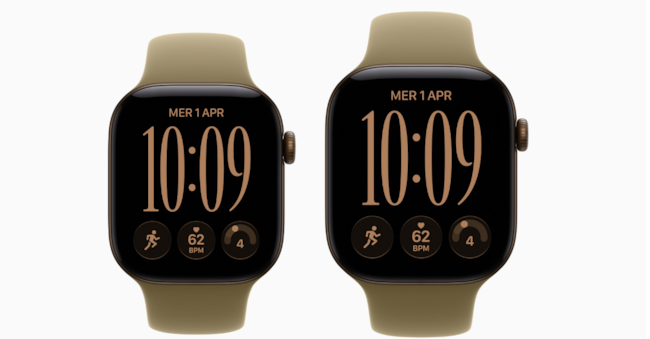
Il nuovo Apple Wacth Series 12

4' min read

Translated by AI
Versione italiana

4' min read

Translated by AI
Versione italiana

Wearing the latest Apple Watch – the Series 12, to be precise – the first impression isn’t exactly thrilling. For those familiar with the Cupertino watch range, the feeling of having worn the same thing on your wrist for years now is very real. After all, this Watch features the case first introduced with the Series 10 – slim and comfortable – in two sizes: 42 and 46 millimetres. If you place it next to the Series 11, it’s really hard to tell them apart. In fact, judging purely by their appearance, the bezels even seem slightly thicker. Of course, it’s difficult to come up with a new design for a watch every year. And Apple hasn’t even tried.

The rest, however, is a wealth of innovations that make this watch a very interesting piece of kit. Particularly given how Apple is seeking, step by step, to make it the nerve centre for health monitoring. But let’s take it one step at a time.

Loading...

The materials and colours are new. The Series 12 sees the return of ceramic, in pearl white and midnight blue, with prices exceeding a thousand euros. Meanwhile, the aluminium models feature Ceramic Shield 2 glass, which, according to the Cupertino-based company, is 60 per cent more durable than the previous generation’s Ion-X.

Health at the heart of it all

The real change lies beneath the case, and it is a change that says a great deal about the direction the product is taking. The Apple Watch is less and less a wrist-worn computer and increasingly, as we’ve said, a health monitoring tool. The new Health Sensing System combines redesigned optical and electrical sensors with larger and even more efficient green LEDs. The practical result is that your heart rate is measured every five seconds throughout the day, whereas up to the Series 11, background monitoring took place at intervals of several minutes.
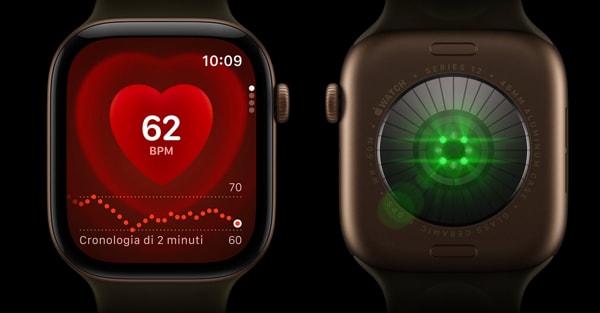
La misurazione del battito cardiaco e i nuovi sensori sulla scocca posteriore

Heart rate variability, the most commonly used indicator for assessing stress and recovery, is also measured more frequently, and is now broken down into two metrics, one of which is dedicated to night-time recovery. Apple claims that this is the most accurate heart rate sensor available on a wearable device. It is a biased claim, but published comparisons with professional heart rate monitors show minimal discrepancies. A remarkable achievement for a device that simply sits on the wrist.

Read: The iPhone 18 Pro Max review: a substantial evolution

The readiness parameter

Apple uses this data to power Readiness, the most interesting feature of this generation. Every day, the watch assigns a score from 0 to 10 that combines sleep, recent activity, training load and vital signs, and accompanies it with a simple indication – ranging from ‘recovering’ to ‘ready for intense exercise’.

L’indicatore di prontezza

The score is updated throughout the day and requires at least seven nights of sleep tracking to appear. Let’s be clear: this isn’t exactly an original idea. Garmin has been offering a similar metric since 2022, whilst the smart rings from Finnish firm Oura and the wristbands from Californian company Whoop have built a business model around it. Apple, therefore, is following in the footsteps of others who have already been there. But it does so without the need for a subscription, and with integration into the ecosystem (the famous Apple ecosystem) that its competitors lack. Interestingly, during our test, after three consecutive days of intense exercise, the score advised us to take a break. Of course, these are fairly simplified measurements, which reduce something complex to a single number, and should be interpreted as a guideline, certainly not as a diagnosis.

Old but gold

In addition to these new features, of course, there are those carried over from previous models. The very same features that, over the years, have made the Watch a highly useful device for monitoring vital signs: from electrocardiograms to oxygen saturation, from notifications about high blood pressure to those about sleep apnoea. Right up to the famous SOS feature in the event of a fall.

The heart of the watch

At the heart of this Watch 12 is the S11 chip, which marks the first substantial upgrade to the processor in several generations. We’ve noticed that apps open more quickly and gestures such as double-tapping respond more consistently. The same chip powers Audio Intelligence, the suite of features that uses the microphone to recognise sounds and songs. The two most ambitious features – Live Rewind, which transcribes the last 15 seconds of a conversation, and Siri Recap, which summarises the day’s conversations – are not available in Italia, and in the United States they have already raised legal concerns regarding the consent of those nearby.

Loading...

The weak point

The battery is where the Series 12 falls short. Apple claims up to 24 hours of normal use – the same as the Series 11 – and 38 hours in low-power mode. During a month-long test, the watch never managed to last a full two days, and often – especially whilst travelling when you have less time to charge it – you end up using it with the display switched off, which actually takes away some of the point of having a watch.

The comparison with Chinese manufacturers is stark: Huawei claims up to 12 days’ typical use for the 46-millimetre Watch GT series. These watches have fewer apps and a more limited ecosystem, but the gap remains enormous. Apple has chosen to focus on charging, and a 15-minute charge provides up to 12 hours’ use, compared with eight hours for the Series 11. Furthermore, a five-minute charge is enough for a night’s sleep tracking. But this remains the Achilles’ heel of this device.

Copyright reserved ©
Loading...

Brand connect

Loading...

Newsletter

Notizie e approfondimenti sugli avvenimenti politici, economici e finanziari.

Iscriviti