
The new course for the port of Gioia Tauro: centre of local development

4' min read
4' min read
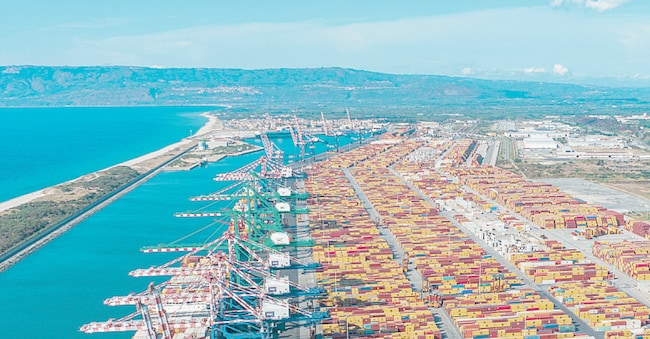
It is the first transhipment port in Italy, in pole position in Europe and the Mediterranean. It is barycentric compared to other infrastructures dedicated to container handling, such as Tanger Med in Morocco or Porto Said in Egypt. The port of Gioia Tauro is overflowing, large ships, large cranes and large spaces, even in the hinterland. Quays are being electrified and the seabed is up to 18 metres deep. Car loading and unloading and intermodality, with a gateway under consolidation. An advanced logistics hub.
It has withstood the pandemic, but also the geopolitical instability of the Red Sea, with the crisis in the Suez Canal forcing ship-owners to circumnavigate Africa, dramatically increasing container transport costs: in 2024 Gioia Tauro grew by 10 per cent compared to the previous year. The infrastructure has also held up against the European ETS directive for emissions trading. And at the moment it is not affected by tariffs. It is called resilience.
In August it reached 2.9 million Teus. By the end of 2025 the estimate is well over 4 million. "By 2029 it is estimated that container handling will touch 7 million Teus": this is one of the first goals set by lawyer Paolo Piacenza, the new extraordinary commissioner of the Port System Authority of the Southern Tyrrhenian and Ionian Seas. He has just taken over from Admiral Andrea Agostinelli, who in nine years has helped transform an industrial reality, the largest in Calabria, so many times at risk of closure, into one of the main transhipment ports in the Mediterranean. Thanks also to investments by terminal operators (first and foremost Mct of Gianluigi Aponte's Msc Group) and the port authority itself. And European, regional and ministerial funds.
"We will give continuity to the growth of an avant-garde infrastructure, with an impeccable organisation and record numbers". A native of Savona, Piacenza, secretary general of the port of Genoa, will keep his post in Liguria, but will dedicate himself to Calabria "not only to support Gioia Tauro in its growth, increasing intermodality, diversification of services and activities, pushing for digitalisation and sustainability, but also to give the port increasingly international prospects and a greater impact on the territory". Starting from a study on the relationship between the city and the infrastructure, on investment and employment: 'The Calabrian port of call,' he announces, 'must become a centre of local development. More operationally, the first move will be the approval of the Port System Strategic Planning document.
'Given its large spaces,' Piacenza adds, 'the port is preparing to become a logistics hub for the construction of the Ponte sullo Stretto bridge. Not only that, it has been judged suitable to become the new green Ilva: inside it will be possible to build the Dri (Direct Reduced Iron) pole, which will have to guarantee the supply of materials that feed the new furnaces of the green steel industry.

