
The elegance of the new Jil Sander, the neo-baroque of Fendi, the romantic tale of Antonio Marras
Simone Bellotti's debut at the helm of the brand founded by the German designer is convincing. Missoni discovers legs, Etro's psychedelia

3' min read
3' min read
Clarity, at present, is not the most popular of virtues, even when aesthetics profess to be quiet. Rather, there is a tendency to 'meddle', in fact to bungle, with a great deal of cowardice, forgetting that less, really, is more, never too little.
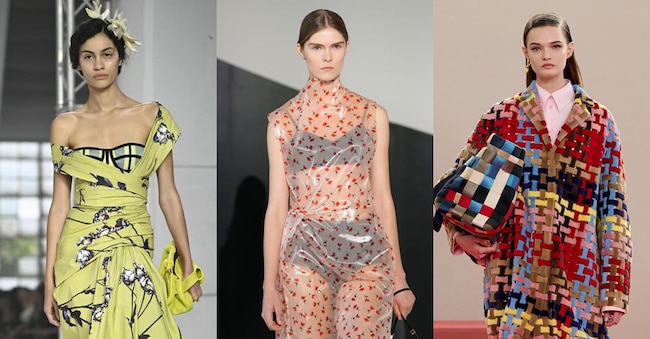
Simone Bellotti's brilliant debut at Jil Sander, on the other hand, is as clear as a surgical light in an operating theatre, even at the risk of appearing orthodox: a rewind of the ribbon to rigour as a synonym of efficiency and elegance, with the personal addition of a certain fragility, with the invigorating doubt of colour, with the daily injection of jeans. Everything speaks of homecoming, from the choice to parade in the white and perennially modern spaces of the headquarters overlooking Piazza Castello to the model Guinevere Van Seenus, the brand's historic face, who opens the show.
It is a sure proof, confirmation of Bellotti's ace talent, of his attention to the objective materiality of clothes, whose only limitation is perhaps only the strict adherence to the founding imagery set by Jil himself, and a debt of sensuality. Now that the foundations have been unequivocally laid, it is legitimate to expect from Bellotti the dry, even perverse twist, which he has demonstrated elsewhere, and which is so much his own, already visible, at the moment, in the slashes on the skirts, in certain mechanical folds.
At Fendi, minimalism has never been an option, but the rich, material language of the now century-old house is nourished precisely in the tension between clean lines and neo-Baroque frenzy of decoration, or workmanship. Equally baroque, and defining as an identity trait, is the taste for deception and surprise, that is, the fact that nothing is ever as it seems: the most precious silks are treated like nylon and skins like fabrics.
This season, Silvia Venturini Fendi - which insistent rumours want soon to be released - imagines a future summer, which she sets in a labyrinthine room made of three-dimensional pixels, halfway between an old-fashioned video game and a childhood garden. The choice of saturated, acrylic colours, the rhythmic embroideries that smell of Meccano also give a sensation of childlike, incoherent energy, which is then reflected in a magnificent cast of women and men of all ages and physical types because, Venturini Fendi wisely says, "I have never had a single ideal of beauty and I tenaciously resist the idea that the only possible age is youth". It derails in many directions, however, and the message risks dissipating.

