Paris

ICOM’s new Code of Ethics consigns the ‘universal museum’ to the past: it is now a participatory institution

There had been fears of a ‘Kyoto-bis’, but following the postponement of the vote in Dubai, a large majority approved a new text in Paris: here are the key points. There is no reference to regulations

by Giuditta Giardini

Il nuovo Codice Etico per i Musei 2026

8' min read

Translated by AI
Versione italiana

8' min read

Translated by AI
Versione italiana

On 25 June 2026 in Paris, the national and international committees of the International Council of Museums (ICOM), which hold voting rights, were called upon to give their verdict on what the Executive Board continued to describe, right up until the last moment, as a ‘revision’ of the Code of Ethics for Museums of 2004. The proposal was approved late on Thursday morning with 85.9 per cent of votes in favour, compared with 10.58 per cent against and 3.52 per cent abstentions (540 voters out of more than 60,000 members). Despite the concerns that had led to the vote being postponed, the large majority recorded demonstrates a significant convergence within the organisation around a new concept of the museum, in which the centrality of the collections is complemented, in terms of principles, by that of the communities, marking a rebalancing of the museological paradigm.

The organisation: attendance and absences

The 2026 Code moves away from the structure based on the eight principles of the 2004 text, replacing it “with five principles identified by letters,” explains Sally Yerkovich, who led the “revision” – with the aim of avoiding any hierarchical interpretations’. The new ‘circular’ principles are: S (Society), ‘Museums serve society’; P (Professionalism), ‘Museums operate and communicate with competence, knowledge and professional standards’; E (Education), ‘Museums offer diverse experiences for the sharing of knowledge and reflection’; C (Collections), ‘Museums research, collect and conserve’; and G (Governance), ‘Museums are permanent, non-profit organisations’.

Loading...

The most significant change, however, is an omission. The previous Principle VII, ‘Museums operate in a legal manner’, which required museums to operate in compliance with applicable national, regional and international legislation and to align their ethical conduct with the principles set out in the relevant international legal instruments relating to cultural heritage, including conventions not yet ratified by the State in which the museums were located. Although the Preamble states – albeit in a somewhat convoluted manner, inexplicably separating the reference to international conventions from that to international law – that the law constitutes ‘the baseline for action by museums and museum professionals’, this reference remains essentially programmatic. In fact, the same paragraph specifies that ‘a list of these frameworks, including international conventions, resolutions and declarations, accompanies this Code’. The reference is to the so-called Legal Guidelines , which, however, have not yet been approved.

The Discontinuity Between Ethics and Law

The decision to draw a clear distinction between ethics and law is one of the most significant departures in the new Code from the current legal framework. This appears to reflect the drafters’ desire to free the Code from a legislative framework deemed, presumably, incapable of providing adequate responses to the needs of the museums to which the document is addressed. As is clearly evident from the Preamble, the new Code is presented not so much as the result of a matured awareness of the museum’s social role, but rather as the expression of a kind of institutional self-criticism. The text is permeated by an awareness of the inadequate understanding of the implications of new technologies, to which the five ‘circular’ principles devote only marginal references; of the belated attention paid to sustainability issues, which are mentioned only sporadically; and a lack of full awareness of the legacy of colonialism, renewed neo-colonialist pressures and the persistence of power imbalances. From this perspective, the value framework within which the new Code is situated appears to be dominated by a sort of grand mea culpa.

A revision or a new tool?

A preliminary, yet essential, overview concerns the legal nature of the process that led to the adoption of ICOM’s new Code of Ethics. In 2019, at the 25th General Conference in Kyoto, the Executive Board entrusted ETHCOM with the mandate to carry out a review and, where necessary, a revision of the 2004 Code. ETHCOM considered that a full revision of the text was necessary, but instead began work on a new code. This characterisation, however, appears problematic. From a legal perspective, a revision implies that the identity of the original text remains intact, with only certain provisions being amended; the adoption of a new Code, on the other hand, presupposes the complete replacement of the previous one, its formal repeal and a specific mandate conferred upon the body responsible for drafting the new text. The issue is not merely one of terminology. If the text approved in 2026 constitutes, as it appears to do, a new Code rather than a revision of the 2004 version, this raises a question regarding the legitimacy of the procedure followed and the validity of the final act. ETHCOM would, in fact, have acted beyond the mandate it received, without this extension of its powers ever having been formally ratified retrospectively by the Executive Board, which, right up until the final vote, continued to present the process as the adoption of a ‘revised Code of Ethics’.
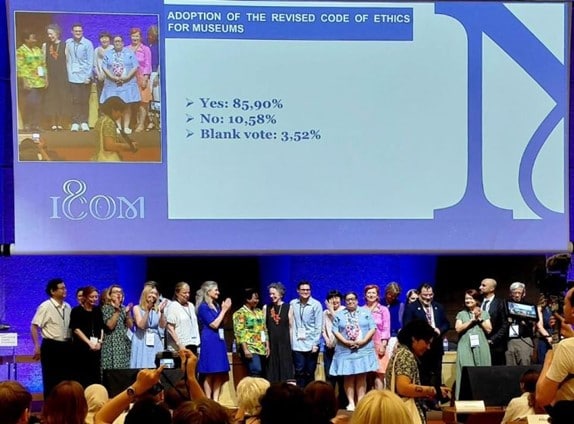
L’approvazione a Parigi del nuovo Codice Etico per i Musei 2026

The revolution in the museum world: what does this mean for Italian museums?

Principle S.2 stipulates that museum activities must be guided by members of society, whilst respecting their agency, the diversity of knowledge and their right to participate in the museum’s activities. Furthermore, it assigns a new role to museums, establishing them as spaces for dialogue and the resolution of social conflicts.

Principle S.3 further reinforces this approach by requiring the involvement of communities, including Indigenous Peoples, in decisions concerning their heritage, whilst respecting their right to identify, preserve and interpret it, as well as the principle of free, prior and informed consent. With regard to objects originating from cultural contexts other than that of the museum in which they are held, Principle C requires that a dialogue be established with States, communities, groups and populations of origin, with a view to revising or supplementing the museum’s narrative in line with alternative perspectives that take into account the viewpoints of historically marginalised communities.

The provisions on exhibition practices (including wall texts) are also innovative: in accordance with Principle C.8, heritage assets must be presented in a respectful manner and exhibition decisions shared with the relevant communities, making it necessary for Italian museums to put in place procedures that involve heritage communities.

Principle S.4 stipulates that all information on cultural heritage not subject to confidentiality requirements must be accessible to the public, whilst Principle C.7 requires the publication, either online or on request, of documentation relating to the collections. For many Italian museums, this will entail a significant investment in the digitisation of collections, catalogues and archives.

Overall, these provisions mark a significant shift in the Code’s focus: from the traditional emphasis on the museum’s role as a custodian to a model based on community participation and the sharing of interpretative authority in the management of cultural heritage.

The Code also assigns an explicit social role to museums, entrusting them with the task of combating discrimination and systemic racism (S.5), whilst promoting human rights and the rights of Indigenous Peoples. Finally, in terms of governance, higher standards of transparency and independence are required, obliging museums to make their financial statements, sources of funding and internal policies public, and to resist undue political, economic and financial influence (G.4).

The rules governing the duties of museum staff are also strict. In particular, measures to prevent conflicts of interest and the obligations relating to the acceptance of gifts have been tightened. The Code also prohibits staff from recommending art dealers, auction houses, valuers or other market operators (p. 9), thereby reinforcing the principle of independence from commercial interests.

Combating illicit trafficking and the return of cultural property

The Code introduces further restrictions on acquisition policies to combat the illicit trafficking of cultural property. It is prohibited to acquire cultural property originating from territories that are currently or have historically been under occupation, as well as objects belonging to collections formed through unethical, destructive or exploitative practices (C.4). This provision effectively means that the museum is required to assess not only the history of the object, but also the manner in which the collection of origin was formed and the behaviour of the collector.

Museums and their staff are assigned a central role in preventing and combating the illicit trafficking of cultural property. In addition to requiring them to carry out adequate due diligence on the provenance of the artefacts, the Code transforms museums into active participants in the fight against illicit trafficking, requiring them to ‘collaborate with other museums, cultural institutions, police forces, judicial authorities and international organisations engaged in combating illicit trafficking [of cultural property], in order to ensure compliance with applicable legislation’. This is a particularly significant obligation which, even in the absence of specific operational guidelines, significantly broadens the responsibilities of both museum institutions and the professionals working within them. The scope of this change becomes even more evident from the simultaneous repeal of another important provision of the 2004 Code. The combined provisions of principles 2.9 and 3.4 had, in exceptional circumstances, the acquisition of cultural property of exceptional significance even where, despite thorough due diligence, its provenance proved to be incomplete or contained significant gaps. In line with this approach, Principle 2.11 recognised museums’ role as ‘emergency repositories for objects or specimens of unknown provenance or those acquired unlawfully and recovered within the relevant territory’. The removal of these provisions marks a clear paradigm shift. A clear reconstruction of provenance is now an essential requirement for an artefact to remain in museum collections, with the consequence that even the display of objects already present in the collections, but lacking sufficient documentation of their ownership history, risks being incompatible with the new Code. For Italian museums, this entails a particularly onerous burden: it will no longer be sufficient to demonstrate mere provenance – that is, the geographical origin of the artefact – to justify the display, for example, of an Etruscan artefact belonging to the permanent collections. In the absence of an adequately documented provenance, the museum could in fact find itself in breach of the 2026 Code.

Finally, of particular significance is Principle C.10, according to which museums should take a proactive role in the processes of restitution of stolen cultural property and the return of illicitly exported cultural property, both in response to a formal request and when they independently identify problematic elements (red flags) when reconstructing provenance. The restitution process is thus conceived as a collaborative endeavour, based on dialogue between the parties concerned, rather than as a unilateral decision by the museum.

Conclusions

The adoption of the new ICOM Code of Ethics, despite the critical issues and ambiguities that characterise it, undoubtedly represents a revolution for contemporary museology – a clear paradigm shift that marks the transition from a museum primarily focused on the conservation of collections to one that genuinely serves society. The museum is thus conceived as a common good of the communities it serves and as a space for dialogue, participation and the shared construction of cultural heritage. Objects are no longer presented as artefacts to be passively contemplated, but become tools for dialogue and the production of meaning, fostering that process of ‘heritagisation’ evoked in his writings by the Rector Tomaso Montanari, through which cultural heritage acquires value thanks to the dynamic relationship between artefacts, institutions and communities. Whilst, as might be expected, the new Code is already in force, the agenda for Italian museums already appears particularly demanding.

Copyright reserved ©
Loading...

Brand connect

Loading...

Newsletter

Notizie e approfondimenti sugli avvenimenti politici, economici e finanziari.

Iscriviti