
The new Nederlands Fotomuseum in the historic Santos coffee depot
The new Dutch photography centre in Rotterdam, opened on 7 February, houses six and a half million works and objects

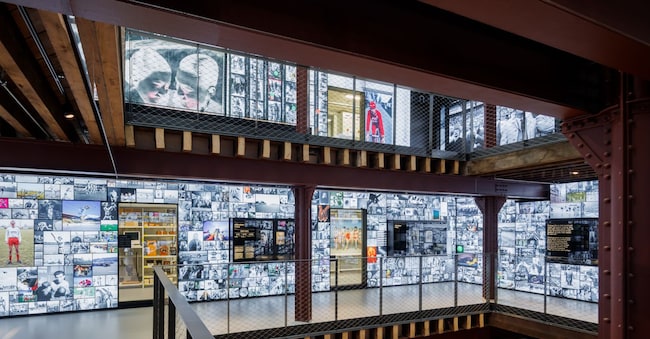
There are one hundred, in the sense that there are ninety-nine plus one, ninety-nine images that make up the Gallery of Honour of Dutch Photography, and one missing. An empty space to remind us that even in one of the largest and most authoritative museum collections in the world, that of the magnificent Nederlands Fotomuseum, and we are talking about six and a half million works and objects, a gap is always possible, indeed necessary. And it is precisely this moment of visual apnoea, this photography that has not yet reached the collection or is there but has not yet been fully appreciated and recognised, in short, this diaphragm that must remain open to catch the light of the unexpected, that makes the new Dutch photography centre in Rotterdam, inaugurated on 7 February and already on the way to international success, so vital, so welcoming, so intelligent.
Everything makes sense in the contemporary project, which leaves behind the headquarters inaugurated in 2003 and is rooted in a monumental building from 1901, the historic Santos coffee warehouse, a Brazilian brand, which architects J.P. Stok Wzn and J.J. Kanters built in the port of Rijnhaven, on the left bank of the river Maas, and which today the Renner Hainke Wirth Zirn Architekten and Wdjarchitecten studios have rewritten, safeguarding as much as possible the original structure, closed and dedicated to darkness, and adapting it instead to a stimulating dialogue between light and darkness. The museum's nine floors - and to understand the cultural, identity logic of its design, one must go through its architectural structure - "develop" vertically each phase of the photographic process, from the basement floor dedicated to dark rooms, including workshops on printing techniques, to the large entrance hall with library and café, to which one has free access so that the museum is first and foremost a place for meeting and exchange. Then, ticket in hand, up the first flight of stairs between red cast-iron columns and modern elements in dark grey, one enters the gallery of honour, an exhibition of Dutch photography, curated by a committee headed by Martijn van der Broek, head of the collections.
Shrouded in the black of the setting, the black of deep memory, the black of preservation, one hundred and eighty years of Dutch photography flow by, from 1842, the date of the first daguerreotype in the exhibition, to 2021, the year of grace in which Jaya Pelupessy reflects on the very birth of the image in a basin of analogue memories. In between are the trials, the attempts, the embrace, the most generous, just and restorative in trying to understand the contradictory complexity of Dutch identity, as of any national identity.
The Dutch people were sailors and colonialists
Who are the Dutch, a people of sailors, farmers, artists, conservatives, rebels, colonialists and open today to a society that welcomes and integrates migrants? Who are they? This is told first of all by the collection's historical viewpoints, acrobatic in their counter-fields, and so, next to the daguerreotype depicting the 1846 wedding of a mixed Surinamese couple, and then two women dancing in the streets of Amsterdam, a snapshot by Johannes Rombouts in 1888, and Katharina Behrend's self-portrait, nude before the lens in 1908, and again, in crescendo, next to Paul Citroen's collages of 1923 and Paul Schuitema's abstract of a moving gramophone of 1929, the face of Anton de Kom, an anti-colonial Surinamese writer, in Holland in 1921, a fighter in various left-wing organisations and dedicated to getting an honest chapter on slavery into the official historiography of the Netherlands, appears by Piet Zward in 1933. Denunciation that did not prevent him, during the German occupation, from joining the Dutch resistance and dying in a Nazi death camp. Six years after the bombing that razed Rotterdam to the ground, Cas Oorthuys, a Leiden-born photojournalist and designer, travelled to the Dutch Indies, now Indonesia, to document the war of liberation from colonial power, which was otherwise bloodily repressed. Contrary to his compatriots, Oorthuys chose the point of view of the Indonesians, as recounted in his book Een staat in wording, a nascent state. As in, short memory is intolerable.
We go back over the years and other chapters appear, fundamental because they complement each other in defining a hypothesis of identity, and they are, for example, the images of Ed van der Elsken in Paris, cantor of the lost generation of Saint Germain in the post-war period, and mirrored are the nihilist punks posing for Max Natkiel at Paradiso in Amsterdam in 1981. Or it is Rineke Dijkstra's teenage girls and cognitively impaired teenagers in Erwin Olaf's lens, or the rappers Dana Lixenberg portrayed for Vibe, beautiful Tupac Shakur, and so is Anton Corbijn's Nick Cave, printed backwards from the original (on display) on the cover of The boatman's call album. One last glance at Viviane Sassen's D.N.A., from 2007, and we go up to the second and third floors where, open on the balcony and protected by large internal windows, the archives of negatives and restoration laboratories - the interventions are live and the public can follow them - remind us of the fragility and preciousness at the same time of photographic matter. Two more flights, and on the fourth and fifth floors shine the temporary exhibitions: Rotterdam in Focus. The City in Photographs 1843-Now, curated by Frits Gierstberg and Joop de Jong, and the overwhelming Awakening in Blue: An Ode to Cyanotype, curated by Guinevere Ras and the interdisciplinary collective MAISON the FAUX, a true sea wave that comes to us from the oldest heart of photographic history. We ascend again to the light raining from the ceiling and to the ZES restaurant with breathtaking views of the city and the ships anchored in the harbour.

