
The new raison d'être of museums is to be able to give back to the territories
Care becomes the key for museums, which must restore value to the territories in which they are located, as Mariacristina Gribaudi, president of the Fondazione dei Musei Civici di Venezia (Muve), explains

7' min read
7' min read
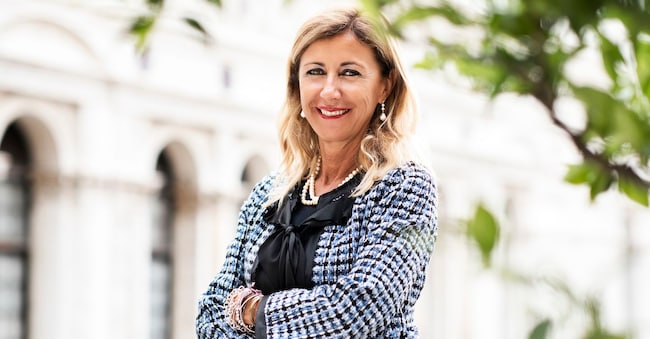
At the end, which is also the beginning of every story and every wonder, there is care. For the children and the work, a key and a swing, a masterpiece and the earth: 'My father Carlo, able to return from the concentration camp in Cottbus, between Berlin and Dresden, took every little thing into consideration. In those two years, he had pulled at his belt and even just a mouldy potato or the smile of a fellow prisoner was precious. He had learnt how everything made sense and he cared,' recalls Mariacristina Gribaudi on this Venetian midday, with the sun playing hide-and-seek and making the Lagoon change colour. And she, who has led the Fondazione dei Musei Civici di Venezia (Muve) for ten years, has made care the mantra of an action that is both entrepreneurial and artistic.
St. Mark's Square, Procuratie Nuove, the presidency office of the Fondazione Muve, which groups together eleven museums (Palazzo Ducale; Museo Correr; Torre dell'Orologio; Ca' Rezzonico - Museo del Settecento Veneziano; Museo di Palazzo Mocenigo Centro studi di storia del tessuto, del costume e del profumo; Casa di Carlo Goldoni; Ca' Pesaro - Galleria d'Arte Moderna; Museo Fortuny; Museo del vetro di Murano; Museo del merletto di Burano; Museo di Storia naturale Giancarlo Ligabue). The windows open to beauty, from the Basilica della Salute to San Giorgio Maggiore, a large table for discussion: 'I asked for this when I arrived,' recalls the president. My world is the factory and I needed to dialogue with the souls of the museums to choose projects and the future together, to get to know human resources and enhance their talents'. Gribaudi, who has a degree in Management and a master's degree in Business Administration, comes from the factory, first her father Carlo's factory that produced kitchens and moved from Piedmont to Veneto in the early 1970s, then her husband's factory, Keyline in Conegliano (Treviso) that produces keys, heir to the Bianchi family tradition active since 1770 in Cibiana di Cadore, and that also has a business museum dedicated precisely to keys.
Factory, sweat and steel have found a home among the canvases of Tintoretto and the magical colours of glass: 'Fifteen years ago, I had followed a start-up project with Luigi Brugnaro, then president of Confindustria Veneto. We had met and esteemed each other. It was he, as mayor of Venice, who called me because he wanted me to bring to the Foundation the business model I had applied in the factory, a metalworking company that had grown with welfare and culture'. And with the names of Adriano Olivetti and Marisa Bellisario, whom Mariacristina's father knew well and from whom he took his cue: 'The first half hour of work, managers and workers could read the newspaper because being informed means being free. I never forget this, even though more than fifty years have passed and, taking my father's example as a starting point, we introduced work-family reconciliation at Keyline. The unions didn't understand what I was doing but for me it was the only way to improve the organisation.
If employees are better off, they produce more and start a virtuous process for everyone that leads the factory to open up to the outside world and have an impact on the community with exhibitions, presentations, meetings. Factory and community contaminate each other and grow'. Something similar has happened at the Fondazione Muve: 'Just as the factory opens its doors wide, so do the museums. The museums of the Fondazione Muve, which in 2024 involved more than 45,000 people in dozens of activities and were visited by more than 2.3 million people, are open to the outside world because today's museums are yesterday's factories. Perfect examples are the textile and glass museum, the fruit of the sweat and toil of the men and women who came before us. Museums are not just places to go to three times in a lifetime, as children, parents and grandparents, but are the factory of our past, therefore, today's factory is none other than tomorrow's museum. Therefore, we have to take care of the factories and those who know the management of a business museum can transfer this knowledge to the management of art. If the conservator and curator of the glass museum, the entrepreneur who produces it and a student from Ca' Foscari and the Veneto Region sit at the same table, we are writing a page for the future'.
Factory and art seem to brush up against each other in Gribaudi's work, whose gaze, as clear as glass, goes beyond the windows to reach far into the distance: "The museum is home, a mother's womb, a space in which to feel good, as can happen at the Mariano Fortuny, which is a museum par excellence because it is home and has been a workshop and factory. And also a relationship with the territory. Venice was born because people from the mainland wanted it; its glory was born from spruces, beeches, larches and oaks that the arsenal turned into ships to conquer and trade. Venice owes a lot to its hinterland and its duty today is to give back, which means for us, who manage Venetian museums, to imagine exhibition projects that bring works from Venice to the territory. For example, an exhibition on gondolas made in Cadore, where the wood used to come from'. Restitutions would also be a boon to decongesting calli and campielli: 'This is a concern of ours and the activities, begun in 2016, at the Candiani Cultural Centre in Mestre go in this direction: they are art workshops and exhibitions, such as the one planned on Edvard Munch'.


