
Italy's new tram spring: projects worth 5.4 billion in the pipeline
The Legambiente report: 250 kilometres of new lines under construction (+63% compared to those currently in operation). Consolidated successes in Florence with 39 million passengers (+11.8%) and Padua with 25% of public transport on trams
by Marco Morino
3' min read
Key points
3' min read
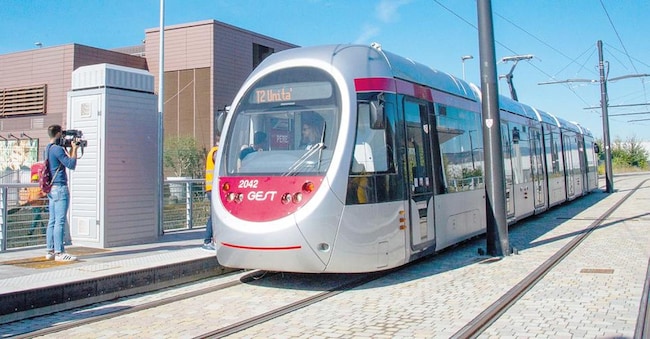
The tram is back in fashion in Italy. Almost a plunge into the past, in the name of more environmentally friendly mobility. Born in the 19th century and partly obscured by the advent of the automobile, the tram has been experiencing a new springtime throughout Europe and now also in our country. And it is no coincidence that it is precisely Legambiente that has turned a spotlight on a little-investigated phenomenon that is silently revolutionising urban transport in many cities. Suffice it to say that in a capital city such as Florence, a real boom is underway for the city's tramway, with passengers that by the end of the year will exceed 42 million (a record figure for Italy), an increase of three million compared to the 39 million with which the year 2024 closed. Also in Florence, work is proceeding on the new line to Bagno a Ripoli, with the first tracks scheduled to be laid shortly. Numbers that testify not only to the success of the tram as an alternative to private transport, but also to the growing trust of citizens in a more sustainable and functional urban transport system. Important numbers are also recorded in Padua: with the Sir1 line carrying 33,000 passengers a day, 25 per cent of TPL journeys are made by tram. But Florence and Padua are only the tip of the iceberg.
The Pnrr thrust
.A big boost to the new tram season in Italy came with the Pnrr funds allocated in 2021, thanks to which numerous cities have started to build, consolidate or extend their tram network. At the moment, the Legambiente report states, a total of 250 kilometres of new tramways are planned in Italy, 63% more than those currently in operation. The total cost to build them is 5.4 billion euro, partly covered by Pnrr funds and partly by other funding. Trams will also finally return to the capital: four new lines totalling 34.2 kilometres, including the Termini-Vaticano-Aurelio tramway in the historic centre and the Termini Tor Vergata tramway. The Italian cities focusing on new trams are: Bologna, with an expansion plan of 23.4 kilometres (km) of new tramways, Palermo (64.2 km), Padua (30.3), Florence (25), Bergamo (23.2), Milan (35.9), Brescia (23.2), Naples (4.1 km), Cagliari (6.9 km) and Sassari (2.5).
Despite progress, however, the Legambiente report notes, Italy's infrastructural backwardness compared to other major European countries is enormous. In fact, the number of tram lines stops at a total of 397.4 kilometres, a far cry from the 878.2 km of France and especially the 2,044.5 km of Germany.
Uncertain future
.The report observes: "The return of the tram in Italian cities represents a crucial challenge for the future of the country's sustainable mobility: either the pace is accelerated with structural and continuous investments, starting with the urgent refinancing of the National Fund for Mass Rapid Transport, or Italy risks losing the opportunity to close an infrastructure gap". According to Legambiente, more must be done to support this new spring that administrations and citizens are clamouring for. The Budget Law 2024, for the first time since 2017, has not provided funds for mass rapid transport, with the risk of halting the positive momentum started thanks to the Pnrr funds. In fact, on closer inspection, after the Pnrr, no financial instruments are planned to adequately continue the necessary season of investment in rapid mass transport in cities. And yet the tram has many advantages: it is able to rid urban space of cars, redeveloping and reconnecting entire city quadrants, thus contributing to a radical transformation of urban space towards a healthier and more liveable layout. An old idea capable of meeting new challenges.
Today, the Italian city with the most extensive tram network is Milan (157 kilometres), followed by Turin (88.5), Rome (36) and Palermo (23.3 kilometres). Of course, trams are not the answer to the entire demand for urban mobility, but they are certainly proving capable of responding adequately to the challenges of public transport transition. So, what will happen after 2026 when the NRP expires? There is no answer to this question at the moment. What we do know, however, is that the tram remains one of the best means of increasing the strength of public transport and helping to reduce emissions from private mobility.


