
The new world order? Multi-allied middle powers decisive
Emirates and Turkey strategic for conflict resolution and US-China leadership dialogue

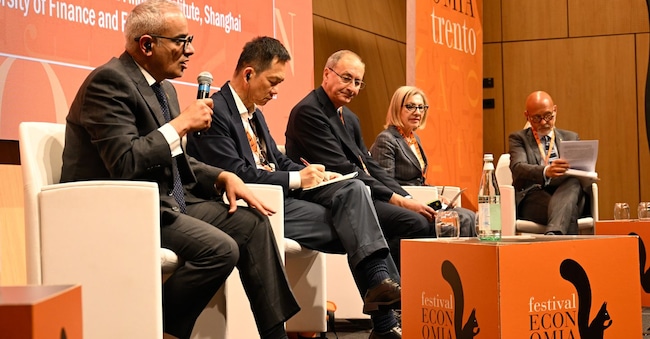
The multi-allied middle powers, as historian Adriana Castagnoli defined it in the Trento Festival of Economics panel on the new protagonists of the international chessboard moderated by Corriere della Sera columnist Enrico Franco, will be decisive in this transitional phase. A phase in whichthe benign American hegemon, which emerged dominant from the Second World War and is increasingly being undermined by China, is pulling the last strings to maintain its leadership.
The numbers, which seldom lie, even in geopolitics, draw a new leadership that is consolidating. In 1980, explainsUniversity of Perugia economist Marcello Signorelli, at purchasing power parity, China's GDP was 2.3% of global GDP; that of the United States was 20.9%. In 2030, again with purchasing power parity, China's GDP will rise to 20.4% of global GDP and that of the United States will fall to 13.9% (just for the statisticians and the curious, Italia was at 4.7% in 1980 and will be at 1.6% in 2030). These numbers alone would be enough to explain US President Trump's unhinged activism in trying to increase the American sphere of influence and win back GDP and markets.
China, explains Yang Yao, rector of the Shanghai University of finance and economics, has increased its weight thanks to investments in technology and manufacturing.It has a decisive role in the control of raw materials and has exercised this power, for the first time, in the negotiations on tariffs. China, after Trump's threats of 45% tariffs, got it to go back to square one, with levels similar to European states.
China's goals, Yao explains, are long-term. Eradicate absolute poverty, break down inequalities, which are still very large, bring the income of the Chinese to 45% of that of Americans by 2031. With further investments and with synergetic policies with the West based on mutual market openings. Because, Yao points out, the fears of being overwhelmed (e.g. on data) are also the same.The Tesla model, which has to keep data collected in China, can be an example for the future.
In this now evident tug-of-war, Castagnoli explains, the multi-allied middle powers, capable of playing a crucial mediation role, become decisive. Turkey, for example, a NATO member and close to Putin, central to the solution of the conflict between Moscow and Ukraine. But also the United Arab Emirates, strategic in the Middle East.


