
The Nobel Prize in economics, open science and innovation

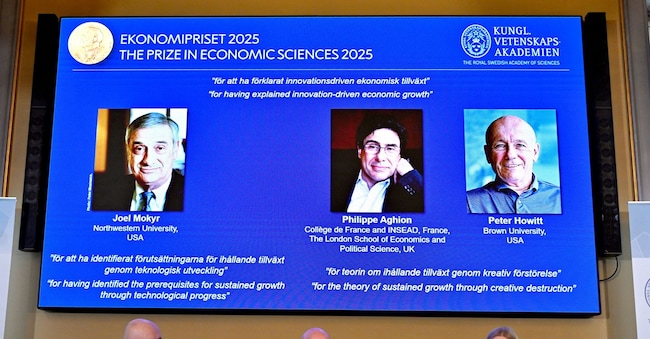
The Nobel Prize in Economics 2025 goes to Joel Mokyr, Philippe Aghion and Peter Howitt, three scholars who have contributed to defining the way we understand the link between knowledge, innovation and growth. A well-deserved and overdue award, rewarding a strand of research that is crucial for interpreting the technological and economic transformations of our time.
The Stockholm verdict also marks a symbolic turning point: after decades of a focus on models and theoretical formalisation, an economy that dialogues with history, science and other disciplines is rewarded. In this sense, it is also an acknowledgement of Joseph Schumpeter, the ideal father of the analysis of innovation, the concept of creative destruction and an 'out of equilibrium' economic analysis, in which economic actors do not have perfect information, may act irrationally or do not necessarily have optimising behaviour.
Joel Mokyr, economic historian and author of The Gift of Athena, has been highlighting the role of 'useful knowledge' as an engine of progress since the early Industrial Revolution. His distinction between episteme and techne and the idea of knowledge as a global public good remain highly topical in an era in which research alone can meet the challenges of climate change and the digital transition and must be increasingly transnational. In The Republic of Letters, Mokyr recalls how the networks of scientists that crossed European borders made modernity possible: a message that resonates strongly today, in a world that is in danger of closing down.
Philippe Aghion and Peter Howitt, in the Schumpeterian tradition, have instead worked on the link between innovation and economic growth, developing models that explain how technical progress fuels long-term dynamics. Their work follows in the footsteps of giants such as Richard Nelson, who recently passed away, Sidney Winter, Christopher Freeman and Giovanni Dosi, who were already talking about innovation-driven growth and structurally out-of-equilibrium economies in the early 1990s.
This year's Nobel Prize therefore recognises the value of multidisciplinary and critical research, which sees science and the university as essential infrastructures for development. It is a particularly important message at a time when trust in science is faltering and academic institutions are under pressure, especially in the United States.

