The Nobel Prize that lit up our homes: meet the inventor of the LED
In 2014, three Japanese researchers received the high distinction of Stockholm for the invention of the LED. Today, Hiroshi Amano recalls the excitement of those days and the consequences of blue light on everyday life.
6' min read
6' min read
If talking about 'light-emitting diodes' won't turn on any light bulbs in your minds, it's because the devices are much more amicably known as LEDs: this is one of those inventions that, silently yet brilliantly, has changed our daily lives forever, so much so that it deserves a Nobel Prize. On the one hand, we are talking about the discovery that enabled the birth of modern smartphone and TV screens. On the other, we are talking about the technology that brought a new, more efficient, cheaper and longer-lasting form of lighting into our homes. Yet had it not been for the pioneering work of three Japanese researchers, Isamu Akasaki, Hiroshi Amano and Shuji Nakamura, things would have turned out differently.
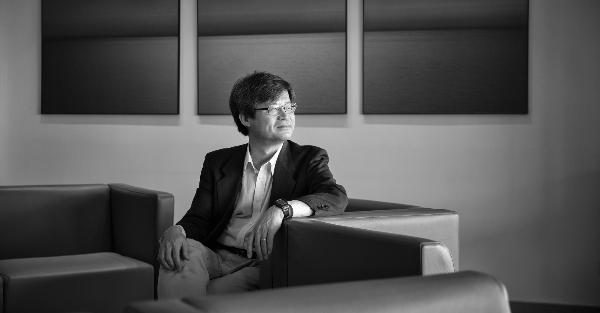
But let's go in order, trying to shed some light. Light-emitting diodes work by applying a current to a layer of semiconductor materials capable of emitting a specific wavelength, depending on the chemical composition of the materials themselves. The first LED light put into production was red, created in the early 1960s, which was followed by green. Blue was long considered impossible to recreate: it took thirty years of global failures before the three future Nobel Prize winners had the intuition to focus on a semiconducting compound known as gallium nitride (or GaN), creating the long-awaited shade. By succeeding in developing the first high-efficiency blue LEDs, they paved the way for white light: the colour synthesis technique used in most of the displays of our latest electronic devices, from smartphones to televisions, as well as in LED lamps, in fact requires red, green and blue light to recreate a white light source.
It all began thanks to Professor Akasaki and his work carried out in the 1960s and early 1980s at Matsushita Electric, now Panasonic: 'Precisely because of the difficulty of the project, the company's managers decided to abandon this research and he moved to Nagoya University, where I was studying,' Professor Hiroshi Amano recounts, in a loud and passionate voice. 'He became my supervisor: three years and thousands of experiments later, we succeeded in creating the first GaN crystals'. There were, however, other major technical obstacles to overcome, he points out, thoughtfully adjusting his glasses on his calm face and interspersing his account of the tortuous journey with a few bursts of laughter. The big hurdle, he attempts to summarise, was making GaN a 'p-type' semiconductor: it is useless to go into the complex technical reasons why this was essential. Suffice it to say that they only managed it in the early 1990s in tandem with Nakamura, who was working independently on an identical project at the Nichia Corporation.
Their discovery was rewarded exactly ten years ago, in 2014, with the Nobel Prize in Physics: 'They succeeded where all others failed. Akasaki worked together with Amano at Nagoya University, while Nakamura was employed at Nichia Chemicals, a small company in Tokushima. Their inventions are revolutionary. Incandescent bulbs illuminated the 20th century; the 21st will be illuminated by LED lamps,' decreed the Royal Swedish Academy of Sciences.
That year, while the names of Akasaki and Nakamura were raging in the scientific elite's tototo-names, the then very young (by the standards of the coveted goal) 54-year-old Amano, despite his crucial contribution, was not considered among the possible winners: 'The announcement was set for 7 October, journalists were waiting and I (he laughs, embarrassed, ndr) was a little tired of all those people standing in front of the office,' he recalls. 'At the time, we were working with the French company Aledia, from Grenoble: without informing the university, I decided to go and see them. The announcement came while my plane was in the air to Frankfurt. No one could find me,' he says, in the tone of someone who feels guilty. "I landed in Germany for a stopover and opened my computer: I had been inundated with hundreds of e-mails entitled 'Congratulations' or 'Omedetou gozaimasu', in Japanese. I thought I had ended up in a spam loop'. He concludes, while bursting out laughing: 'On the other hand, nobody had written to me clearly why I should be so happy! When I arrived at my final destination, I saw a disproportionate amount of journalists and onlookers at the airport. I was just looking around, trying to find out who the celebrity in question was, when a journalist approached me and said: 'Professor, you have won the Nobel Prize. That was the news...'.