
Betocchi and de Libero’s ‘Novecento laterale’

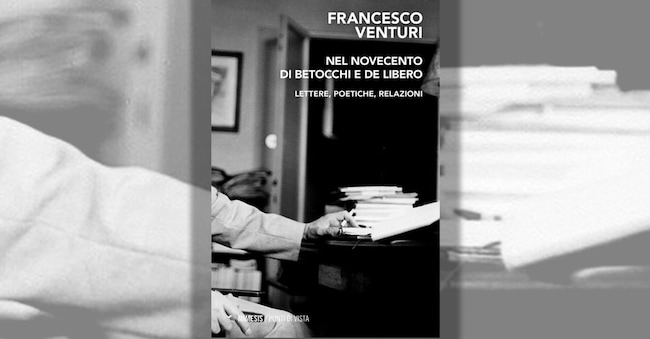
Can a collection of correspondence reveal more than a biography? Sometimes the answer seems to be yes. This is the case in Can a collection of correspondence reveal more than a biography? Sometimes the answer seems to be yes. This is the case in *Nel Novecento* by Betocchi and de Libero. Letters, Poetic Essays, Accounts (Milan, Mimesis, 274 pp.) by Francesco Venturi, dedicated to the friendship between Carlo Betocchi and Libero de Libero: a relationship that began in the mid-1930s and remained strong until de Libero’s death in 1981. This is not merely the story of two reclusive poets, but a journey through the century as seen by two outside observers, both of whom are difficult to categorise within the most familiar frameworks of twentieth-century literature.
At first, Betocchi and de Libero seem to belong to worlds apart. Betocchi moves in the circles of the *Frontespizio* in Florence, within the atmosphere of hermeticism in which Carlo Bo is a key figure. De Libero, originally from Ciociaria but a Roman by adoption, moves instead in a milieu where literature and the visual arts constantly draw on one another: the Roman School, Scipione, the Galleria della Cometa, and the world of literary journals where poets and artists coexist without rigid hierarchies. The book clearly demonstrates how this initial distance does not prevent dialogue, but rather makes it all the more meaningful.
Betocchi carefully reviews de Libero’s early collections, *Solstizio* and *Proverbi*, at a time when the poet from Ciociaria was still little understood. Then came misunderstandings, hesitations and some friction. The turning point came when Betocchi visited the Ciociaria region for himself: only then was he able to gain a deeper insight into his friend’s poetic world, that rugged and mythical land which, for de Libero, was not merely local colour but his very origin and obsession. From this springs a deeper understanding, fostered in part through works such as *Vino di Ciociaria* and through a rich exchange on landscapes, memories and folk figures.
One of the most interesting threads in the book concerns Carlo Bo. Both authors have an important, yet very different, relationship with him. Betocchi engages in debate with Bo from within *Frontespizio*, disagreeing on crucial issues without severing their friendship; de Libero, on the other hand, feeling misunderstood, severed ties in the early 1950s and only re-established them much later. Through these intersecting relationships, Venturi reconstructs not only two individual journeys, but an entire literary society: Florence and Rome, Catholicism and hermeticism, poetry and painting, major journals and ephemeral publications, central and peripheral publishers.
Betocchi emerges as a figure of extraordinary industriousness: not only a poet, but also a reader, a mediator and a cultural organiser. Following his time at *Frontespizio*, he played a pivotal role at the radio programme *L’Approdo* and subsequently at *L’Approdo Letterario*, where he worked for years with almost artisanal dedication, selecting material, compiling issues and keeping abreast of contemporary poetry even when it was far removed from his own tastes. This willingness to listen does not imply a lack of judgement. Betocchi knows how to be generous, but also firm; he follows younger authors, reads his friends’ work, and assesses new poetry without easy indulgence.

