Air transport

IATA: the number of missed connections has almost doubled due to the Entry/Exit system

From 7 September, restrictions will be tightened. Airports and airlines fear new queues at the borders

4' min read

Translated by AI
Versione italiana

4' min read

Translated by AI
Versione italiana

From next week, and specifically from 7 September 2026, European countries will no longer be able to temporarily suspend certain procedures under the Entry/Exit System (EES) in the event of excessive queues. This flexibility was introduced during the summer specifically to reduce waiting times at border controls and now risks being withdrawn at a time when the system has not yet achieved full operational stability.

The EES is the new European border control system covering third-country nationals entering and leaving the Schengen Area. Instead of the traditional passport stamp, the system records the traveller’s details and, gradually, their biometric data as well, including facial images and fingerprints.

Loading...

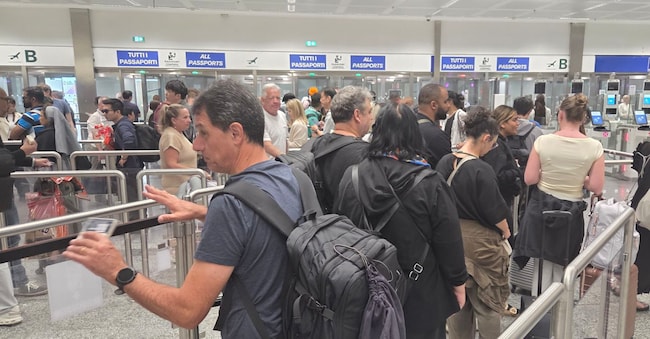
However, the increased complexity of the procedures has had an immediate impact on airports, particularly during peak travel periods: longer waiting times at border controls and an increased risk of missing connecting flights.

Missed connections doubled

The issue was raised again by IATA during a press conference in Brussels. According to the International Air Transport Association, over the summer ‘the number of missed connections doubled’, whilst ‘some airlines recorded increases of up to six times’.

These figures bring the issue of border control capacity back to the forefront of the debate. The question now is what might happen after 7 September, when it will no longer be possible to invoke the derogations, even though the peak of the summer season has now passed.

For IATA, however, the problem cannot be regarded as having been resolved with the end of the summer. According to the association, the removal of flexibility poses a ‘real risk of further congestion and operational disruption’.

The airlines’ request: to retain the exemptions

Until now, when queues were particularly long, Member States could intervene by temporarily suspending certain aspects of the biometric registration process. This measure was designed as a safety valve to prevent the border system from becoming a bottleneck for air traffic.

According to Thomas Reynaert, senior vice-president of IATA, the problem of queues has affected virtually all European airports, to varying degrees. For this reason, the association is calling for ‘flexibility to be maintained at least until the end of the winter season’, and in any case until there is greater certainty regarding the full operation of the EES.

Among the requests made by IATA to the European Commission is a call to increase the number of staff assigned to border controls and to allow part of the check-in process to be carried out before arrival at the airport, so as to reduce the time taken for physical checks at the border.

The aim is to prevent the EES from evolving from a system for border security and digitalisation into a new constraint on the capacity of European airports.

Loading...

The risk to international hubs

The issue is particularly relevant for airports with a high proportion of non-Schengen passengers and, above all, for major hubs characterised by a significant number of transit passengers.

For airlines, in fact, the time spent at border controls is not merely an indicator of service quality. Where connections are tight, a longer queue can directly result in missed connections, passengers having to be rebooked, additional costs and a knock-on effect of service disruption.

It is therefore the system’s ability to absorb traffic peaks that represents the real risk.

This issue also arises against a backdrop of already very heavy European air traffic. Eurocontrol forecasts that by the summer of 2026, traffic will have increased by around 2 per cent compared with 2025, with peaks of close to 37,000 flights a day.

Frankfurt, Amsterdam and Munich under pressure

The latest figures indicate that the problems are not confined to a single country. In the main European hubs – Frankfurt, Amsterdam and Munich – there has been a sharp increase in waiting times at security checks.

The situation remains delicate at Paris Charles de Gaulle, Rome Fiumicino, Milan Malpensa, Madrid, Barcelona, Lisbon and Tenerife too, with varying levels of pressure depending on the time of year and traffic peaks.

At Milan Malpensa, in particular, there were instances where over a hundred passengers bound for Manchester were unable to reach their gate in time due to queues at security.

Meanwhile, in Germany, Lufthansa, Fraport, Condor and the German Airports Association have called for the exemptions to be retained. Fraport has reported waiting times of up to 90 minutes, expressing particular concern about the impact on international passengers with connecting flights.

The 7 September incident

The date of 7 September thus becomes the first real-world test for the European system. The summer season, characterised by the highest volumes of traffic, is now behind us, but the structural problem remains: the EES will have to prove that it can manage these flows without turning border controls into a bottleneck for the European airport network.

Airports and airlines are therefore being asked to maintain a certain level of operational capacity at least until the system has stabilised further. The issue is not just about passenger waiting times, but about the overall capacity of European hubs to ensure connections and cope with peaks in traffic.

In other words, the focus of the EES is now shifting from the system’s roll-out phase to the more complex phase of ensuring its operational sustainability.

Copyright reserved ©
Loading...

Brand connect

Loading...

Newsletter

Notizie e approfondimenti sugli avvenimenti politici, economici e finanziari.

Iscriviti