Books

The occupier’s ancestors

Between 1941 and 1944, the Italians, Germans and Bulgarians did not merely divide up Greece amongst themselves. They also sought to divide up its past. A conference in Athens reopens the archives of archaeology during the war.

3' min read

Translated by AI
Versione italiana

3' min read

Translated by AI
Versione italiana

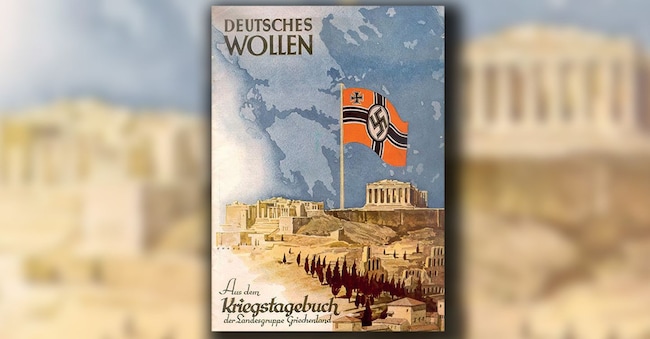
On 27 April 1941, German soldiers hoisted the swastika on the Acropolis. The image was all too perfect: the Reich towering over the Parthenon. Germany was occupying the monument that Europe had chosen as its very birth certificate. For National Socialism, ancient Greece was a legacy to be seized.

Hitler himself had sorted out the genealogy. One evening in 1942, Heinrich Heim, the lawyer who recorded the Führer’s private conversations, transcribed these words: ‘When we are asked who our ancestors are, we must always say the Greeks’. With a single sentence, the Greeks were enlisted into the ranks of the Germans’ unlikely Nordic ancestors.

Loading...

This contradiction lies at the heart of the conference Archaeology and Occupation. Greece 1941–1944, organised in Athens from 15 to 17 October by the Hellenic National Research Foundation, the Italian School of Archaeology and the German Archaeological Institute. Not a tally of national grievances – the Balkan archives are already well-stocked – but an investigation into excavations, museums and institutions during the Italian, German and Bulgarian occupations. Archaeology, too, found itself on the front line. The invaders did not merely divide up the territory: they sought out titles of ownership in the past.

Greece was divided into three zones, but ideologies cross borders without a pass. The Germans proclaimed themselves guardians of the Hellenic heritage whilst they plundered the country, starved the population and annihilated the Jewish communities. Walther Wrede, director of the Germanic Institute, was also head of the Nazi party in Greece. Archaeological excavations, heritage conservation and propaganda travelled in the same convoy: culture did not disarm power, but provided it with the weapons of language.

When it came to colonial archaeology, Italia had been the first to act. In the Dodecanese, archaeology and restoration had gone hand in hand with the occupation since 1912. On 28 October 1940, Italia invaded Greece from Albania. Following the initial setbacks, on 18 November Mussolini promised: ‘We shall break Greece’s back.’ The Istituto Luce footage preserves the voice and the applause; the military campaign played out the Duce’s words, but turned the ending on its head. The following April, the Wehrmacht turned the Italian defeat into a victory for the Axis.

The Italian School of Archaeology, too, was swept up in the war, which saw three directors succeed one another in quick succession. Alessandro Della Seta was dismissed under the racial laws; his successor, Guido Libertini, was removed from office for having abandoned the School. After 8 September 1943, Luciano Laurenzi refused to pledge allegiance to the Social Republic and was interned for eight months. The School’s premises changed hands between Fascists, Republicans, Swiss protection, Greek authorities and British troops: from a centre of learning to an occupied territory.

In Macedonia and Thrace, which were under Bulgarian control, the search for ancestral roots took a different turn. The regime in Sofia, led by the archaeologist Bogdan Filov, sought arguments for annexation in history and ethnolinguistics. Priority was given to medieval monuments and manuscripts; the presence of Slavic-speaking populations was exploited to support territorial claims; antiquity was stripped from the Greek national narrative and reattributed to a Thracian origin. Each excavation, manuscript or place name was assigned a mission: to confer historical legitimacy upon a newly drawn border.

Greek archaeologists attempted to salvage what they could. Before the troops entered, the artefacts from the National Archaeological Museum were evacuated and brought to safety in pits, crypts and storage facilities. Elsewhere, there were thefts, illegal excavations and damage to monuments; the reverence for antiquity did not preclude the use of men as tools for excavations.

The battle over artefacts continued after the liberation. Scattered artefacts and damaged archives marked the reopening of foreign schools. The Monuments Men surveyed the damage, but their lists gave priority to classical antiquities and Christian monuments: Jewish heritage all but disappeared from the inventories of those who had come to save it.

The conference thus reconstructs a second occupation, one that is less visible on military maps. Italians, Germans and Bulgarians sought evidence of their claims in monuments, languages and the subsoil. Each chose the ancestors that suited them best. Archaeology played its part: it provided genealogies, maps, prestige and alibis. The regimes bowed down before the ancient Greeks and trampled on the modern ones. The living could resist; the dead, far less so.

Copyright reserved ©
Loading...
Loading...

Brand connect

Loading...

Newsletter

Notizie e approfondimenti sugli avvenimenti politici, economici e finanziari.

Iscriviti