
The Octopus’s Dream: A Story of Friendship
From the Danish writer Anne Cathrine Bomann, a moving and tender story of the friendship between a woman, Vigga, and Rosa, a mollusc

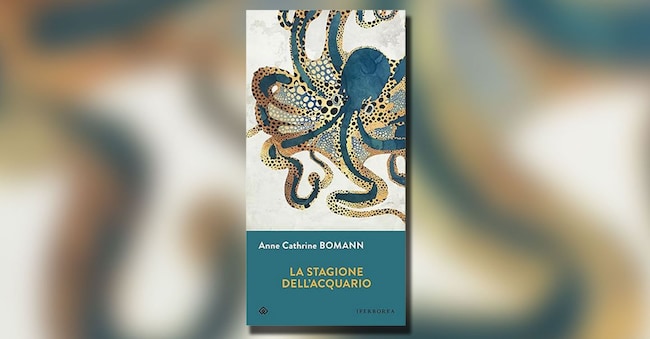
When they sleep, octopuses sometimes change colour. New shades of colour flow over their skin, which is as fluid as water, and it quivers and changes shape: from smooth, it can become bristling, rippled or stiff. It is not yet certain, but it could be a dream. Or something akin to talking in one’s sleep. A ‘revealing on the skin what is happening in the soul’. A betrayal, the breaking of the boundary between what happens inside and what is shown on the outside. Behind closed eyes, the octopus might be locked in a battle or a fierce hunt.
Vigga, the protagonist of *The Season of the Aquarius*, an original novel by the Danish writer Anne Cathrine Boman, is a surly young woman. She detests pretence, hypocrisy and dissimulation. She stands on the other side – the side that does not delude, does not sparkle, but sticks to reality, whatever that may be. She struggles to make sense of her days and wonders whether, in the end, meaning is not, in fact, just pretence. She goes from one job to the next until the job centre sends her to do a temporary stint at an aquarium. Her job is to chop up frozen fish and other dead organisms to feed the living ones, to clean and set up the tanks, and to stay in the smelly, noisy backstage area, amongst ‘mechanical lungs that suck up the water, purify it and spew it back out into a sort of parallel universe where everything stinks, screams and makes your hands freeze’. At least she doesn’t have to be on the other side – that of the spectators, or the people in charge, those who accept the idea that it’s right to keep animals in cages. She feels less uncomfortable here: ‘Despite everything, back here we’re more sincere than those out front, precisely because we’re on the side of the ugly. Because the aim of *Mondo Oceano* isn’t to show things as they are – I’ve realised that much. The aim is to create an illusion that suits everyone, a pretty little picture, interesting and presentable enough to be bearable for visitors.” It is whilst she is trying to adapt to her new job, to avoid snapping at her colleagues, to feel less excluded from people and from life, that her only friend, Maiken, tells her she is pregnant. Their very close bond had already begun to fray when Maiken left their flat to go and live with her boyfriend, but for Vigga it was just a temporary situation. Now, however, a rift is beginning to open up between them. The foetus begins to transform her friend’s body, to take possession of it, and Vigga withdraws further and further into the background.
Johannes, Vigga’s boss, explains something to her day after day about the lives of aquatic organisms. Gradually, the young woman begins to distinguish the actions and reactions of the aquarium’s inhabitants, which had previously seemed to her ‘always incredibly similar, little copies without consciousness or personality, behaving in exactly the same way every day’. He ‘notices a whole host of details that I can barely make out even when he points them out to me. Within a few seconds, he can tell if a sea bass is carrying eggs simply by observing the trail it leaves in the water; he knows how an eel wriggles when it’s feeling well, and he can tell one seahorse from another’. Vigga begins to reflect on how much richer the world would be when viewed through such a precise lens.
One day, Johannes gives her a new tank. That’s how she meets Rosa, the octopus. She waves her hand in the water to catch its attention, and immediately it rises from the bottom. ‘Now Rosa is floating just below the surface, and is no longer grey, but a reddish-purple. Over-excitement, perhaps, or curiosity? (...) Rosa remains in a waiting position for a few seconds, then rests the tip of a tentacle on the back of my hand.’ Thus begins the friendship between the two solitary creatures, Vigga and the octopus, a ‘decentralised thinking’ organism, because in addition to its central brain, most of its neurons are distributed throughout its tentacles – eight of them, each endowed with a certain degree of autonomy, each capable of thinking: of gathering and processing information, of making decisions and carrying them out’. Rosa likes Vigga; when she arrives, she goes to meet her and wraps her in her tentacles. She doesn’t do this with others. ‘At first, when I didn’t know the language to understand her, her world seemed as superficial to me as a stylised drawing on a sheet of paper,’ reflects Vigga. Now she can appreciate all its nuances; she understands her and recognises herself in her mind. “There she is, in the gorgeous coral pink she usually wears, rhythmically moving the cavity of her mantle and expelling jets of water from the siphon that protrudes like a snorkel from a fold in her skin. And suddenly her expression changes. She turns a deeper red that then fades to brown, all in the space of a single breath. Her skin shifts from silky to something resembling goosebumps, then to a knobbly surface dotted with tiny horns, and finally changes colour once more. A tremor runs through its body, blowing away the bluish tinge to return to a pale orange.’ Rosa’s eyes are closed; perhaps she is dreaming, Vigga speculates in this moving and delicate novel about friendship, which has the power to change the way we look at the world.
Anne Cathrine Bomann


