
Odyssey: Nolan is the multifaceted genius
The director has devised a film technique, with depth and resolution, capable of freeing cinemas from their role as mere appendages to streaming platforms

Key points
If the Muse were to sing of a man of multifaceted genius today, she would look to Christopher Nolan. The deceptions in his Odyssey have worked to perfection: the first directed at Ulysses, who is transformed from a shrewd and melancholic hero into the chief architect of a civilisation’s collapse. The second is directed at the Homeric epic, which he cuts, weaves and grafts together (he is, after all, the director of Inception) with The Iliad and The Aeneid. The third is aimed at us, the heirs of Greco-Roman culture, forced to forgive him – especially in the scenes set in Ithaca – the information overload of pornographic banality, in exchange for the incredibly powerful flashback scenes, where the viewer is always right alongside Odysseus, no less vigilant, fearful, astonished, confused and anguished.
New techniques
But Nolan isn’t just concerned with intrigue; he also brings gifts: he fills cinemas in July and gets people talking about a war that began three thousand years ago, whilst overlooking its modern-day ramifications. Above all, however, with *The Odyssey*, the director is championing a technology that allows audiences to enjoy a new experience and offers cinemas a chance to break free from their role as mere satellites of streaming platforms: IMAX (a portmanteau of ‘Image MAXimum’), a cinema projection system capable of delivering images of superior size and resolution. Cinemascope in 1953 and VistaVision the following year had already increased the size of the film stock, whilst multi-projector systems such as Cinerama in 1952 had expanded the projection area. With IMAX, the 70-millimetre frame is exposed horizontally inside the projector (illuminated by a special 15 kW xenon lamp), whereas traditional 70-millimetre films run vertically. To put this into perspective, ‘normally’ an image area is 48.5 millimetres wide and 22.1 millimetres high and comprises the space of 5 perforations; with the IMAX system, the images are 69.6 mm wide and 48.5 mm high and occupy 15 perforations.
The first feature film shot entirely in IMAX
The first film shot in IMAX was Tiger Child, which was screened at Expo ’70 in Osaka. Nolan, together with his director of photography, Hoyte van Hoytema, began using the system in *The Dark Knight* (2008) for just a few scenes, expanding its use in *i* *Oppenheimer* and creating the first feature film shot entirely with IMAX cameras in *i* *Odyssey* . The revolution has also affected the actors, who have had to adapt the acting techniques they learnt with digital technology and smaller cameras to a massive camera that places them in proportion to the majesty of the scenery it captures. Nolan returned to film (using 640,000 metres of it), employing a camera that had to be recharged every three minutes and was so noisy that the actors had to shout to be heard above the din (‘like having a blender in your face’, said Odysseus Matt Damon). The engineers had to devise a silencer (the blimp), a casing that transforms it into a fridge weighing around 130 kilos, to be transported up and down the not exactly friendly terrain of six countries: Greece, Italia, Iceland, Morocco, Scotland and the United States. Production costs, estimated at around $250 million, have already been more than tripled (so far) by box-office takings.
Previous experiments and their effects today
From *The Dark Knight*, through *i**Interstellar* and *i**Inception*, Nolan has always rooted his stories in reality, and with *Odyssey* he subjected himself and the crew to physical exertion designed to emulate Ulysses’ nostos, creating – after some hesitation regarding 3D – the most immersive experience ever, with a depth and level of detail never before experienced. By pushing cinematic technique a little further, he has given a gift to cinema and to the filmmakers of tomorrow, because there are fewer than a thousand IMAX theatres worldwide and only three in Italia (Orio al Serio, Sesto San Giovanni and Rome) – and these are not entirely suited to the format of the Odyssey. The writer saw it in a ‘normal’ cinema, but, even without IMAX, I found myself descending with Ulysses from the horse with which he had deceived the Trojans; I felt terror at the sight of the Cyclops’ milky-white body; I was filled with wonder amidst the snow on the island of the dreadful Laestrygonians; was horrified by the stretching of the bones with which Circe transformed the soldiers into animals, and endured the grasp of Scylla’s tentacles as they plucked victims from the crowd at random, in accordance with the injustice of fate that descends upon our daily lives the moment we open certain pages of the news. She felt nauseated on the stormy sea, sensing the cold of the water on her skin; she felt remorse for past mistakes when Tiresias emerged from the sand and unleashed the wrath of her comrades who had died because of the egotistical commander’s strategies. Admittedly, it was harder to remain on Ogygia with Calypso, who attempts to psychoanalyse Odysseus, dishing out New Age advice. But by removing the god who decides from on high, Nolan introduces an exploration of the unconscious, turning Calypso into a sort of psychopathic manipulator who ‘cures’ Odysseus by making him remember and, to some extent, drugging him with the lotus flower, and merging the Ogygia episode with that of the lotus-eaters – an episode that has been omitted, like others, including the Nausicaa sequence, which has deeply offended the purists. But what is the purity of an oral poem? Nolan has removed the songs whose protagonists are dative and positive to make way for a civilisation without hope, as our own now appears to us.
Pointless controversies
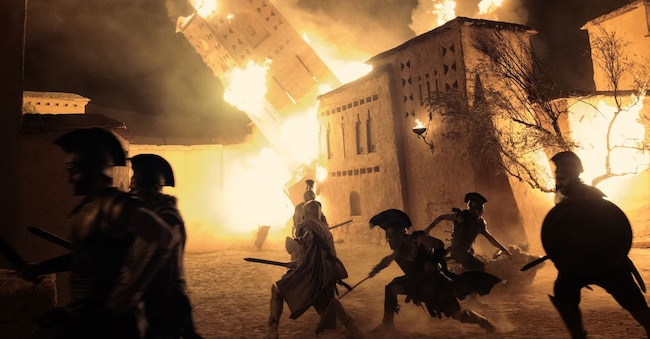
There is no point in debating the accuracy of the armour in relation to the period; the peplum films of yesteryear drew their inspiration for costumes and set design from Romantic art, and the exposed spine at the back of Agamemnon’s helmet is a sublime symbol of fragility. The beaches where Odysseus lands are as cold as those at Dunkirk – a metaphor for the carnage of war; it is impossible not to think of Normandy, Ukraine, Gaza, Sudan, Iran and all the other ongoing wars. The sea is black, save for a few rare shots; Greece is dark; and Ulysses’s cunning is not to be commended: he does not win with honour; he breaks the law of xenia, a move that is also damaging on an economic level because, for the Greeks, hospitality was a way of smoothing and fostering trade routes. The path of diplomacy is abandoned in favour of war; logos is trampled underfoot: Polyphemus knows this, having been denied the chance to be heard. Human beings are, for the most part, greedy, self-absorbed and deceitful, and women are no better – not even the excellent Anne Hathaway (Penelope), who treats Tom Holland (Telemachus) like a baby, whereas a twenty-year-old in the Bronze Age was more than just an adult. Nolan has chosen a star-studded cast to attract the widest possible audience. Damon is never rhetorical, and Robert Pattinson is a thoroughly cowardly Antinous. If we had no objection to Liz Taylor playing the Egyptian Cleopatra, on what grounds should we complain if Zendaya is Athena, and Lupita Nyong’o is Helen and Clytemnestra? The cast is exceptional, and that’s enough (apart from Holland, who’s rather daft, but I fear that’s just the part). Let’s forget the flaws and enjoy the film and its pacifist message, even for those who don’t like Ulysses, such as Bobi Bazlen, who considered him a petty bourgeois who, instead of enjoying psychedelic experiences and free love, wanted nothing more than to rush home to his wife.


