
The Odyssey tops the Italian box office: €10 million in 4 days
Christopher Nolan has achieved his best-ever opening, surpassing the final box-office takings of *Dunkirk* and *Tenet* on the Italia market

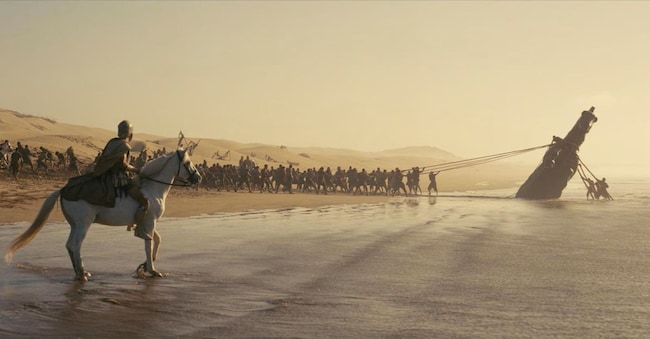
It has been praised, criticised (and at times reviled, and not in a particularly polite manner), be that as it may, Christopher Nolan’s Odyssey has already broken records, particularly at the Italian box office, where it has grossed 10 million euros in just four days. Christopher Nolan has achieved his best-ever opening on the Italian market, surpassing the final takings of Dunkirk and Tenet.
The international box office and America
Nolan’s film is also doing extremely well in the rest of the world, bearing in mind that the figures are as at 19 July. In the UK it has taken 17.5 million, followed closely by Italia, then Australia (10 million), Germany (8 million) and India (7.5 million). In Greece, 1.5 million people have seen it (the population is less than 10 million). Not to mention the US, where, with takings of 260 million, it has already recouped the film’s production cost of 250 million. The Odyssey has beaten the formidable Moana, Minions and Monsters and Toy Story 5 in the US.
The cast and production
The star-studded cast has played a major part – Matt Damon (Ulysses), Anne Hathaway (Penelope), Tom Holland (Telemachus), Robert Pattinson (Antinous), Zendaya (Athena), Charlize Theron (Calypso) and Lupita Nyong’o (Helen and Clytemnestra) – but also the creation of a grand, imaginative epic poem, with special effects set against rugged backdrops, which convey the hardships of war and the difficulties of the journey home across far from tranquil seas. This Odyssey is Nolan’s highly personal take on Homer’s epic, with key sections omitted, elements drawn from the Iliad, and fusions with other myths, including the Aeneid (for the depiction of the fall of Troy). It is no coincidence that people say ‘it was an Odyssey’ when they want to describe a complicated undertaking. Nolan’s was just that because he filmed in five countries – Italia, Greece, Morocco, Iceland and Scotland – in extreme weather conditions, in challenging locations, using 70-millimetre IMAX technology. Word is now spreading amongst cinema-goers, and the film is still proving a hit even in July.
The records
Released on 16 July, Odissea has already surpassed the results achieved by Oppenheimer during the same release period (5 million in the first 3 days, 28.5 million in total) and is one of the most talked-about cinematic events of the year, competing in Italia with Gennaro Nunziante’s Buen camino, starring Checco Zalone (over 76 million euros). As well as being a personal triumph for Nolan, it also marks the biggest opening day and debut weekend ever achieved by Universal Pictures Italia, and the best result ever for IMAX cinemas and the 70mm format. Odyssey sits thirty million dollars ahead of Michael, Antoine Fuqua’s biopic about Michael Jackson, in the box office rankings.
Nolan’s adaptation of the Homeric poem
Forget Homer’s Odyssey – or rather, don’t forget it at all, because Christopher Nolan’s version certainly honours it in its status as a classic, a work that remains timeless, regardless of when it was created. The tale of Homer’s Ulysses was originally an oral tradition and has been reworked over the centuries; Nolan makes some adaptations to remain true to the message he wishes to emphasise: breaking Zeus’s law, which requires us to show strangers the same care we would show ourselves; breaking this law brings shame and destruction. The Greek law of xenia was not based solely on idealism. The Greeks, a seafaring people, knew that this was the only way they could maintain their trade routes.


