
Ancient artefacts in the bedroom

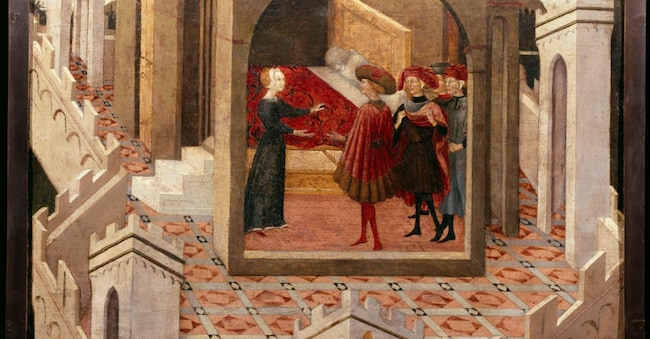
In the Renaissance, the gods did not dwell solely in temples, nor did heroes remain confined to the pages of books. Diana hunted on the front of a chest of drawers, Scipio practised virtue on a backrest, and Venus took possession of Mars’s helmet beside the bed. The ancient world had entered the home and had plenty to say.
This is the primary merit of *Abitare il Rinascimento. Domestic Furnishings in Siena from the 15th Century to the Mannerist Period*: to restore a sense of context to objects that have been reduced to isolated artefacts in museums. The more than eighty works – trunks, cots, headboards, majolica – once accompanied aristocratic ceremonies, weddings and births. Fragmentation, often caused by the antiques market, has placed them within a gilded frame that has stripped them of their meaning. In the Palazzo delle Papesse, they do not return home – that would be a fiction – but they rediscover a domestic context, revealing what can be found within the bedroom.
Of course, we’re not starting from scratch. Renaissance interiors have a substantial body of literature; in 2006, *At Home in Renaissance Italy* at the Victoria and Albert Museum offered an overview, followed in 2008 by *Art and Love in Renaissance Italy* at the Metropolitan. A major exhibition need not discover a new continent: it can better map out a city already marked on the map. Here, the focus is narrowed to Siena, a city often reduced to a mere appendage of Florence. The exhibition brings together works that had been scattered or recovered from storage, through which we can identify workshops, patrons and families. It does not offer a generic illustration of the Renaissance home: rather, it examines a Sienese workshop. And that is no small feat.
Leon Battista Alberti wrote that the city is like a large house and the house, in turn, a small city. The rooms established hierarchies, the furnishings signified rank, and the coats of arms symbolised alliances. The bedroom was not a sanctuary of intimacy: it served to receive guests, bring heirs into the world and demonstrate the continuity of the family line. Mario Praz would have appreciated this. In *The Philosophy of Furnishings*, he demonstrated that interiors are a visible form of existence; in *Conversation Pieces*, he studied portraits in which people, gestures and objects keep each other company. In Siena, the inhabitants have vanished, but the furniture continues the conversation.
It is the figures from antiquity who speak most powerfully: Lucretia contemplates suicide after being raped, Daphne transforms herself into a laurel tree to escape Apollo, Artemisia drinks her husband’s ashes. They do not merely illustrate a humanistic passion; they point to the right path: fidelity for the bride and self-control for the husband; an ancient lineage for the family. The bridal chamber had many counsellors, all dead for centuries or descended from Olympus. The Bible also featured: Judith, chaste and armed, triumphed over Holofernes’ lust and pride; Joseph did not yield to Potiphar’s wife; Susanna, spied upon whilst bathing by old men, saw her innocence vindicated. The examples were intended for both sexes, although the consequences were not distributed with perfect fairness.

