
The Open Arms affair, from the safe harbour tug-of-war to the landing of minors
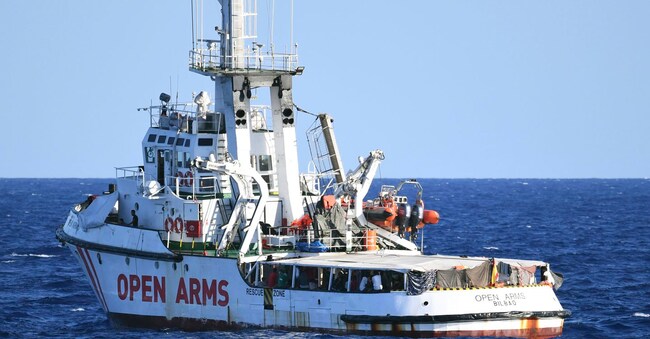
It all started on 1 August 2019, with the rescue of 124 migrants in Libyan waters by the Spanish non-governmental organisation

3' min read
3' min read
The Open Arms affair begins on 1 August 2019, with the rescue of 124 migrants in Libyan Sar waters by the Spanish NGO. After the rescue, the crew of the boat asks for a safe harbour to be assigned to Italy and Malta: it is the first of a series of instances to this effect but, as a response, they receive a ban on entering Italian waters from the then Minister of the Interior Salvini, who moves in agreement with his 5 Star colleagues in Defence and Transport. The tug-of-war with Open Arms began. Two refugees and one of their family members, meanwhile, are disembarked for health reasons. A total of 121 remain on the ship. On 9 August, the NGO's lawyers appeal to the minors' court demanding the disembarkation of the underage migrants and file the first complaint. A few hours later they rescue another group of people on a stranded wood: this time there are 39 of them.
The scanning of moments
.On 12 August, the court in Palermo ordered the disembarkation of the minors. In the meantime, the ship sailed towards Lampedusa and continued to ask Malta and Italy for a safe port. Against the Viminale's repeated refusal, the NGO appealed to the Lazio Tar. On the eve of mid-August, the president of the board suspended the entry ban. Two days later, when the yellow-green government began to crumble, Open Arms filed a complaint with the Agrigento Public Prosecutor's Office claiming that, in spite of the administrative judge's decision, Salvini continued to deny entry into Italian waters. In the meantime, the situation on board is unmanageable: the migrants, who have been in precarious sanitary conditions for a good 18 days, are at the end of their tether. Some, seeing the Italian coast, try to swim to Lampedusa by throwing themselves into the sea. Open Arms is again calling for disembarkation.
Decided on indictment
On 20 August, when tensions were running high, the then Agrigento prosecutor Luigi Patronaggio boarded the ship to ascertain the physical and psychological conditions of the migrants. It is he who speaks of 'an explosive situation' and seizes the boat, breaking the stalemate. On board, of the initial 164 rescued in Libyan Sar waters, after transfers for medical reasons, 88 remained. The Agrigento public prosecutor's office is starting investigations. The outcome of the investigation and the identification of responsibility in Minister Salvini led to the inclusion in the register of suspects of the leader of the Italian League for kidnapping and refusal to carry out official acts in conspiracy with his chief of staff Matteo Piantedosi. For competence, the papers were sent to the prosecutors in Palermo - the capital is the seat of the Court of Ministers - who then formulated the indictment for Salvini while filing for Piantedosi.
The stages of the process
.On 1 February 2020, the college sends the acts to the Senate for authorisation to proceed. Palazzo Madama, unlike what happened in the twin case of the navy ship Diciotti, which was also prevented from disembarking, says yes this time. On 17 April 2021, the gup Lorenzo Jannelli ordered the indictment. On 15 September 2021, the trial begins. A trial that went on for more than three years and 24 hearings, during which former Prime Minister Giuseppe Conte, former Foreign Minister Giuseppe Di Maio and current Interior Minister Matteo Piantedosi, among others, testified.
The Minister's Line
."The government's policy was to combat human trafficking and to involve Europe," Salvini told the judges during lengthy spontaneous statements. The League leader repeatedly returns to the total agreement by the majority on the management of migratory phenomena, recalling that Conte had changed his position on the matter only in mid-August, at the height of the government crisis. On 14 September, the Public Prosecutor's Office is asking for Salvini to be sentenced to six years in prison for 'the intentional and conscious disregard of the rules and conscious and voluntary denial of the personal freedom of 147 people', say prosecutors Gery Ferrara, Giorgia Righi and deputy Marzia Sabella.

