
Orsini’s appeal: ‘We need an industrial policy – no to handouts and piecemeal measures’
According to the president of Confindustria, we need to step up investment now that the Recovery Plan is drawing to a close

Key points
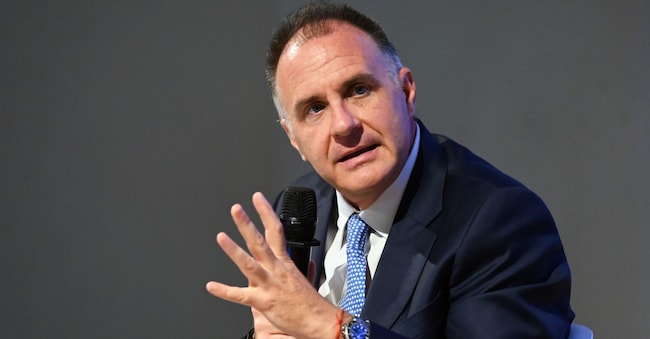
‘I believe that keeping our accounts in order is important today because it presents us in a better light to the world. But we need to ensure that the budget bill is not seen as a patchwork of measures or a series of handouts. What the country cannot afford is to lack an industrial policy. We called for this last year, and we will call for it again this year: better to focus on a few things but with a long-term vision.” Speaking from the stage at Confindustria’s Education & Open Innovation Forum, ‘The Odyssey of Intelligences’, currently taking place in Taormina, the head of Viale dell’Astronomia, Emanuele Orsini, has appealed to the government as it strives to find a difficult balance in the forthcoming Budget Bill.
Orsini: The NRRP is drawing to a close; we need to push for investment
For Orsini, the priorities are clear, and the president of Confindustria sets them out with his usual clarity. ‘We are aware that the NRRP is coming to an end; we need to boost investment, so through super-depreciation and by pushing for the single SEZ. We are in an area where the SEZ has been utilised effectively; funds have been well spent, generating investment and new jobs – which is another reason why we are here.’ Another important issue, he goes on to explain, “is the consolidation of small businesses; it’s a matter of productivity, so we need to help them grow – if we bring them together, we can make them perform better.”
There is also one aspect that the president of Confindustria considers crucial. “The other thing is knowing how to attract patient capital. We know that pension funds have 440 billion in investments and there are 1,500 billion in uninvested deposits held by Italians; therefore, we need to develop a plan where we can attract investment to continue doing what we need to do: growth, healthcare and education,’ emphasised the president of Confindustria.
Greater focus on training and skills
As well as investing in capital goods through hyper-depreciation, there is also a need for investment in training under the Budget Act, to develop the skills required by businesses. ‘Hyper-depreciation is a good measure to support the country, but the crucial aspect is training’, which ‘is a problem because new technologies increasingly require significant specialisation, and with what is yet to come – as we are increasingly seeing these new technologies, from artificial intelligence to quantum computing to humanoids, which will soon be part of our markets anyway, we must be ready to know how to use them’, Orsini explained, adding that ‘we must ensure that young people are attracted to businesses and industry. We must prioritise merit; I would therefore also like to thank Riccardo Di Stefano (Confindustria’s Vice-President responsible for Education and Open Innovation, ed.) and this wonderful region for hosting the second edition of the Forum. I believe the key issues are being able to attract young people and ensuring there is a net positive balance with those who go abroad – even to study – rather than a negative one where they do not return.’
ETS: it’s good that they’ve softened their stance, but we’re still a long way from what’s needed
The head of Confindustria comments on the go-ahead, just granted by the European Parliament, for the new parameters of the ETS system for the period 2026–2030, with the aim of offering more free allowances to industry: “It is positive,” explains Orsini, “that the window has been opened a little, but today we are still a long way from what European industry needs, because there is now a single European energy market and this can no longer be circumvented; we cannot envisage not buying freely traded energy within Europe.” ‘There has been a softening on the ETS,’ he adds, but the discussion centred ‘on minor details’ and “I had the feeling that politics is still being conducted on the basis of ideology”, whilst “we cannot think of conducting politics at the expense of European entrepreneurs, because the real issue is that today, on certain matters, we either come to a standstill or pause for reflection, because we are playing by our own rules and, obviously, no one else takes them into account”, continued Orsini, emphasising that ‘the truth is that today we must focus on the fact that we have deindustrialised Europe through poor decisions; we have not placed the concept of technological neutrality at the centre, which is fundamental’.

