
The Pacific Ocean is getting bluer and bluer, but that’s not a good sign
Global warming and the warming of the oceans are reducing phytoplankton, a group of organisms that play a key role in marine life – and indeed in human life as well

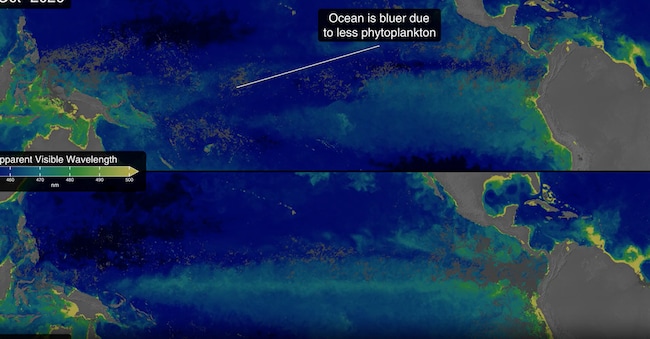
The Pacific Ocean is becoming increasingly blue. And whilst this might seem like good news, in reality, it isn’t. In fact, as seen by satellite instruments, the Pacific is crossed horizontally by a strip of green-turquoise colour stretching from South America to South-East Asia. By October 2026, this band will be much narrower. This is shown by images from the ‘PACE’ (Plankton, Aerosol, Cloud, Ocean Ecosystem) satellite, launched by NASA in 2024 to monitor the health of the Earth’s climate and oceans. In particular, it is the Ocean Colour Instrument that detects variations in the light reflected from the sea’s surface.
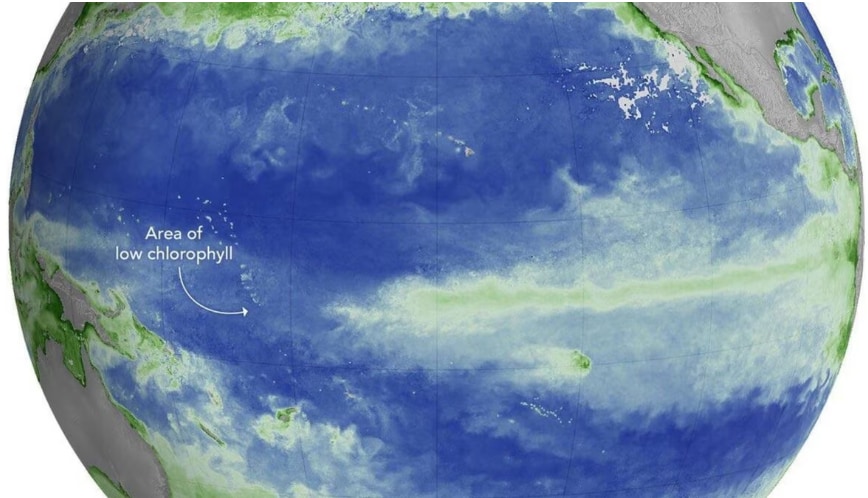
Temperatures are rising, phytoplankton is declining
The change in the colour of the Pacific Ocean – specifically in its equatorial region – is due to the Super El Niño, which is expected to peak at +4 °C in December this year. The rise in water temperature creates unfavourable conditions for phytoplankton – that is, the collective term for microscopic plant organisms, mainly algae and cyanobacteria, that live in the marine environment. And it is these organisms – capable of photosynthesis – that give the ocean its greenish hues. NASA explains that phytoplankton prefer ‘cold’ and ‘nutrient-rich’ waters, waters whose upwelling to the surface is reduced due to the weakening of winds caused by El Niño. These plant-like microorganisms play a key role in the functioning of marine ecosystems: they absorb carbon dioxide, produce oxygen and form a fundamental component of the oceanic food chain. The reduction in phytoplankton, combined with its underlying cause – namely global warming – can trigger a chain reaction, forcing various forms of marine life to migrate to other areas in search of food.
This phenomenon is yet another wake-up call regarding the risks associated with Super El Niño, the consequences of which are being felt globally and across the entire Earth’s ecosystem.

