
Maria Cristina Vimercati’s moving paintings
The canvases on display at the Fabbrica del Vapore – whether large or small – are both abstract and figurative, and contain a whirlwind of colours and ideas

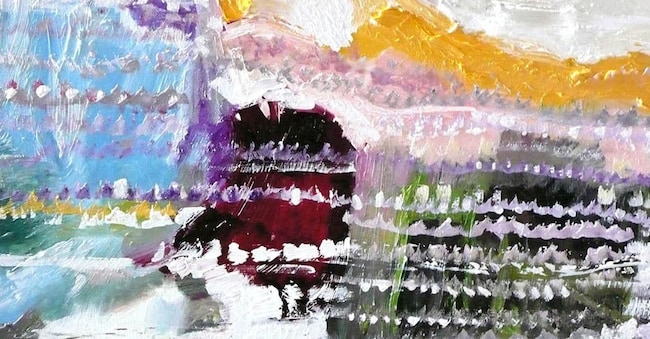
Whether they are enormous, colourful canvases or small ones – there is no middle ground – the paintings by the Milanese artist and photographer Maria Cristina Vimercati are filled with storms. Anyone venturing to the Fabbrica del Vapore in Milan during these days of sweltering heat to see the exhibition The Marvellous in Painting, upon entering the White Room, will be struck by a crisp breeze: the vast oil paintings seem to move of their own accord, drawing the viewer into a whirlwind of ideas, emotions and possibilities.
And this is true whether one focuses on observing the exquisitely detailed elements – which change colour as the angle of the light shifts, suggesting alternative interpretations – or whether one seeks to take in the overall picture. ‘The works are multidimensional and multisensory: they draw on various modes of expression and guide the eye to delve deeper, or to linger, amongst variations in surface and planes, between a rich, impasto-like colour and a delicate pencil drawing that appears not far away”, writes art critic and curator Maria Fratelli in the catalogue. She goes on to emphasise the ‘plurality of narratives, one for every gaze’ that these paintings evoke.
Paintings which, as Andrea Jacchia writes, ‘tackle head-on the most canonical distinction in art history: that between the abstract and the figurative, or rather, between the abstract “or” the figurative, and vice versa’. In fact, both coexist within the paintings, where large forms, imbued with a multitude of colours, textures and depths, unfold alongside recognisable images: houses, figures – often merely sketched in pencil – trees, animals, little monsters, flowers and flames.
Paintings which, as Nicoletta Bocca observes in the catalogue, speak ‘to the psyche that exists beyond the space and time to which we have become accustomed’. Paintings that are often joyful, capable of conveying immediate emotions and evoking the beauty of nature – of woods and seabeds, of mist or golden fields — paintings that are undoubtedly adventurous, transcending the everyday and transporting us ‘from a linear, sequential time to a time that alludes to synchronicity, the spatial dimension of time and the soul’ (Bocca).
The marvellous in painting


