
The parable of Bacoli: from bradyseism to cultural and tourist revival
The city of the Campi Flegrei has bet on legality and culture: this is how it now manages to retain its citizens and attract international visitors

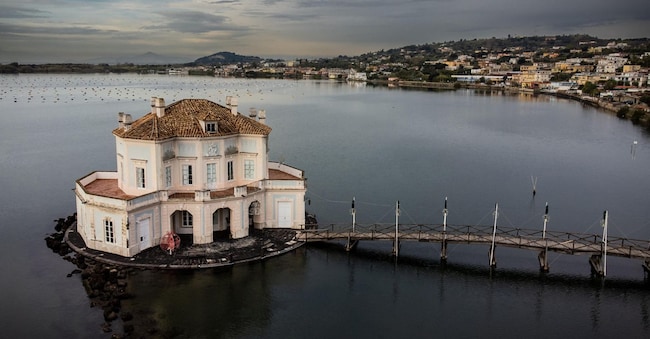
From bradyseism to economic and social revival, from budget deficit to investments in infrastructure, services and tourism: this is the parable of Bacoli, a city of 25,000 inhabitants, in the Phlegraean Fields, which in the space of about eight years has reversed its destiny, even though the earth continues, even these days, to tremble: a destiny that seemed to condemn it to decline, despite a record environmental and cultural heritage. Two volcanic lakes, an outlet to the sea in the Gulf of Pozzuoli with Nisida, Ischia, Procida, 20 monuments and archaeological sites including submerged Baia in front of it. And now it is among the finalists in the race to become the Italian Capital of Culture in 2028.
It was 2015 when Josi Gerardo Della Ragione, a young journalist with a degree in modern literature from the Federico II University, was first elected to the leadership of the municipality, but his junta only lasted a year. In 2019 he was re-elected and then again in 2024: since then he has governed with a junta made up of members of the Free Bacoli association and a centre-left coalition. 'We inherited a budget deficit of 56 million _ says the mayor _ we went through the pandemic and then had to deal with the bradyseism. But we did not get down and wanted to raise our heads again'.
Since its first term in office, the Bacoli administration has focused above all on restoring legality. "We have recovered the Bacoli beach _ says the mayor _ that had been occupied illegally by industrial sheds for over 50 years. It is the same story in the Miseno area, where the same bathing establishments have always operated on the basis of concessions dating back even 90 years. It is a matter of 250 thousand square metres that have been reclaimed and are now partly intended as a free beach and partly to be sold under concession. In fact, the tender for the assignment of 50% of the beach areas is about to be announced, as required by the European directive known as Bolkestein. "We succeeded _ comments della Ragione _ but it was not easy. In many cases we had to defend ourselves before the Tar and the Council of State. Even from threats'. The municipality acquired the confiscated property Villa Ferretti, an 18th-century villa, and entrusted it to the Federico II University, which set up its own premises there. 'Here we have the Centre for Humanistic Informatics and the School of Underwater Archaeology _ says Andrea Mazzucchi, director of the university's Department of Humanistic Studies _ the Villa is also a venue for international conferences. In short, I believe that the administration of Bacoli has shown great sensitivity by not only wanting to protect the precious monuments, but to bring them to life in order to produce new culture'. Work is also underway to improve services. Starting with waste treatment. The management of waste collection is entrusted to the municipality's company, 'Flegrea Lavoro', and Bacoli becomes a 'Recycling Municipality' for Legambiente, having managed to achieve 91% differentiated waste collection. Three kindergartens for 100 children a year were built and inaugurated, and the school canteen was restarted. The municipality emerges from bankruptcy in 2023 and undertakes to recover evaded taxes. In two years, we go from 60% evasion to 35%'.
Citizens appreciate the spring in Bacoli, entrepreneurs too. "We have gone from a tourism that was only from Campania and only in the summer to an almost stable and international tourism _ says Roberto Laringe, president of Federalberghi Campi Flegrei with satisfaction _ here the development of the non-hotel sector has had the positive effect of attracting foreign tourists. Between 2019 and 2024 arrivals grew by a thousand units'. The number of available beds has tripled and revenue from tourist tax has increased by 40 per cent to 120 thousand euro (forecast 2025). Admissions to the Casina Vanvitelliana in Lake Fusaro alone will reach 300 thousand in 2024. The city of heavy industry of yesteryear has turned into a city of tourism and services. But it still retains important industrial realities: Fiart, Mbda, Leonard: all together they employ more than 2,000 people.
However, the bradyseism does not help, the tremors are frequent, sometimes intense, and for the citizens they are a serious source of stress and discomfort, but they want to stay and have learnt to live with it.


