The judgement

France: Le Pen has been convicted, but is standing for the presidential election and has lodged an appeal with the Court of Cassation

“Tonight I am standing as a candidate in the presidential election.” So said Marine Le Pen live on TF1, despite having been sentenced by the Court of Appeal to house arrest with an electronic tag.

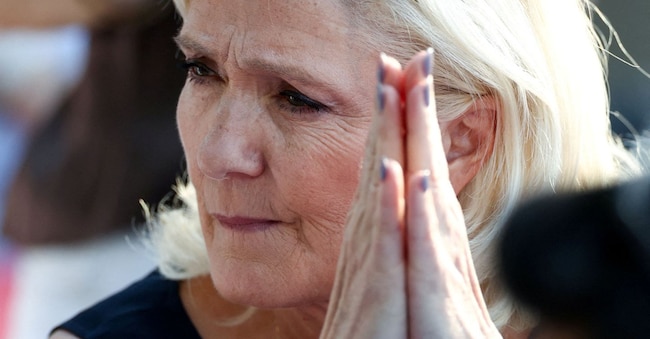
La leader dell'estrema destra francese Marine Le Pen, deputata del partito Rassemblement National (RN), reagisce durante un discorso tenuto da Jordan Bardella, presidente del partito RN, davanti ai sostenitori in occasione di una fiera di paese a Lievin, nel nord della Francia, il 4 luglio 2026. REUTERS/Tom Nicholson/Foto d'archivio REUTERS

5' min read

Translated by AI
Versione italiana

5' min read

Translated by AI
Versione italiana

“Tonight I am a candidate in the presidential election.” So said Marine Le Pen live on TF1, despite today’s conviction by the Court of Appeal. When the interviewer reminded her that she had previously stated she would not campaign whilst wearing an electronic tag, she reiterated that she is innocent, announced that she would appeal to the Court of Cassation, and said she was confident that the Court of Cassation would rule in her favour. “The final say rests with the French people,” which is why, despite everything, Le Pen said she was “happy” after today’s verdict was read out.

“What if the Court of Cassation doesn’t rule in your favour?” presses the journalist. “We’ll see. The French people are the judge; let’s not assume they’re incapable of making a decision,” she retorts, placing her trust in her electorate.

Loading...

The ruling of the Paris Court of Appeal

On the afternoon of Tuesday 7 July, Marine Le Pen’s sentence was upheld: three years’ imprisonment, two of which were suspended, and one year under house arrest with an electronic tag. Le Pen was also sentenced to 45 months’ disqualification from holding public office, 30 of which were suspended.

According to the Court, the leader of the Rassemblement National has already served the remaining 15 months of her period of ineligibility and therefore, from a legal point of view, she can still stand as a candidate in the presidential elections scheduled for 18 April 2027 and 2 May 2027.

One possibility that has emerged – immediately after the verdict was read out – is that Le Pen might request a reduction or adjustment of her sentence, even though, as experts point out, the electronic tag is in itself an adjustment of the sentence. If the one-year requirement were reduced to six months, Marine Le Pen could campaign without an electronic tag from January onwards. With her evening announcement broadcast live nationwide, Le Pen has dispelled any doubts: she is aiming directly to have the sentence overturned.
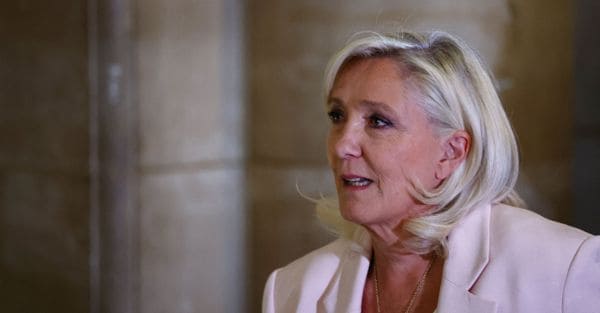
“The facts are serious.” The president of the Paris Court of Appeal, whilst reading out the judgement against Marine Le Pen, repeated this phrase several times, adding that they are serious “because of the scale of the offences and the length of time over which they were committed”. She specified that the Court accepts the principle of “no personal enrichment”, but emphasised that “European funds are public funds” and “the definition of the duties of European parliamentary assistants is clear and predictable”.

“Thank you for being here,” Le Pen had said, in a loud voice, in the packed and very hot courtroom, addressing her supporters present. Then the presiding judge entered the courtroom and everyone stood up for the reading of the verdict.

Le Pen’s lawyers’ response: a call for ‘voters’ freedom’

Marine Le Pen’s lawyers, on leaving the courthouse that afternoon, highlighted a “significant reduction in the sentences, particularly the ban on standing for election”, just a few minutes after the announcement of the sentence handed down to the leader of the French nationalist party.

According to lawyer Rodolphe Bosselut, the President of the Court referred to the principle of ‘the freedom of voters to choose a candidate’.

"It’s ‘a good start’," commented the lawyer, saying he was "partially" satisfied with the decision.

Loading...

Conviction for embezzlement and ineligibility

Le Pen’s political future has been in limbo since last year, when she was found guilty of misappropriation of European Parliament funds – between 2004 and 2016 – for having some of her assistants work for her party, the Rassemblement National (which was known as the Front National at the time of the events), rather than for the European Parliament. She was sentenced to four years’ imprisonment, two of which were suspended, and to five years’ disqualification from holding public office.

Francia, oggi la sentenza su Marine Le Pen: giornalisti in attesa fuori dalla Corte d'appello di Parigi

The long road to the Élysée

It remains to be seen what the Court of Cassation will rule. The Court of Appeal’s decision comes at a time when Le Pen has never seemed so close to the Élysée Palace, following three presidential campaigns and two defeats in the run-off against Macron. But even if she were to be excluded from the race, it is unclear whether her party’s prospects would suffer: the president of the Rassemblement National, Jordan Bardella, aged 30, has been touted as a possible replacement, and in some early polls he appears to be at least as strong.

Le Pen said that she would not campaign if she were placed under house arrest and forced to wear an electronic tag, but in an interview last week she gave assurances that she would continue to participate in French political life whatever the outcome of the proceedings. “It’s no longer up to me,” she had said. “But I will continue to fight and I will continue to be an activist. And if I am just an activist, I will be just an activist.” It seems, however, that she is not yet ready to give up on the idea of becoming President.

La leader dell'estrema destra francese Marine Le Pen, deputata del Rassemblement National (RN - RN), arriva per assistere alla lettura della sentenza nel processo d’appello che la vede coinvolta, insieme allo stesso partito RN e ad altri 10 imputati riconosciuti colpevoli di appropriazione indebita di fondi del Parlamento europeo, presso il tribunale di Parigi sull’Ile de la Cité, a Parigi, in Francia, il 7 luglio 2026. REUTERS/Sarah Meyssonnier

After leaving the courthouse, Le Pen went to the party headquarters, in the western part of the French capital, to meet Bardella.

Bardella was not in the courtroom when the verdict was read out.

Jordan Bardella and the future of the Rassemblement National

It is unclear whether the far right would have a better chance of winning the presidency with or without Le Pen. Polls suggest that Bardella is slightly more popular. A survey by the French institute Ifop, published last month, puts him at up to 37 per cent in the first round, more than 15 points ahead of his nearest rival in the scenarios tested.

The same poll suggests that Le Pen would also win the first round, but with a maximum of 32 per cent.

The first round of the presidential election is scheduled for 18 April. If no candidate secures more than 50 per cent of the vote, the top two will face each other in a run-off on 2 May.

However, Bardella’s lead in the popularity polls is offset by his lack of experience. His age and the fact that he has not yet been put to the test add to the uncertainty surrounding his ability to maintain momentum in the coming months. It remains to be seen whether French voters are prepared to entrust a thirty-year-old with the leadership of a nuclear power and Europe’s second-largest economy.

For Le Pen, the issue is more personal: she has spent over a decade cleaning up the image of the party she inherited from her father and transforming it into a major force in French politics.

Now that the Rassemblement National is closer than ever to coming to power, she may not be the one to reap the rewards.

Copyright reserved ©
Loading...

Brand connect

Loading...

Newsletter

Notizie e approfondimenti sugli avvenimenti politici, economici e finanziari.

Iscriviti