
The past is a legacy to be passed on: an exhibition on the power of sowing ideas
On 22 October, the Fondation Cartier in Paris will host the opening of *The Harvest Season*: Ghanaian artist Ibrahim Mahama reflects on the possibility of imagining new futures, reaping the fruits of a collective endeavour.

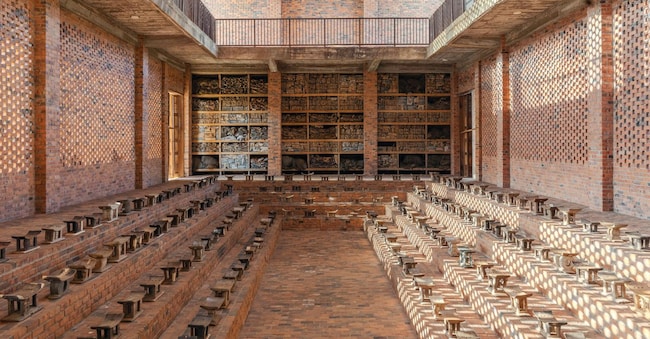
For Ibrahim Mahama, a Ghanaian artist, the future is not necessarily something that has yet to happen. It can be sought in the past, in its traces, in its materials and, above all, in its ‘unfulfilled futures’. It is from this idea that The Harvest Season, his first exhibition in Paris, takes its inspiration; it is scheduled to run at the Fondation Cartier from 22 October 2026 to 28 February 2027.

Born in 1987 in Tamale, in northern Ghana, Mahama has built his research around collected materials, archives and fragments of industrial heritage, transforming them to construct new imaginaries. His work explores Ghana’s colonial and post-colonial history, the circulation of goods, infrastructure and the sharing of knowledge.
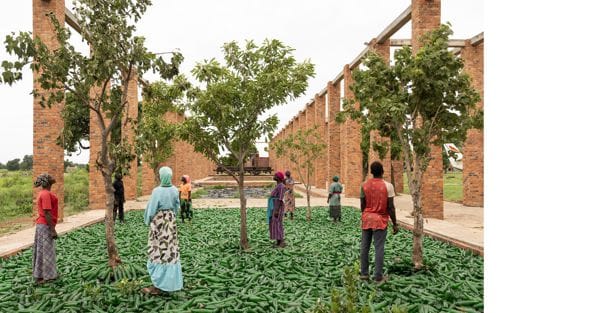
This same concept of transmission underpins the three centres that Mahama has founded in Tamale since 2019: the Savannah Centre for Contemporary Art (SCCA), Red Clay and Nkrumah Volini. These are spaces dedicated to creation, dissemination and education, rooted in the local context and part of a network of independent cultural institutions across the African continent. It is within this relationship between memory, materiality and transmission that the Fondation Cartier project also finds its place, where Mahama brings together nine artists and collectives with whom he shares long-standing collaborations, research and exchanges. The collective dimension is, in fact, central to his practice, understood as a space for collaboration, exchange and dialogue between diverse experiences.
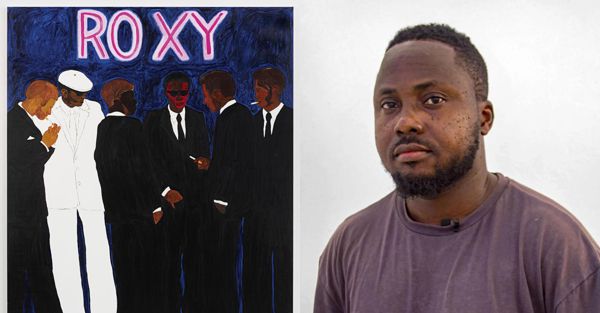
A relationship that is also given form through architecture in the exhibition. In Things Fall Apart, Mahama reconstructs an old Ghanaian glass bottle factory, opened in 1966 in the south-west of the country and one of the last major decentralisation projects promoted by Ghana’s first president, Kwame Nkrumah, before his downfall. After lying abandoned for many years, the structure was acquired by the artist and dismantled for transfer to Tamale, where it was reactivated as a work of art and a place of learning. At the Fondation Cartier, the factory returns in the form of a reconstruction, built using the original materials.
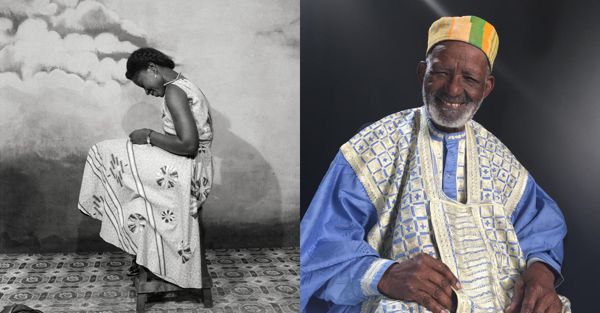
Among the artists involved are James Barnor, whose photographs depict Ghana in the years following independence, and Gideon Appah, who draws on archives of Ghanaian advertising and press from the 1950s to the 1980s to create dreamlike scenes linked to the country’s history.

