
The inspiration for philanthropy stems from the UN’s objectives
The sustainable initiatives of Cibjo, the World Jewellery Confederation, which, to mark its centenary, has inaugurated a lake in India’s arid Gujarat region. A project made possible by the Dholakia Foundation

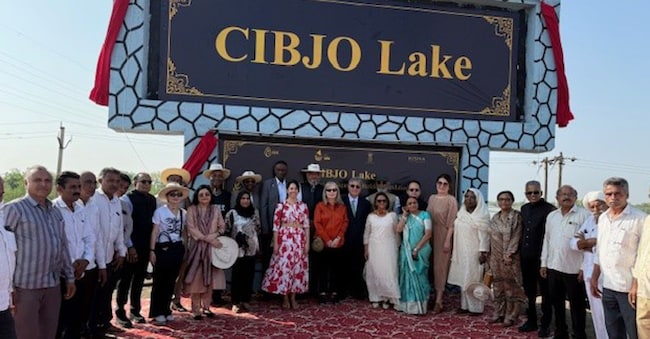
From the most remote, underdeveloped areas of Peru, China, Sri Lanka and sub-Saharan Africa, there has been a steady increase in efforts towards sustainability – a value that Cibjo, the World Jewellery Confederation, has long embraced. This culminated in the most complex project to date: Cibjo Lake, inaugurated in India last March on World Water Day, forming part of a major initiative on the Gagadiya River, which flows through the arid region of Gujarat. ‘A real gem,’ says President Gaetano Cavalieri, ‘in honour of the association’s centenary – a project made possible by the Dholakia Foundation, established by one of our members. Having begun a decade ago, it is unclear if or when it will be completed. Our commitment to sustainability, however, goes back a long way: Cibjio is the only association in the world that has held a seat on the UN Economic and Social Council since July 2006, which – adds Cavalieri with his characteristic candour – is not exactly a bridge club. It is the world’s leading organisation for discussing human rights, international relations and the Millennium Development Goals, which later became the Sustainable Development Goals.”
It is undeniable that, under his leadership, the jewellery industry was among the first to take action, addressing the issue through the three ESG components (social, economic and environmental). “For us,” says Cavalieri, “being part of such a forum means contributing to the achievement of the United Nations’ principles: each of us knows what to do, must do it, but above all must achieve it. Regarding the 17 UN Sustainable Development Goals set in 2015, CIBJO has carried out extensive and wide-ranging outreach and engagement activities; these are the subject of constant study, just as the Millennium Development Goals of 2000 were before them. Awareness of and adherence to these values led to the introduction of the Kimberley Process in the diamond sector, which came into force in 2003 and has been continuously updated ever since.’
“Our continued membership of the UN is by no means a foregone conclusion,” adds Cavalieri, “as it is subject to an annual review required to retain our so-called Special Consultative Status. Obviously, good intentions alone are not enough; funding is required, as in Gujarat, where it was necessary to alter the terrain in order to achieve the aim of lifting local communities out of poverty and improving the quality of life and working conditions for thousands of people, making their lives sustainable.” Behind the façade of luxury, there is more: there is work, and there are the conditions faced by those working in the industry. ‘Work gives dignity to people,’ concludes Cavalieri, ‘without this quality, human beings get nowhere. The awareness of being able to contribute to the development of one’s own family and community – and, by extension, to that of society as a whole – is our concept of sustainability. Behind this, therefore, lies the need to provide information and training, offering tools that in turn give people the opportunity to create wealth by establishing the conditions for development in challenging environments’. Cibjo is doing a great deal of work within the sector, with an academy – a school to teach less fortunate people how to make jewellery – and, finally, with a thoroughly innovative university master’s degree in luxury management.


