Venice

The oasis of peace of the Capuchin Garden opens at Giudecca

The Garden Garden of the Capuchin Friars of the Redeemer at Giudecca in Venice is reborn and for the first time in five centuries opens its doors to the public thanks to a careful restoration by the Venice Gardens Foundation
by Silva Menetto

Foto ufficiali di Venice Gardens Foundation

4' min read

4' min read

Restoring a garden can be a disruptive, almost revolutionary act: it can open up new architectural readings and create a new social and community context in an asset that becomes shared.

This is the case in Venice, where the Capuchin friars of the Church of the Most Holy Redeemer, on the Giudecca, are opening to the public, after five centuries of exclusive use, the garden of the convent, completely restored thanks to the Venice Gardens Foundation.

Loading...

In Venetia Hortus Redemptoris is a project that has something surprising about it, hinging on the principles of knowledge, responsibility, sustainability and self-sufficiency, to bring man back into dialogue with nature and offer visitors - residents or tourists alike - a corner of paradise in a city suffocated by overtourism and the frenzy of 'hit and run'.

L’Orto dei Capuccini del Santissimo Redentore alla Giudecca

Photogallery17 foto

The Redeemer Complex

The Redentore is one of the pillars of popular Venetian devotion, the church that is a pilgrimage destination every year in July. The Serenissima called the great Andrea Palladio to build it after the terrible plague of 1576, an ex-voto dedicated to the Holy Redeemer as a sign of gratitude and rebirth of the city.

That majestic votive temple overlooking the Giudecca canal guards behind it a precious one-hectare garden garden that reaches to the other side of the island and overlooks the quietness of the southern lagoon and the islets of Le Grazie, San Clemente and Sacca Sessola. Access is from Calle dei Frati, next to the Redentore church: you walk past a small courtyard with olive trees, a cloister, and finally your heart opens wide in front of the Garden Compendium, with the vegetable garden, the Meditation Chapel, the Antiche Officine, and the Convent Greenhouse. A microcosm that has remained closed to the world for five hundred years, maintained by the hard-working community of Capuchin friars who, following the Franciscan rule of holy frugality, were until recently almost entirely self-sufficient.
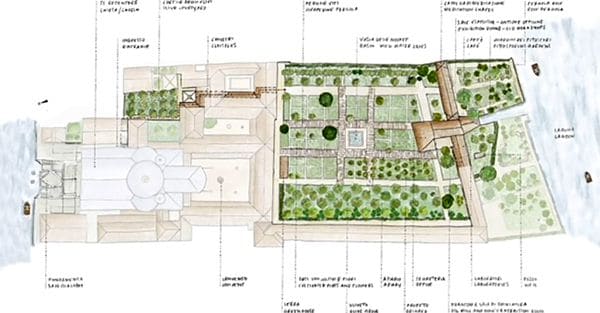
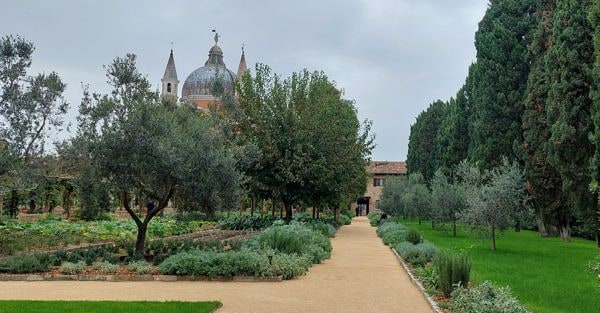
Foto ufficiali di Venice Gardens Foundation

Of course, over five centuries, time had laid its hand heavily on the monumental complex, but it was the devastating force of the aqua granda of 2019, which brought the entire city to its knees, that inflicted the real coup de grace. Even for the friars, the damage caused by the exceptional tide (187 centimetres in the middle of the sea) was so heavy that it convinced the small community of Capuchins - just a dozen or so remained in the huge Giudecca complex - that the time had come to rely on someone to restore and preserve the hortus Redemptoris.

With the authorisation of the Holy See and the Soprintendenza Archeologia Belle Arti e Paesaggio, the task was entrusted to the Venice Gardens Foundation, which in Venice has restored and manages the Giardini Reali di San Marco and will now also maintain and manage the Redentore monumental complex for 22 years.

Foto ufficiali di Venice Gardens Foundation

Recovery Intervention

.

The work began in 2021 and cost almost 6 million euros: 2 million came from the PNRR, the others were added thanks to donations from generous patrons, including foundations, banks, corporations and many private individuals who were also able to adopt a tree or a bench from the Garden Garden Garden.

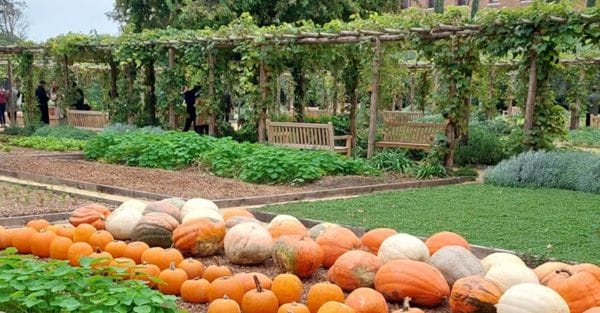
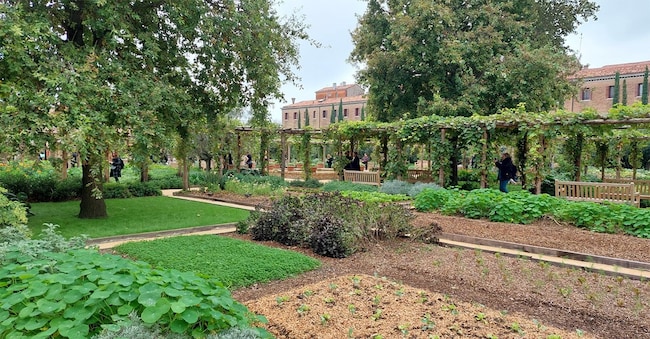
Designed by the landscape architect Paolo Pejrone, this special garden of wonders is now inhabited by more than 2,500 tall trees, with cypress trees along the boundary wall, the orchard and olive grove, a very long chestnut wood pergola with a cross-shaped pathway covered with vines, wisteria and climbing roses for strolling in the shade, and more than 1,500 species of flowering plants, as well as vegetables, medicinal herbs and aromatic plants; at the crossroads of the paths the large water lily pond, on the lagoon side a small and cosy pittosporum garden. Each season will have its fruits and colours, so that the garden will always be a discovery.

The architectural restoration work - entrusted to Alessandra Raso - has always been conceived according to the concept of essentiality: the old Istrian stones have been recycled to perimeter the flowerbeds, the wooden lintels of the Antiche Officine are recovered beams that already belonged to the place. Irrigation will not be a problem either, with the well for collecting rainwater giving the complex water self-sufficiency.

Recycling, reuse, valorisation of existing

Recycling, reuse, valorisation of the existing in short, have been the guiding star of the intervention, whose annual running costs will be around 300,000 euro. Contributing to the maintenance will also be the income from entrance tickets, which range from 6 to 12 euro; for residents it is possible to obtain an annual card with unlimited access for 30 euro. The Redeemer Garden Garden is open to the public on Thursdays, Fridays and Saturdays, according to a schedule that will follow the seasons.

Foto ufficiali di Venice Gardens Foundation

A living and breathing garden

For the brothers, the opening of the garden to the public is the sign of a new concept of communion and dialogue. Br Alessandro Carollo, provincial minister of the Capuchin friars of Triveneto, emphasises this: "It is a wall that falls, a door that opens and puts in communication a centuries-old tradition. This is a living garden, it is a work of art where the spirit of the friars who have lived and live here hovers: we want to share it with all those who wish so that the beauty, the peace of this place may help us to find the best part of ourselves beyond all prejudices".

It's hard to argue with that: strolling through the paths of perfectly beaten draining gravel, among olive trees, flowers, vegetables, silence and water, one finds harmony with creation. Here you can come for a walk, sit and read a book, drink a coffee or eat something simple (only raw materials from the garden) at the small cafeteria run by Illy: take a break, in short.

A programme of musical, literary and artistic events in keeping with the spirit of the place is also planned over time.

Copyright reserved ©
Loading...

Brand connect

Loading...

Newsletter

Notizie e approfondimenti sugli avvenimenti politici, economici e finanziari.

Iscriviti