Art de la table

The perfect festive table: everything revolves around an idea

by Paola Pianzola and Nicoletta Spolini

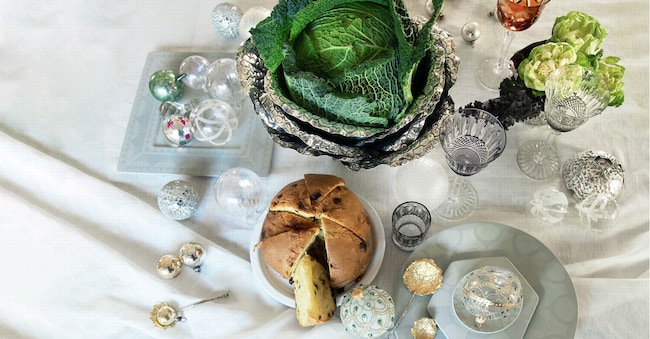
Sulla tovaglia di lino, realizzata con materiali fine serie da A:URE (265 €), centrotavola apribile, in argento collezione Nature (34.500 €) e spatoline con foglia, BUCCELLATI; bicchieri Tommy da vino roemer fumé in cristallo soffiato a bocca e intagliato a mano, SAINT-LOUIS (480 €); dietro, calice in cristallo pezzo unico Rossana Orlandi, panettone prodotto da Davide Longoni per FORNASETTI (135 €), piatti NORITAKE (a sinistra, piatto quadrato 110 €; a destra, piatto piano 89 €, piatto esagonale 69 €, piatto del pane 50 €). Palline di Natale vintage e palline in vetro soffiato a bocca, decorate e dipinte a mano con l’aggiunta di cristalli di grafite e glitter, DAGMARA (21 € la coppia). Foto di Francesca Moscheni con art direction di Nicoletta Ferrari e Fabrizia Monticelli.

7' min read

Translated by AI
Versione italiana

7' min read

Translated by AI
Versione italiana

A tablecloth signed by the guests, a star centrepiece, a precious vintage piece bought at auction. The best way to receive is to set a story.

The value of a handwritten word on linen: this is the starting point for the first of our tables, the other celebrates the decorative centrepiece, perhaps unusual today, but which finds interesting contemporary declinations. The third seeks the value of a history hidden in auction pieces, precious precisely for the memory they preserve. There are three ways of imagining a mise en place, starting with a single idea, around which everything else - plates, glasses, cutlery, decorations - revolves. If we start with the first, we immediately lay a white tablecloth that preserves the calligraphic imprint of the guests who have shared it. An imprint that then becomes embroidery, with that taste for time that leaves a mark, but also of the handmade, of taking care of things because they hold a trace of the people loved. It all begins with the story of a poet and writer who marries a poet, journalist and playwright. We are at the beginning of the 20th century, she is Maria Freschi and he Giuseppe Antonio Borgese. From 1915 to 1947, their home and their table welcomed illustrious guests - to name but a few, Eleonora Duse and Igor Stravinsky, Grazia Deledda and Stefan Zweig, Benedetto Croce and Carlo Carrà, Felice Casorati and Anna Kuliscioff - and each of them, at the end of dinner, signed that white linen tablecloth, always the same. From year to year, the testimony of a generation of intellectuals and conversations is composed.

Loading...

It is from that idea of a talking fabric that HTSI started to set up an interactive and participatory festive table, presented on the occasion of Tabula Rara, the Milanese event at the Rossana Orlandi Gallery which, until Christmas, proposes a reflection on the ways of living conviviality and is a sort of creative prelude to the festivities. A white linen tablecloth, then, made to measure for HTSI by A:ure (€265), a brand founded by three sisters who salvage production waste from the family textile business. Above, between vintage pewter pieces and Bric, the terracotta bricks designed by Erwan and Ronan Bouroullec for Mutina to create decorative structures, there are two vintage Fornasetti plates from the Specialità Italiane collection (€280 at Galleria Rossana Orlandi), with the recipe for Gnocchi di Patate and Mondeghili. Past and present, memory and future intertwine in as many table settings, each original and different from the others: it is a coherent stitching together of worlds that are temporally distant, yet aesthetically similar, held together by the metaphor of embroidery. The Imperial Peacock by Frank Lloyd Wright by Noritake (square plate 110 euro) is a preview: it is a Japanese artisan brand about to debut on the Italian market and the collection is a tribute to the master of architecture and his iconic Peacock artwork used for the Imperial Hotel in Tokyo. Instead of cutlery, the original first edition, unearthed in the Libreria Antiquaria Pontremoli, of Bruno Munari's book Le Forchette Parlanti (1,900 euro). The Smoke glasses by Joe Colombo (€ 256 a pair) and the smoked roemer wine glasses in mouth-blown and hand-carved crystal, Saint-Louis (€ 480 each). They belong to the Tommy collection and, together with the Noritake plates, also feature on the cover of this issue. In the centre are the Buccellati silverware from the Nature series, in particular the small and medium bowls (4,850 and 7,100 euro) and the centrepiece with lid (34.500 euros) in the shape of a cauliflower, the artisan panettone that Fornasetti, for the sixth year running, has entrusted to the bakery Davide Longoni and has then proposed in a package inspired by the feline imagery of High Fidelity (135 euros), with the original polish of the panettone recipe used to print the plate, once again part of the Italian Specialities series. Among the vintage silver-plated balls from the 1950s, there are two in mouth-blown glass (€21 a pair), decorated and hand-painted with graphite crystals and glitter, made by Dagmara, a Polish handicraft company.

FROM VENETIAN DESERI TO CONTEMPORARY GLASS

Beyond the functional intent, setting an important table means creating a landscape, building a subtle bond between diners by involving them in a game of enchanted amazement. This was the purpose of triumphs, in Venice deseri, elaborate centrepieces composed of various pieces that, since the end of the 18th century, enriched the tables of the most sumptuous banquets. Today, artists Riccardo Monachesi and Cecilia Valli reinterpret this traditional archetype in an ironic and surreal key.
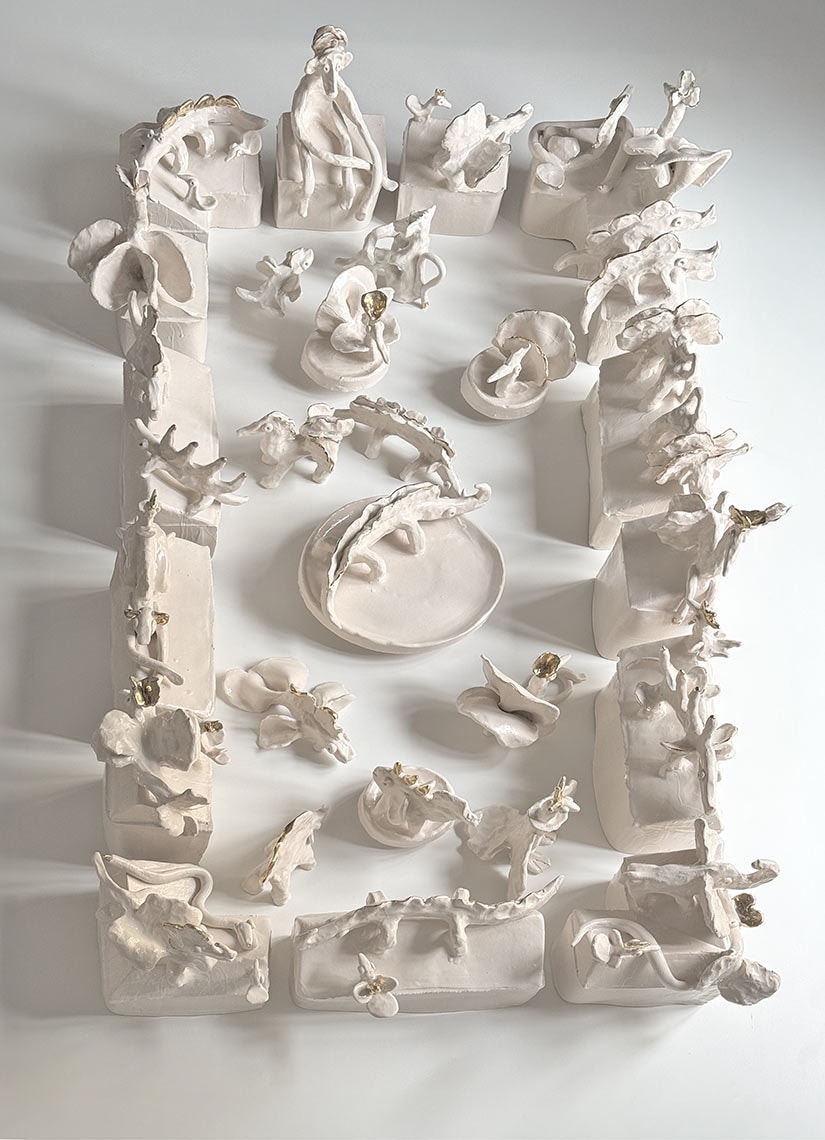
“Archè” di MONACHESI/VALLI è una composizione di blocchi in ceramica popolata da una serie di immaginarie creature scampate al diluvio. Foto Cecilia Valli

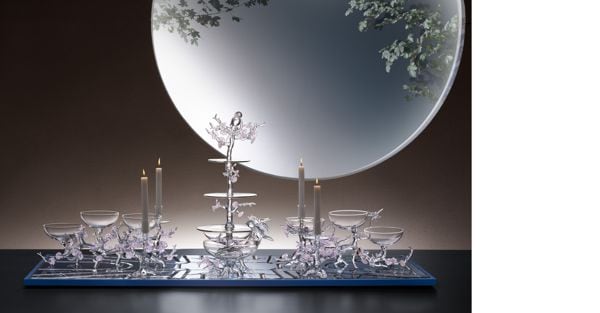
Played on the double meaning of beginning (arché in Greek), and the plural of ark, Archè is a composition of ceramic blocks on the surface of which a series of dazed and imaginary creatures escaped from the flood land as if on the roofs of small houses. On the same wavelength of delicate poetry are the blown glass works by Simone Crestani, who uses the sophisticated technique of lampworking for his creations. Carolina Levi, owner of the Spazio Giallo gallery in Rome, describes the Veneto artist's magical universe as follows: "The splendour of 18th-century Venetian banquets, the enchantment of mirrors and frescoed ceilings and the poetry of haiku inspire Crestani's blown shapes and find a shining synthesis in contemporary tableware triumph.

il centrotavola “Petali soffiati nel cielo” di SIMONE CRESTANI (18.500 €) si ispira ai deseri, elaborati centrotavola composti da vari pezzi che, dalla fine del Settecento, arricchivano le tavole dei banchetti veneziani più sontuosi. È stato esposto da Spazio Giallo a Roma. Foto Alberto Parise

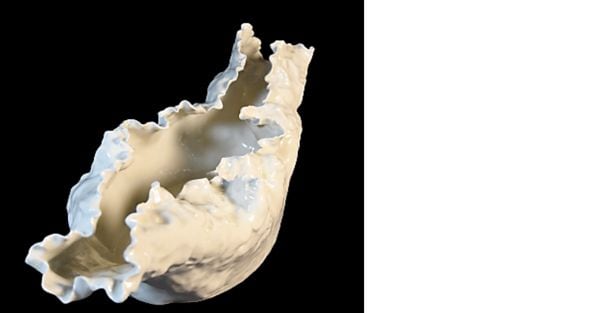
The title of one of his works, Petali soffiati nel cielo (€18,500) alludes to a triumph that is both lightness and poetry and brings into the present the magnificence of sumptuous receptions of other epochs". Also of an almost impalpable lightness is the quality of the work Cirro by Bertozzi & Casoni, artists who have revolutionised the presence of ceramics in contemporary art. Produced in a limited series by Laboratorio Pesaro in the 1990s, this centrepiece features a work where the crystallised white glaze emphasises the subtle shape of the ceramic.

“Cirro” di BERTOZZI & CASONI (480 €), realizzato in serie limitata dal Laboratorio Pesaro negli anni Novanta, propone una lavorazione dove lo smalto bianco cristallizzato evidenzia la forma sottile della ceramica.

The skilful gestural intervention on each object makes each piece unique (€480). The Battuti blown glass plate, designed in 1962 by Tobia Scarpa with Ludovico Diaz De Santillana for Venini (€9,865) also stands at the centre of a linear and elegant table. Shapes with undulating edges extend from the base, with transparencies thickened by grooves and traces sculpted by the master glassmakers' beating at the grindstone.

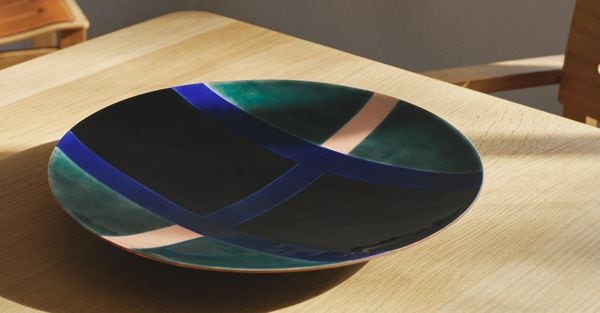
Centrotavola rotondo Sialk, modello grande, HERMÈS (3.750 €).

An eye-catcher is the Sialk plate by Hermès (€3,750), which expresses all the beauty of enamelled copper, a very ancient process and a true feat of craftsmanship: the reactions of the different oxides must be mastered and several firings must be carried out according to the nature of the enamels and the possibility of juxtaposing them to give form to an extraordinary wealth of textures and contrasts dictated by fire, where transparency and depth, the coldness of the metal and the vibrancy of the colours meet. On the modern design side, Gio Ponti's famous centrepiece for Sambonet (from €350) participates, in the fervour of the 1950s, in the moment when the master, in every design, corroborated form by giving it an expressive essentiality. In stainless steel, but also in silver-plated or gold-plated steel, it consists of two cups that together make up an almost perfectly spherical element. Separated, the cups can accommodate compositions of fruit or flowers, and when joined together, they form a single striking piece of architecture. Today as yesterday, therefore, it is the strong choices at the centre that characterise the most successful table settings, those that are remembered not only for the excellence of the menu.

FROM THE TSARS TO THE VIENNESE SECESSION

The festive table is an extraordinary tale when it is populated by objects from the most prestigious international auctions, with appointments dedicated to the art of setting it. On these occasions, one can come across artefacts that are rare and precious, but also illuminated by an evocative story. During L'Art de la Table, the event that every year celebrates elegance at the table, Cambi Auction House proposed a precious porcelain service by Royal Copenhagen. The history of the manufacture still in activity is evocative: founded in 1775 at the behest of Queen Mary Julia of Denmark, in 1868 it became a private enterprise, maintaining its name and logo with the royal flag.

Servizio in porcellana di Royal Copenhagen proposto da CAMBI CASA D’ASTE nel corso di L’Art de la Table: realizzato nel XX secolo, si ispira al leggendario servizio Flora Danica ed è composto da 44 elementi (stima 20.000 - 38.000 €). ©Cambi Casa d’Aste

Its fame is mainly linked to the sumptuous Flora Danica, one of the most famous table services in Europe (estimate €20,000 - €38,000): the pictorial inspiration and the name of the porcelain come from the floral motifs taken from the Flora Danica, a monumental Danish botanical encyclopaedia. Commissioned in 1789 by the royal family as a gift to the Empress of Russia Catherine II, the 1,800 pieces of the service took 13 years to complete. On the death of the Tsarina, the diplomatic gift remained in the Danish royal household and still belongs to Queen Margrethe, who uses it for gala banquets. From 1870, production of this artefact resumed and it was put on sale to the public. And it is precisely a 20th century service consisting of 44 items that is one of the highlights of Cambi's auction.

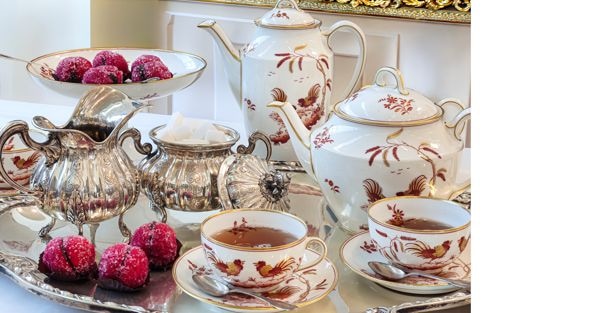
Lo scorso 3 dicembre IL PONTE CASA D’ASTE durante l’asta L’arte della tavola ha battuto alcuni pezzi della prima metà del XX secolo della manifattura Richard Ginori, comprendenti parte di un servizio in porcellana con decoro Galli rossi (2.400 - 2.500 €). ©Il Ponte Casa d’Aste

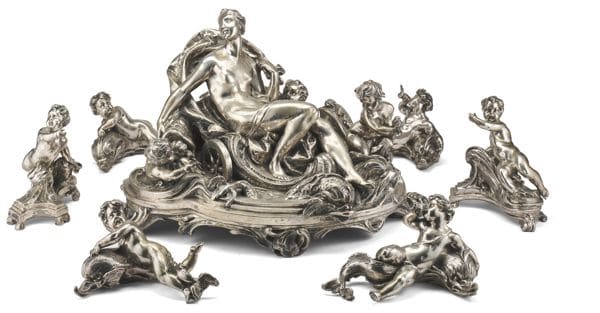
In its first auction dedicated to table art on 3 December, Il Ponte Casa d'Aste offered a large silver centrepiece of Italian manufacture from the first half of the 20th century depicting the Triumph of Galatea on a Chariot, embellished with putti in the round, dolphins and cornucopias. Valeria Agosto, head of the department for furniture, sculpture, objets d'art, porcelain and majolica, and silverware at the Milan auction house, emphasised that the opulence of the work, as well as testifying to the unique quality of Italian artistic craftsmanship, recommended its fragmentation into four separate lots. The opulent opulence of the centrepiece is contrasted by the No. 40 candlestick, in gilded wood and brass, designed in the 1930s by Josef Hoffmann, one of the founders of the Viennese Secession, which fetched £5,805 at Phillips Auction House's Design Auction in London in November.

Altri lotti del XX secolo proposti da IL PONTE CASA D’ASTE durante L’arte della tavola: al centro, un centrotavola in argento raffigurante il Trionfo di Galatea su un carro, arricchito da putti, delfini e cornucopie (13.000 - 15.000 €); coppia di amorini in argento a tuttotondo su delfini (1.600 - 2.000 €), anche mentre suonano conchiglie (1.700 - 1.800 €) e poggianti su volute rocaille (2.400 - 3.000 €). ©Il Ponte Casa d’Aste

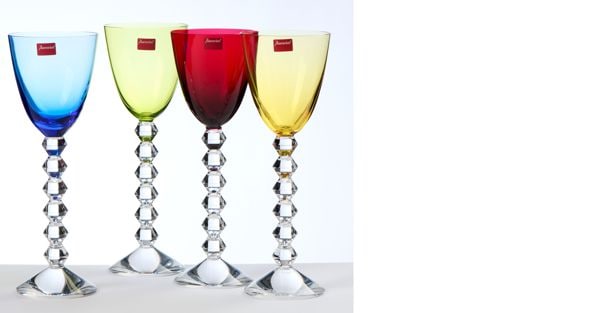
A romantic dinner party and an upscale table are the ideal setting for this straightforwardly beautiful utensil, which was exhibited at the L'artigianato liberato exhibition in Vienna in 1934 and at the Exposition internationale des arts et techniques appliqués à la vie moderne in Paris in 1937. The crystal goblets from Baccarat's Véga collection also stand out for their contemporary design (estimate EUR 1,000 - 1,400 for the set of 12 glasses).

Calici in cristallo colorato della collezione Véga di Baccarat, battuti da FARSETTI ARTE ricordano le forme di Brâncuși (set 12 bicchieri 1.000 - 1.400 €).

Presented in the L'Arte della Tavola auction from 25 March to 8 April 2025 by Farsetti Arte, their characteristic feature is the geometric and transparent stem characterised by overlapping diamond shapes that recall the totems of Brâncuși and create an unusual contrast with the smooth and coloured cup. And these are just some of the possible stops on a journey of discovery of the culture of hospitality, which tells of the art of transforming the table into a stage of style.

Copyright reserved ©
Loading...
Loading...

Newsletter

Notizie e approfondimenti sugli avvenimenti politici, economici e finanziari.

Iscriviti