
The Pope to a million faithful: 'No to a comfortable and private faith, closed in selfishness'
The words of Leo XIV during the mass in Plaza de Cibeles in Madrid in front of 1.2 million faithful that ended with the Corpus Christi procession
Key points
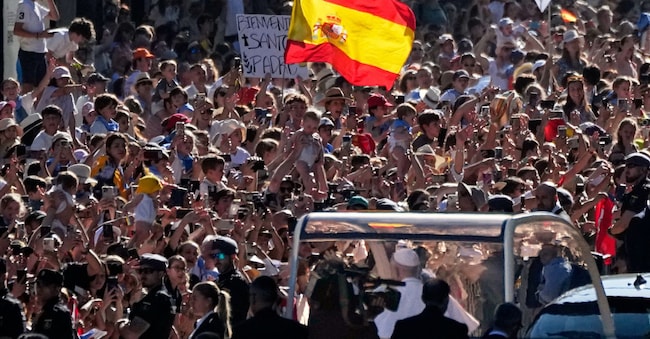
"It is not just a matter of taking out a monstrance, but of allowing ourselves to be taken out of selfishness, indifference, a comfortable and private faith, to respond to his invitation to conversion, to change our gaze, welcoming his presence that changes us and makes us builders of a new world": so said Pope Leo during the mass in Plaza de Cibeles in Madid in front of an estimated 1.2 million faithful according to the local authorities. After the mass, the Pope led the Corpus Christi procession. He explained the meaning of the rite: "The Christ who passes through the streets in the monstrance is the same Christ who is identified with the poor, the sick, the lonely and the discarded". A clear emotion appeared on Pope Leo's face at the end of the Corpus Christi procession that ended with a standing ovation from the square crowded with over a million people. The procession was intense: the Pope carried the monstrance through the streets of Madrid for over half an hour.
The Corpus Christi Mass
In the Corpus Christi Mass, celebrated in Madrid, the Pope left a "consignment for the Spain of today and tomorrow: the religiosity that has animated this country for centuries is not a museum of the past to be visited, but a school of faith from which to draw also today". "A school," Leone stressed, "that teaches us to kneel before God and before our neighbour, because no one can kneel before the Lord and despise their brother; a school that teaches us the gratuitousness of love that becomes a gift, so that it circulates among us and breaks the chains of all selfishness; a school from which we learn that God is a real presence and we too are called to be present in the situations and challenges of society, not to run away, to commit ourselves personally to building the common good. To enable the faithful present to receive the Eucharist, 2,300 chalices are being used at the Corpus Christi Mass officiated by the Pope in Madrid.
Leo XIV: "This is not an outward manifestation"
"The solemn processions of this day have shaped the piety, art, music, architecture and life of the Spanish people for centuries and, even today, they express and manifest the spiritual sentiment of this country also through the beauty and elegance of the floral carpets, the altars in the streets, the care of the monstrances and displays, the chants and vestments," added Pope Leo XIV in Plaza Cibeles, in Madrid, for the celebration of Mass on the Solemnity of Corpus Christi. "This is not an exterior manifestation, a folkloric survival or a simple aesthetic ornament: this is about," he stressed, "faith in the presence of the Risen Lord, who is alive and still passes through our midst, who becomes bread for our hunger for life and visits the corners of our hearts and of our history, even the darkest ones". At the end of the Mass, the long Corpus Christi procession started and will end with the solemn Eucharistic blessing imparted by the Pope.
The procession through the streets of Madrid
There was still a large crowd after Mass for the most solemnly liturgical moment that Pope Leo wanted to include in his programme for his visit to Spain: through the central streets of Madrid, Prevost led the Corpus Christi procession holding high the monstrance under the golden canopy while the faithful threw flower petals as they passed by and bells rang out. For reasons of order and security, the number of people accompanying the Blessed Sacrament had to be reduced from the usual number for the Corpus Christi procession in Madrid. Arranged along the ends of the street, the procession includes, in addition to the necessary deacons and acolytes: children who received their First Communion this year, lay people, consecrated people, priests, all cardinals, archbishops and bishops. The procession route started in the Plaza de Cibeles, continues along Calle Alcalá towards Gran Vía, turns at the Church of San José and returns to Cibeles along the other street.

