
The Pope in Buenos Aires: a business is noble if it serves a social purpose
The Pope emphasises that ‘if economic profit is treated as an absolute, business becomes dehumanised’. Two and a half million people attended the Mass

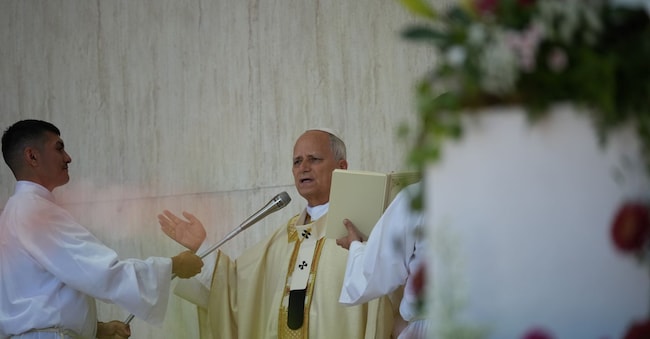
A sea of people filled the central streets of Buenos Aires for the Pope’s Mass: two and a half million people, which to date represents the record attendance for the pontificate of Leo XIV, and takes on particular significance because it was achieved in the city where Jorge Bergoglio once lived but which he never visited as Pope Francis. In his homily, Provost urged people not to lose hope, even when unemployment or difficult living conditions seem to offer no way out. ‘Even our families, in fact, sometimes face complex situations: a lack of stability, social difficulties, precarious employment, domestic violence, painful separations, and addictions that destroy and undermine family relationships,’ he said in his homily. Yesterday, Leone also held a meeting with five people who had been victims of abuse by members of the clergy and ecclesiastical institutions in Argentina. The Pope spoke individually with each of them, listening to their words, the painful experiences they had endured and their proposals for strengthening paths to healing within the Church.
But perhaps the most powerful message comes from the speech he delivered at the Catholic University on the world of work, a text which remains to this day a foundational document of his economic and social thought. ‘Every job and every sector of the world of work must always have one distinctive feature: they are the work of a person who brings their full potential to bear’, and they aim at the full development of those who carry them out. He recalled the words of Leo XIII, who inspired him: ‘In order to promote harmony between the parties and eliminate conflicts in the workplace, he emphasised the need to strike an appropriate balance between economic principles, the vision of entrepreneurs and the needs of the worker and their family. This is why unemployment is a genuine tragedy in the lives of those afflicted by it. Depriving a person of work does not simply mean denying them an income; it means seriously undermining their dignity, nullifying their ability to contribute to society and plunging them into exclusion, thereby fracturing the cohesion of the social fabric and destroying community action aimed at the common good.”
And a strong message goes out to the business world: ‘Entrepreneurs, who create jobs with their own capital, often put their assets at risk. It is, in fact, impossible to create wealth in a country without making a personal commitment, without accepting the uncertainty that the future entails and whose parameters are completely beyond our control’. At the same time, we must remain vigilant to avoid the risk of greed, which, as Pope Francis has stated, ‘is a disease of the heart’. He added that ‘the entrepreneurial vocation is a noble task if it is guided by the principle of the social function of property and capital. When economic profit is elevated to the sole criterion of success, the enterprise becomes dehumanised and turns into a structure of sin that generates exclusion. Entrepreneurs are called upon to overturn this technocratic logic through ethical investment that prioritises environmental sustainability and the dignity of work, based on the premise that financial success must be measured in terms of the common good’.
In this context, ‘trade unions and workers’ organisations have significant scope for growth and development here, by engaging more directly to ensure that decent working conditions are respected for workers’ and “trade unionism must constantly turn its attention to the existential peripheries, integrating and building bridges with precarious, informal and excluded workers, whilst taking into account the profound transformations the world of work is undergoing”. He then returned to a subject close to his heart: ‘The challenges posed by artificial intelligence and unregulated automation can put many jobs at risk and become a real threat to adequate integral human development. Technology must always be subordinate to ethics; algorithms cannot replace human discernment or the intrinsic value of a worker’s physical presence and commitment. Public authorities must ensure that this does not happen.”


