
The history of the Popemobile. Which one will Leo XIV choose?
The first papal car is dated 1909: an Itala 20/30, given to Pius X by the Archbishop of New York. But Pius X never got into it. And, like him, Benedict XV never used cars

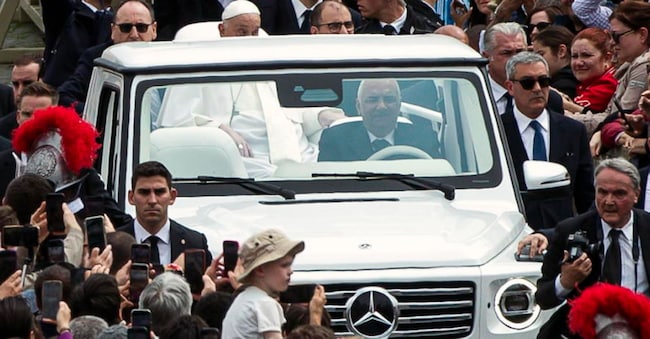
5' min read
Key points
- Once only carriages and sedan chairs were used to transport popes.
- Pope XI, first pontiff in a car
- The plate did not arrive until 1930.
- Paul VI started using off-road vehicles and trucks on international trips
- The farewell to the gestatorial seat
- Pope Montini's first popemobile
- Papemobile with bulletproof glass arrives
- Francisco's official car was the white Fiat 500L.
- Francis' gift for the children of Gaza
5' min read
The Pope's first car is dated 1909: an Itala 20/30, given to Pius X by the Archbishop of New York. But Pius X never rode in it, because he was against the use of motor vehicles. And, like him, Benedict XV never used cars.
Once only carriages and sedan chairs were used to transport popes
.Before the advent of cars, the Popes only used carriages and sedan chairs with stuccoes, paintings and decorations such as, for example, the Berlina di gran gala (1826), created for Leo XII by the Roman coachbuilder Gaetano Peroni. New decorations were made for Pope Gregory XVI in 1841. The carriage was also used on great solemnities by later pontiffs up to Pius IX (1878). There was no lack of travelling saloons, to cope with long journeys on rough roads. Like the one that Pius IX used in November 1849 to flee to Gaeta, after the outbreak of revolutionary uprisings in Rome. The same one used for his return from exile after the end of the Roman Republic. A second carriage was used for his return journey to the Papal State territories of Romagna and northern Marche. Cardinal Giovanni Maria Mastai Ferretti elected to the throne of Peter was the last 'Pope King'.
Pope XI, first pontiff in a car
It was not until Pius XI ascended the papal throne that we saw a Pontiff in a car. His first car was a Bianchi Tipo 15, donated in 1925 by the Catholic Women's Association of the Archdiocese of Milan. Then there was a Type 20, given to the pontiff by Bianchi in 1926. Then there was a real competition between car manufacturers to win the role of papal supplier of vehicles. The first was Mercedes-Benz. The German company's first papal car was a 460 Nürburg long-wheelbase limousine, the first of a long series of papal Mercedes. Unlike the many gifts to the Pontiff, this car was purchased. Pius XI's favourite, however, was a Graham-Paige 837: In that car he went to mass in the Basilica of St. John Lateran, a symbolic act that broke the voluntary imprisonment of the popes inside the Vatican.
The plate did not arrive until 1930
.Until the 1930s, Vatican cars had no number plates. Since 31 January 1930, when the Regulation for the circulation of motor vehicles that established the Vatican Vehicle Register came into force, even the popes' cars had plates. For example the Bianchi Tipo 15 was registered with the Italian diplomatic plate CD 404. The plates reserved for the cars of the popes ranged from SCV 2 to SCV 9, while SCV 1 was applied only when the pope had to use them. Later all papal sedans started to permanently carry the SCV 1 number plate. With the signing of the Lateran Pacts - 11 February 1929 - the major international car manufacturers competed to give the popes their top cars.
Paul VI began using off-road vehicles and trucks in international travel
.Paul Vi began not to use the traditional representation sedan: he often travelled in open-top off-road vehicles and trucks, which allowed greater visibility of his person by the faithful. From 1975 he was seen in St. Peter's Square on board a Toyota Land Cruiser, used for the first time during the Jubilee celebrations.


