
Salento in the wake of Xylella: avocado plantations to curb dependence on imports
Like Sicily, Puglia is also turning to tropical crops. Production is still limited, but the region offers 24,000 hectares suitable for conversion

Key points
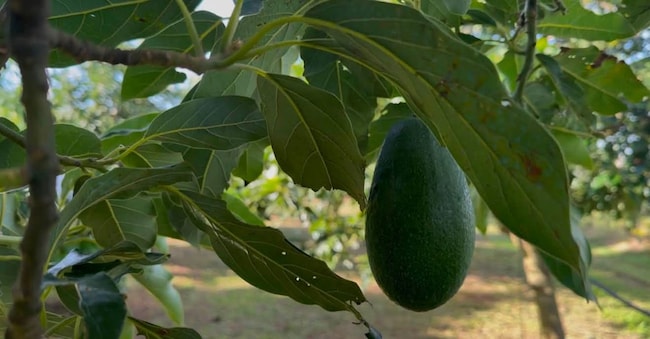
Reinventing oneself in the post-Xylella era, including with avocados grown in Puglia, as at the Tommasi farm, in the countryside around Calimera, in the province of Lecce. Just 2 hectares are already in production, alongside another 78 hectares of olive groves – all of which were destroyed by Xylella and have all been replanted with ‘Leccina’ and ‘Favolosa’, the two cultivars resistant to the bacterium. Tommasi began today the harvest of the first avocados of this new season and will continue in this way until February, or even March, because the fruit is harvested as and when needed – even when unripe – and is then left to ripen alongside apples or bananas. Tommasi believed in avocados as far back as nine years ago. He planted the first trees, now around 10 years old, in 2017, and after three years the first 3–4 fruits per tree appeared. Today we’re looking at 70–80, even 100 fruits which Pierangelo Tommasi, aged 60 and part of the second generation, then sells via social media, word of mouth or through a co-marketing initiative: a 5 kg tin of oil, with a promotional box containing 3–4 avocados.
Cultivars adapt to soil and climate conditions
This diversification can be explained by climate change, and the avocado is, in this respect, one of the crops that symbolises this transformation, accompanied by a spread which, in Puglia – where there are now 4,000 hectares under cultivation —is particularly significant in areas affected by Xylella fastidiosa. Consequently, many farms in the Salento region are being prompted to rethink their future production, considering alternative crops capable of adapting to the new soil and climate conditions and offering prospects for income. These tropical plants adapt very well to the habitat of the province of Lecce; so much so that, according to experts at the University of Bari, there are almost 24,000 hectares of land potentially suitable for cultivation in the areas destroyed by Xylella. The cultivable varieties range from Hass and Bacon to Fuerte, and the potential for profitability is such that Tommasi decided, last April, to plant over 700 trees – using the Ettinger variety as a pollinator – all younger than those planted in 2017, standing roughly one metre tall and including late-season varieties capable of bearing fruit as late as May.
A few simple tips, plenty of benefits
“These are plants,” says Tommasi, “that bring great satisfaction: after eight to ten years, they can produce as many as a hundred fruits per tree, with a yield per hectare of 10 quintals, depending on their size.” Avocado trees have no particular requirements: plenty of water, a minimum of fertiliser containing potassium, at least until they begin to develop, pesticide treatments when necessary, and low pruning to facilitate manual harvesting. Demand is still modest, linked to healthy and Mediterranean diets, but promising. “Here,” continues Tommasi, “it is not yet very well known as a fruit, but it is certain that mine have a different flavour to those that come from Ecuador or Peru.”
Curbing dependence on foreign imports
The Apulian avocado ‘can meet the demand’, says Costantino Carparelli, president of Coldiretti Lecce – “can meet this demand for tropical fruit with a product harvested close to where it is consumed, which reduces dependence on foreign imports”. It remains necessary to support farmers through research, experimentation and technical assistance’.

