
The primal power of Arnaldo Pomodoro’s mark
Until 18 October at the Gallerie d’Italia in Milan, an extraordinary exhibition tracing over sixty years of the artist’s life

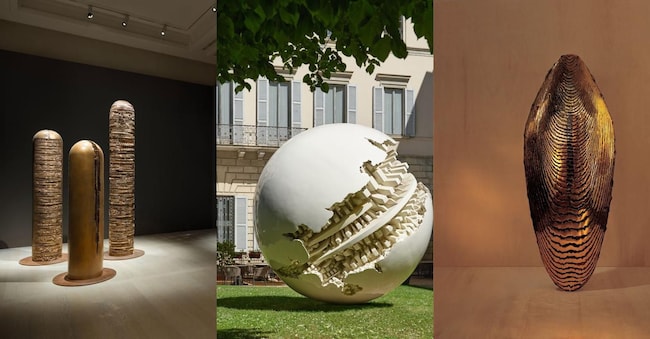
To mark the centenary of his birth, the Gallerie d’Italia in Milan trace Arnaldo Pomodoro’s remarkable artistic journey, bringing together the sculptor’s most famous works in an exhibition that spans the spectrum from minimalism to the archaic. The exhibition begins in the Salone Scala with a large platform filled with sculptures in white fibreglass, a material which, thanks to its ethereal lightness, lends itself well to a dialogue with the surroundings, which are rich in decorative elements.
Pomodoro admires Brancusi, who blends past experiences with modernity, and Fontana’s metaphysical and intimate *Attese*: a prelude to his unmistakable metaphorical style. In the six galleries overlooking the Central Hall, the exhibition traces the key moments of Pomodoro’s artistic career: from his early years in Milan in the 1950s, with a selection of bas-reliefs made from earthly or alchemical materials such as silver, lead, tin, copper, brass, iron and bronze. The artist draws inspiration from Paul Klee’s lyrical abstraction and skilfully works these materials through welding, casting, scratching, drilling and engraving. Moving on from ideas drawn from nature, the exhibition turns to the three-dimensional forms of Euclidean solids – the cylinder, cube and sphere – from the first half of the 1960s: a clear example of this is La Ruota (1961), born from the artist’s vision of an Aztec calendar during a trip to Mexico. Tears that open like skilfully concealed wounds, reliefs that reveal themselves as ancient treasure chests, opening up spaces within the material rather than occupying them. Pomodoro, starting with pieces of weathered redwood, uses his sculptures to convey the most complex and daring nuances of the human soul, offering the visitor an intimate existentialist glimpse: “I am constantly stealing from nature; it offers me incredible inspiration. A sphere, a column, are pierced, corroded as if by a termite, but this termite is me […] I have created these crevices”. By creating perfect solids, with a smooth, reflective surface—symbols of the absolute—the artist delights in tearing them apart and corroding them, as if to reveal their internal fragmentation: mysterious, living mechanisms. The cylinder is, in fact, more properly a wheel, an instrument of technical and scientific progress; the column, a classical symbol of power; the cube, of order and stability; the sphere, a reminder of the womb and the earth in a magical and cosmic dimension.
“The sphere is more successful because it represents the world: a world that proliferates”. As in Jeff Koons’ works, the mirrored surface brings the visitor into contact with their own reflection and everything around them, in a continuous dialogue. A marvel of opposites, the exhibition features a group of works spanning the 1960s and 1970s: Il Rotante and Forma X: two complementary sculptures, in a vital interplay of contrast between full and empty. Of particular note are the Papiri, created between the 1980s and 1990s, inspired by his travels in Egypt: the sheet expands and curves, reaching out into space, expressing the inestimable need for memory. Also worthy of note is the Continuum (2010), a surface covered in handwriting, a sort of infinite ‘Matrix-style’ trace of Pomodoro’s writing, alongside the three Columns, massive and imposing like totems, postmodern versions of funerary stelae and Egyptian obelisks. In a contrast between the perfect smoothness of the form and the hidden complexity of the interior, the exhibition concludes with the Desert Rose-shaped Disc No. 1 (1993–1994) in the Octagonal Cloister, a metaphor for the arduous yet unstoppable principle of germination in the mineral world. “The ‘lighter’ part is the one that is reflected, but what remains in your hand is the erosion that you can make out. And it unsettles you.”
“Arnaldo Pomodoro. A Life”, Gallerie d’Italia (Milan), until 18 October

