AI transition 2024

The production system at the challenge of digital transition

The business front. A Kpmg survey has highlighted the distance between Italian and foreign companies in their orientation towards hi-tech systems. The models of Leonardo and Danieli

by Luca Benecchi

4' min read

4' min read

'The artificial intelligence revolution in Italian companies is not easy. Let's think,' explains Marco Taisch of the Milan Polytechnic, 'of the characteristics of our companies. They were born between the 1970s and 1990s, small in size with entrepreneurs at the head who made their choices in the first person, with a large dose of intuition and let's say a very high emotional capacity. Well, after the successes they have had, how is it possible to think that in a short time they can entrust their strategies to peripheral structures that interpret data management?".

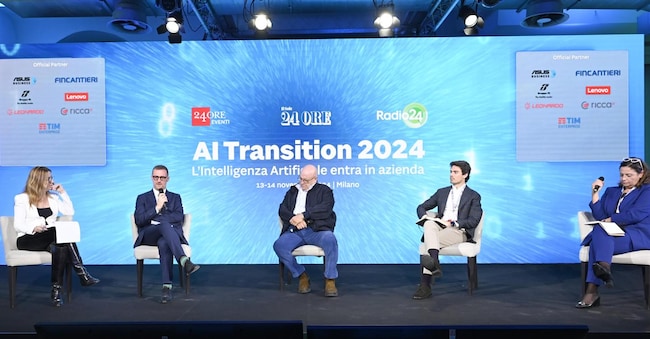
Indeed, in some ways, it is a true Copernican revolution that was under the lens of the first day of AI Transition, Artificial Intelligence enters the enterprise, a meeting organised in Milan by Sole24Ore.

Loading...

If there is one thing that divides the approach of Italian companies from foreign ones, it is precisely that of artificial intelligence. According to research by Kpmg, in fact, Italian CEOs think that its use can primarily improve efficiency and productivity and therefore costs, while Carmelo Mariano (Kpmg) explains that 'for foreign companies, the emphasis is mainly on the ability to improve the product, the process and customer service'.

During the meeting, moderated by RAI journalist Barbara Carfagna, it emerged that for Made in Italy the challenge is above all that of internal efficiency, despite the fact that there is still a great lack of infrastructure. "The primary need is therefore to change organisational models, also due to the fact," explained Alberto Bazzi of Minsait Italia, "that the centrality of calculation and the reading of results inevitably leads to the creation of different decision-making processes, which can be defined as peripheral with respect to the traditional core of the company.

However, it remains decisive, according to Massimo Chiriatti of Lenovo, that companies remain focused on business: 'To start with artificial intelligence as if it were a must is profoundly mistaken, the technological priority risks blocking the system while instead it must remain an aid and facilitator to the company's engine'.

One figure, however, is decisive for understanding the scale of what is happening. As early as 2030, it is estimated that 25 per cent of the gross domestic product will be determined by the further development of this technology. In this, it is clear that Italy on the foundations of data calculation models is certainly lagging behind, but, explains Nicola Gatti of the Politecnico di Milano, 'this does not mean that there is not great scope for making the models we use adaptable in an almost tailor-made manner, while at the same time needing to be interpreted and dropped into different realities'.

According to Chiriatti, this is a great opportunity for the made-in-Italy industry to implement productivity and save time on the lines, also because artificial intelligence is increasingly affordable and easy to use.

Certainly, Italy at system level is still far behind. 'We are a long way off,' Gatti goes on to explain, 'from the big investments of the American big tech companies that have hired the great researchers from scientific universities, or from Canada, which has created an integrated development centre with small companies. Our government has put NRP funds on the table 'but with every change of executive, development policies change, making them uncertain and weak'.

This ballast is all the heavier when one considers that, according to American forecasts, artificial intelligence has technological growth margins that extend the research spectrum for at least the next fifty years.

Someone then does not rule out the hypothesis that this artificial intelligence could be a bubble ready to burst. After all, while huge investments are calculated at 600 billion, what we can call revenues are around 200 billion. A delta that can only be filled if entrepreneurs increase their demand.

And if the small ones struggle, it is the big companies that have made the first steps forward.

This is the case, for example, for Leonardo, which decided to build its own supercomputer for data management instead of outsourcing. Michele Ippolito recounted how in this way it was possible to completely digitally redesign the fuselage of the Atr aircraft, "a successful model but dating back to the 1980s, which in this way was able to be reborn thanks to the latest technologies. Especially in a very sensitive sector like aeronautics, the possibility of creating a digital twin of the product made it possible to raise the safety bar decisively'.

Another case study is Danieli: the company that produces machines and lines for steel processing inaugurated not more than a year ago a production platform entirely managed by machine learning in all its functions, without the use of manpower. 'It is a mini scrap steel mill,' explains Anna Mareschi Danieli, 'powered by an electric furnace that is capable of autonomously separating materials, crushing them, and managing the heat and cooling chain. And all this is already a reality in Italy, near Udine'.

Copyright reserved ©
Loading...

Brand connect

Loading...

Newsletter

Notizie e approfondimenti sugli avvenimenti politici, economici e finanziari.

Iscriviti