
The ‘Progetto Sud’ initiative on internationalisation is launched at the Puglia Boat Show
Meo (President of SNIM): “The other issues covered by the plan are tourist ports, sustainability and skills development”

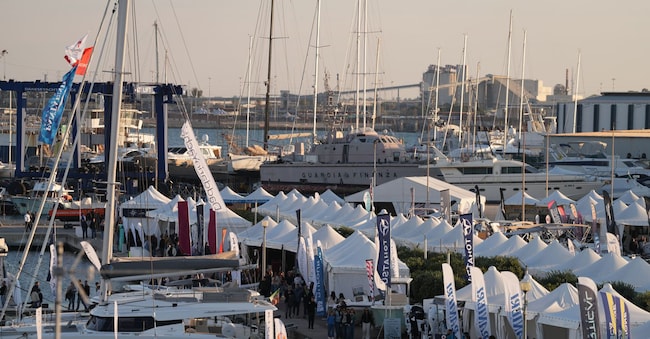
A project for the southern Italian boating sector focusing on ‘internationalisation, tourist marinas, sustainability and skills development’. These are the topics that will be addressed, one by one, during SNIM, the 2026 Puglia Boat Show, which opens today at Marina di Brindisi and will run until 26 October; Giuseppe Meo, president of SNIM, outlines the key points that will form the core of the plan and will be presented during the Forum of Southern Italy’s Nautical Enterprises, to be held on 23 October.
The 22nd edition of the boat show features 180 exhibitors and over 300 boats spread across 20,000 square metres. And Meo’s reflections are based on very concrete industry figures: ‘The South has shipyards and expertise that must be allowed to grow. According to the report The Boating Industry in Figures by Confindustria Nautica, Puglia has 69 port facilities and over 11,000 berths. The 14th National Report on the Maritime Economy 2026, compiled by the Tagliacarne Research Centre–Unioncamere and OsserMare, also confirms the central role of the South in the maritime economy: it generates 34.2 per cent of the sector’s direct national added value, amounting to approximately 27 billion euros, and accounts for 39.9 per cent of employment, that is, over 452,000 workers’.
Southern Italia, Meo continues, “plays a truly significant role in the shipbuilding industry: it mainly produces boats up to 15 metres in length, what is known as ‘small craft’.” It should be noted, however, that production of this type of vessel accounts for 80 per cent of the national total. And it is concentrated precisely in Puglia, Calabria, Campania and Sicily. Hence the idea of launching the ‘Progetto Sud’, because in the South today we have the conditions to further grow the sector, should we ever manage to improve the regulations governing the construction and expansion of marinas, the creation of dry docks, as well as the possibility of attracting significant investment. Not to mention that we are, in any case, Special Economic Zones (SEZs) and offer significant funding opportunities for those wishing to locate their production here. Furthermore, at such a delicate time on the international stage, the South represents a key platform at the heart of the Mediterranean.’
As regards the key themes of the Progetto Sud, Meo continues, ‘a key focus is the internationalisation of businesses. The idea is to find ways to enable our companies to compete more effectively in international markets. All the major trade fairs are held in northern Italia or elsewhere in Europe: the cost of transporting vessels from the South is more than three times higher than that incurred by any other national operator. Unfortunately, boats need to be exhibited, and our small-scale manufacturers – who produce vessels up to 15 metres in length – face significant financial difficulties in getting them to these events. We therefore intend to try to bring our concerns to the attention of national authorities, with the aim of finding support measures for businesses in the South – including for the transport of vessels – through government initiatives and the chambers of commerce.”
On the subject of tourist ports, Meo adds, “As regards the Southern Project, I’ll refer just to my own region: we have 900 kilometres of coastline and I believe we can be an important base for yacht charter. On the other hand, on the Adriatic side, we share borders with countries that have now significantly stepped up their game when it comes to nautical tourism. I am referring to Croatia, Montenegro, Greece and Turkey, but also to Albania’.


