
The province of Trento is looking ahead to 2040 with GDP set to grow by 40 per cent
The ‘Trentino 2040’ document has been presented, setting out prospects for economic and industrial development to make the region more competitive and sustainable and to attract talent. Vice-President Spinelli said: “We want to steer the changes currently taking place, not simply be at their mercy.”


At a time when politics has been reduced to setting the agenda for the very next day, as summarised by Franco Bernabé, President of the University of Trento, Trentino is looking ahead with ‘a very bold initiative’, just as it did ‘in the 1970s and 1980s, periods of greater stability in the geopolitical context’. The work in question is a document that is concise in its drafting but substantial in its content: ‘Trentino 2040: Prospects for Economic and Industrial Development’. It was presented yesterday by Achille Spinelli, Vice-President of the Autonomous Province of Trento and Councillor for Economic Development, Employment, Family, Universities and Research, in the Sala Depero of the Provincial Palace.
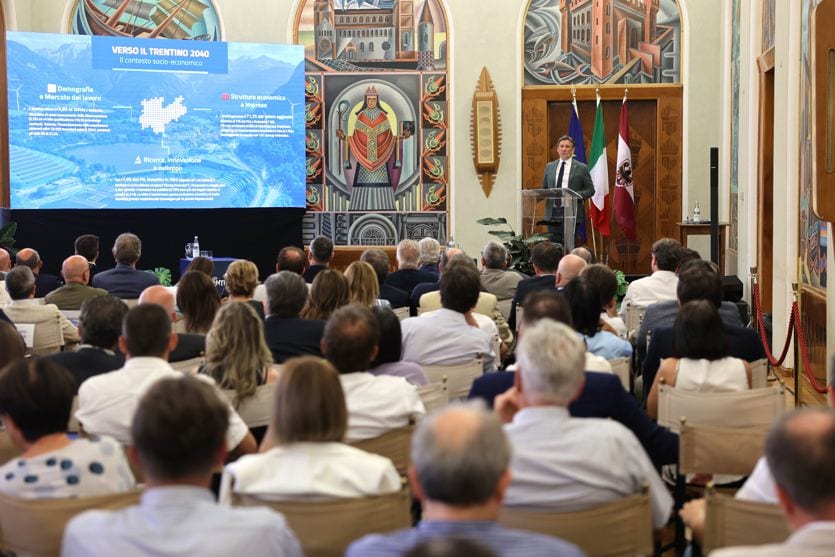
‘We are faced with two paths,’ argues Spinelli. ‘The first is one of waiting, which leads to decline. The second is more challenging: it means deciding today what we want to be in 15 years’ time, and taking responsibility for those choices. This is precisely what Trentino 2040 is all about: the public sector promotes and plans, but the real drivers of development are citizens, businesses and the social partners.” We,” continues Spinelli, “have chosen ‘to lead change, not to be subject to it. The long-term nature of our document is a political choice through which we wish to look to the future.’ In a very pragmatic way, so much so that one of the distinctive features of the document – which was also driven by the business community and social partners – lies precisely in the quantification – and therefore measurability – of the objectives. Let’s look at a few of them. The province’s GDP, which currently stands at around 27 billion euros, is set to grow by 40 per cent by 2040, whilst value added per employee is set to rise by 30 per cent. The wage gap is to be reduced by 20 per cent and average per capita income will increase by 20 per cent. Furthermore, attracting talent will also involve an incentive commensurate with the personal income tax (IRPEF) generated by the worker. The implementation of the Plan will be supported by a dedicated steering group and a monitoring system based on performance indicators, alongside the ‘Valley Roadshows’ – regional meetings to assess progress towards the objectives over time.
The document sets out the major contemporary transitions across the region – from energy to digitalisation and generational change – transforming the Autonomous Region into a permanent laboratory for change. Spinelli emphasised how strongly the region had sought special autonomy, but also that ‘autonomy, if one merely defends it, becomes outdated’. Hence the strongly innovative and forward-looking impetus of Trentino 2040. This also echoes that of the University, as described by Bernabé: ‘We are undertaking significant work to contribute to the realisation of the region’s development strategies in the scientific and technological fields’. In particular, with regard to artificial intelligence, Bernabé suggests taking advantage of “the opportunities offered by the new European directive on cloud computing and artificial intelligence to develop a more sustainable model for the dissemination of technology within the economic and social system”.
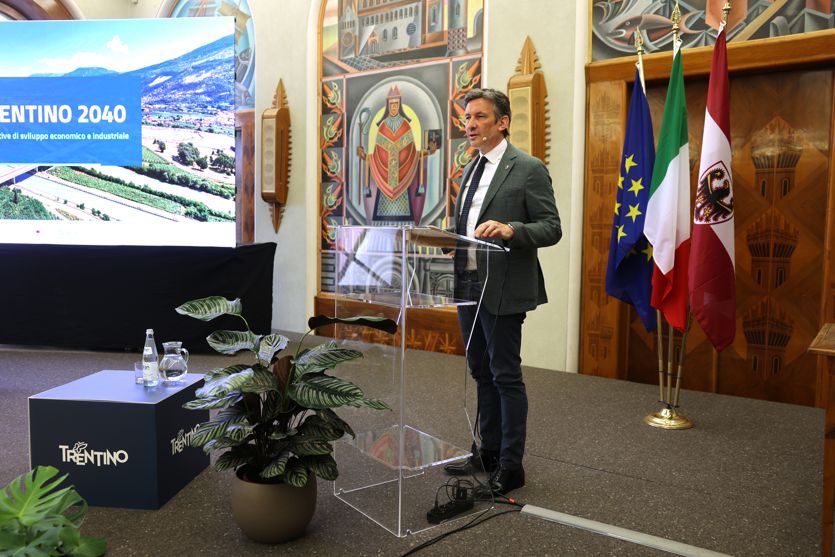
As an innovative region, Trentino will increase investment in research and development to 3 per cent of GDP, predominantly from private sources; the number of innovative start-ups is set to rise by 20 per cent, as is the number of patents filed. In this regard, Francesca Failoni, co-founder of Alps Blockchain, speaks of the need ‘to link social and environmental sustainability with entrepreneurial innovation that leads to greater development’. However, none of this will be possible without viewing the credit system as a partner, given the target of a 30 per cent increase in the volume of investment loans granted by the local banking system to support the technological and green transition of SMEs. A number of instruments will be created, such as the Trentino-Alto Adige Strategic Fund, co-financing schemes through Trentino Sviluppo, and agreements with the banking sector and Confidi to support projects relating to energy and technological transition, as well as generational succession. The credit roundtable will be relaunched and cooperation agreements with the insurance sector will be drawn up. According to Giorgio Fracalossi, president of Cassa Centrale Banca-Credito Cooperativo and of Banca per il Trentino-Alto Adige, ‘in this development plan, in which the credit sector will increasingly play an advisory role within a complex supply chain bringing together many stakeholders, we must ensure that growth benefits everyone, from citizens to businesses’.

