
The quantum computer that uses light: the challenge facing a start-up from Latina in collaboration with Sapienza University
QuantHum Edge is developing a modular architecture based on polaritons, with the aim of scaling up to 9,936 qubits.

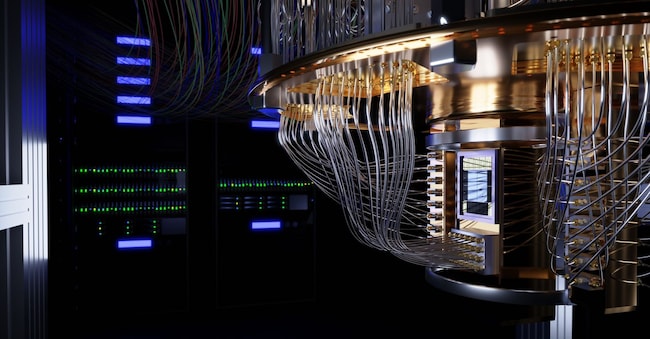
A quantum technology based on light trapped on a chip, developed in Cisterna di Latina. This is the project being undertaken by QuantHum Edge, a deep-tech start-up from the Pontine area that is collaborating with Sapienza University’s research centre based in Latina (Ce.R.S.I.Te.S.). The agreement covers research, simulations and technical validation.
The main programme, Noesis, utilises polaritons – hybrid light-matter quasiparticles confined within integrated photonic cavities. The architecture is modular: 108 qubits per module and up to 92 modules, giving a total of 9,936 qubits in the maximum configuration. The data are derived from over 1,560 simulations carried out using Comsol and QuTiP software, which the company describes as ‘virtual lab evidence’.
Two-qubit operations take 3–3.3 nanoseconds, with the aim of reducing this to 1.2–1.4. The estimated fidelity is 99.86–99.90 per cent, with a target of 99.985–99.995 per cent. The throughput per module is expected to rise from 5.5–7 to 18 billion operations per second. The next step is the first physical module, the Dev-Tile, followed by a pilot prototype and a rack-mounted configuration.
Alongside NOESIS, the company is pursuing two projects. sAIpiens is a research programme into hybrid artificial intelligence that combines classical, neuromorphic and quantum processors. L.I.S.A. is a proposal for a technology hub comprising Quantum Park, AI Park and Energy & Mobility Park at the former nuclear power station in Latina, which has been owned by Sogin since 1999 and is currently being decommissioned.

