The race continues: from ski slopes to art galleries
Athletic performance is a metaphor for the contemporary. From Jeff Koons to Paul Pfeiffer, its representation enters the most quoted galleries and at auctions it smashes the odds.

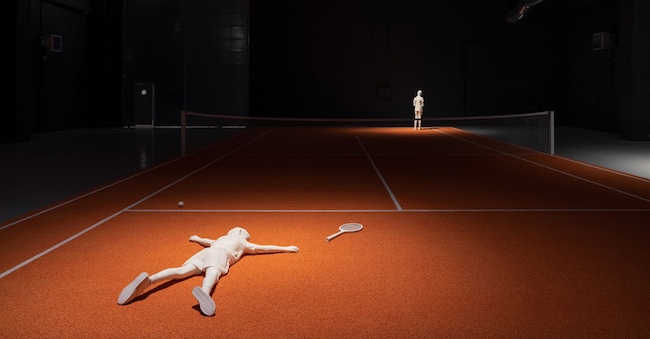
Since antiquity, sport has been a subject for artists. However, it has never been an end in itself, but rather a pretext to explore what lies beyond: the aesthetics of the body in motion, dramatic tension, the ideology of an era, the values of a society. From the Greek athlete, semi-divine hero, to the contemporary athlete, global icon and commercial product, art has narrated the evolution of our relationship with the body, competition and its spectacularisation.
Today, in the wake of major sporting events such as the Winter Olympics Milan Cortina and the Football World Cup next summer in Mexico - but it has already been perceived with the Games in Paris in 2024 -, sport has once again become a hot topic in artistic production, exhibitions and also on the market. Prague even saw the birth of the Sport in Art platform completely dedicated to this dialogue, with an online marketplace for collectors with affordable works, and a dozen physical exhibitions organised from 2017 to date.
Last summer, the auction house Sotheby's also dedicated a selling exhibition to portraits of basketball players by Los Angeles-based artist Julian Pace, born in 1988: large paintings depicting basketball icons, from Larry Bird to Kobe Bryant, in a monumental manner, but at the same time deeply intimate, bringing out the man behind the celebrity.
If, historically, sport has been interpreted by artists as a metaphor for dynamism and the modern world, the perspective has changed in contemporary art. As the great ideals and triumphant narratives have collapsed, artists have treated the sporting theme with a more rigorous gaze, tackling issues of identity, inequality, consumerism and the environment. This is the case, for example, with the White Out exhibition, now at the Triennale, which looks at winter sports in the context of the climate crisis, exploring the relationship between sporting practices, design and innovation.
Basketball, especially in the USA, has always been a way for artists to talk about issues of identity, to tell stories of racial and class barriers. David Hammons, for example, born in 1943, now widely recognised and represented by prestigious galleries such as Hauser & Wirth and White Cube, has repeatedly used basketball to express the country's fascination with the sport and the aspirations associated with it of young Americans of Afro-descent. As early as 1986, his work Higher Goals, installed in Brooklyn and Harlem parks, consisted of nine-metre high poles with unreachable hoops on top. In a later work, Untitled (2000), he made a crystal basket out of pieces of a Baroque candelabra. Luxury tycoon François Pinault, who is an avid collector of his, owns a version, which he exhibited at Punta della Dogana in Venice, while another was sold by Phillips in 2013 in New York for $8 million, setting a record. In the series of works entitled Basketball Drawings, on the other hand, the artist dribbled a dirty ball on a sheet of paper, elevating the sporting gesture to the status of a work of art (at Christie's in 2017, one of these works realised $1.3 million, starting from an auction base of $1-1.5 million. More recently, in 2021, another smaller one realised $750,000 against an estimate of $500-700,000).