
Seurat's radiant seascapes at the Courtauld Gallery
The exhibition 'Seurat and the Sea' can be visited in London until 17 May

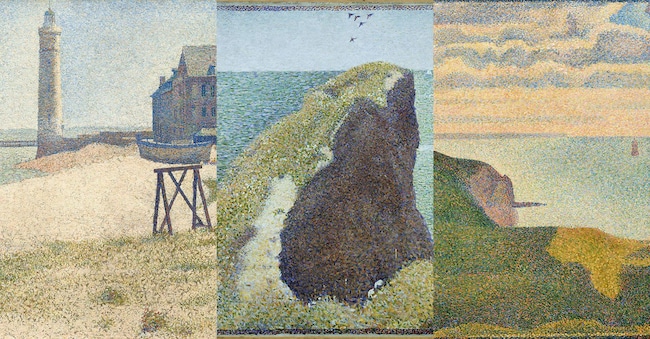
The first exhibition ever devoted to Georges Seurat's seascapes was organised by the Courtauld Gallery, which brought together 26 works, the same works that the French artist had chosen for display at the Salon des Indépendants in Paris shortly before his death at the age of 31 in 1891.
Seurat, known as the inventor of Neo-Impressionism for his technique of painting using dots of pure colour that then blend and 'dance' in front of the viewer's eyes, is famous for his scenes of Parisian interiors such as Le Chahut. Every summer, however, the artist left the capital for the northern French coast to "cleanse his eyes of the days spent in the studio and translate as faithfully as possible the brilliance of light in all its nuances."
Here, in Honfleur and Port-en-Bessin, Le Crotoy and Gravelines, Seurat worked in the open air, exploring coastlines, harbours and seascapes at different times of day and in different weather conditions, without the presence of man, only hinted at by the occasional sailboat on the horizon or a lonely lighthouse. On his return, he would transfer the sketches he made on wooden boards in his travelling colour box onto large canvases which he would then complete in his studio in Paris, often dot-painting the frames as well.
Each landscape was an opportunity to experiment with brushstrokes and colour, progressively refining his technique inspired by the 'optical fusion' described by Charles Blanc in his 1867 treatise 'The Grammar of Painting', studying the positioning of dots of pure colour to accentuate their vividness and brilliance by placing them next to complementary colours.
Chromoluminarism
Seurat considered the term 'pointillism' to be reductive and coined the word 'chromoluminarism' to define his punctilious technique and his continuous search for a new way of painting and portraying nature. Seawater, beaches, bays, rocks, in the iridescent northern light, were ideal subjects for his experiments with colour and atmosphere, which created contemplative and radiant landscapes.

