Rome

The Rebirth of the Comet Theatre

The institution returned to the city thanks to the efforts of Maria Grazia Chiuri and the Nicola Bulgari Foundation

by Maria Laudiero

3' min read

Translated by AI
Versione italiana

3' min read

Translated by AI
Versione italiana

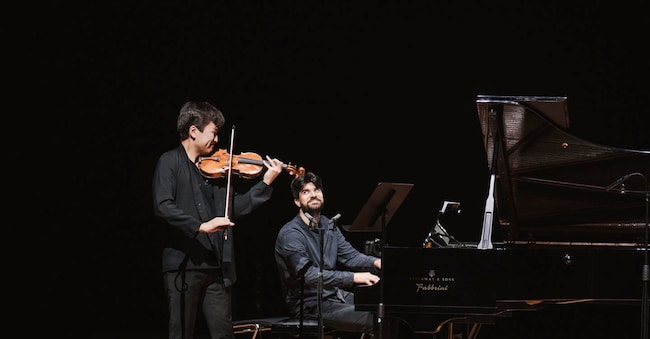
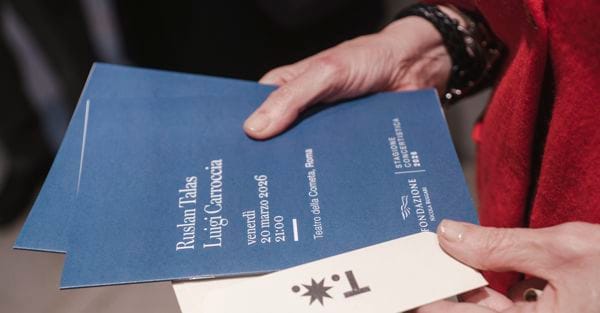
There are concerts that begin as isolated events, and others that are part of a broader cultural moment. Ruslan Talas and Luigi Carroccia's performance clearly fits into the second dimension: not only for its refined programme, but also for the context in which it takes shape, that of the rebirth of the Teatro della Cometa, returned to the city thanks to the commitment of Maria Grazia Chiuri and the projects of the Nicola Bulgari Foundation, of which the two young performers are artists in residence.

A programme as a poetic statement

The proposed programme - a French triptych from the late 19th and early 20th century - traces an aesthetic arc of great coherence: from the lyrical and symbolist tension of Ernest Chausson, through the impressionist ambiguity of Claude Debussy, to the cyclic and romantic fullness of César Franck. A journey that requires not only technique, but above all a refined stylistic intelligence from the performers.

Loading...

The willingness to perform this repertoire is not a neutral choice but a declaration of intent: to privilege finesse over impact, timbre research over spectacularity.
A suspended start: Chausson

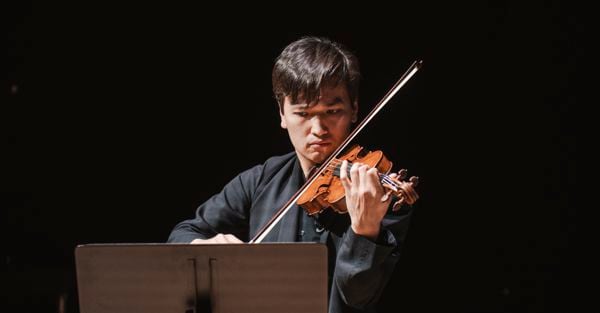
In Ernest Chausson's Poème op. 25, Talas constructs a sound that seems to arise from the very space of the theatre. There is no sharp attack, but a progressive emergence dictated by an inner distance, almost a sonic awareness. The phrasing avoids any formal rigidity, adhering to the fluid nature of the piece. His violin never seeks brilliant effect; rather, it builds a soft narrative arc, made up of transitions rather than contrasts. The phrasing is continuous, but never uniform: it ripples, retreats, starts again. In this sense, the reading avoids the temptation - always lurking in this piece - to turn lyricism into declamation.

Carroccia, for his part, does not 'follow' the violin: he surrounds it. The piano becomes an environment, working by subtraction, creating a harmonic terrain on which the violin moves freely. Contributing, in this way, to creating that suspended dimension that makes the piece something more than just a concert page.
Debussy: fragments and restlessness

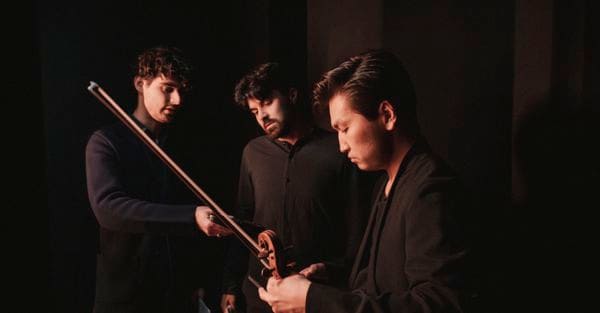
With Debussy's Sonata in G minor, the language changes radically. Here the form breaks up, the musical gestures become brief, allusive, almost sudden. It is music that lives of breaths, of silences, of subtle tensions.

Talas shows a remarkable ability to lighten the sound: his violin becomes drier, less vibrato, adhering to that typically Debussy 'anti-rhetorical' aesthetic. The pizzicati and attacks are sharp, never decorative.

Carroccia, for his part, shows particular sensitivity in the control of dynamics: the piano never invades the space, but builds a network of colours that supports and at the same time destabilises the violin's speech.

The result is a convincing reading, especially in the more fragmented movements, where an almost nervous tension emerges, well in line with the latest Debussy.

Franck: building in time

César Franck's Sonata in A major requires a different perspective: colour is not enough here, an overall vision is needed. It is music that grows, returns, transforms.

Talas approaches the first movement with a broad but controlled chant, avoiding overloading the discourse from the outset. The line is clear, well-designed, and above all coherent throughout the entire span of the sonata.

The second movement tests the duo's balance: the piano has dense, almost orchestral writing, and Carroccia tackles it with energy without ever becoming invasive. The dialogue works precisely because neither tries to prevail: it is a confrontation, not a competition.

The most interesting moment comes in the Recitativo-Fantasia: here the two seem to abandon all formal rigidity and find a freer, almost improvised space. Time dilates, phrases are suspended, and for a few minutes the music stops being structure to become pure expressive gesture.

The finale, bright and built on imitative dialogue, is resolved with elegance and clarity

What strikes one, in the end, is not so much the virtuosity - although present - as the quality of mutual listening. Talas and Carroccia build a coherent path, avoiding too marked contrasts and favouring an expressive continuity that links the three pieces.

Copyright reserved ©
Loading...

Brand connect

Loading...

Newsletter

Notizie e approfondimenti sugli avvenimenti politici, economici e finanziari.

Iscriviti