
The Reconstructed Gospel of Mark
After 700 years, the 6th-century manuscripts, preserved in Cividale, Venice and Prague, have been brought together. The exhibition explores the theme of the saint’s presence in Friuli

---U08687541275LPP-1440x752@IlSole24Ore-Web.jpg?r=650x341)
Tomorrow, and on each of the next six Mondays, before Palazzo Meizlik opens its doors to visitors, an expert conservator will be tasked with turning a page – just one – of the two original manuscripts featured in the exhibition ‘The Gospel of Mark. Seven Centuries. Three Fragments. A European Tale’, curated by Martina Dlabajová, Cristiano Tiussi and Luca Villa. These parchments are so delicate that they require special care, dim lighting and a constant temperature. Aquileia throws open its doors to Europe, just as it did when, under the Roman Empire, it was a wealthy and multi-ethnic capital of the world, with an exhibition that, for the first time in seven centuries, reunites the three parts of the Gospel of St Mark, which originated in Friuli and are now preserved in Cividale, Venice and Prague.
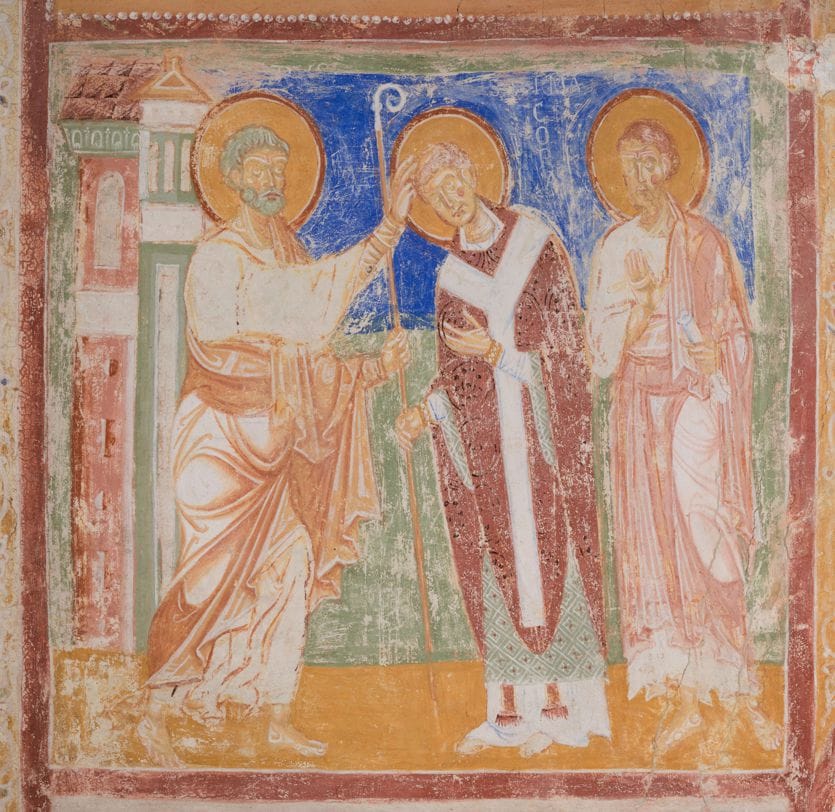
Following a long process of cultural diplomacy, a history spanning over a thousand years – one of faith, journeys and vicissitudes – has been pieced back together. Towards the middle of the 9th century, probably under Patriarch Theodemar (851–872), who signed it, a 6th-century codex from the Ravenna area arrived in Aquileia: it contained the four Gospels and served as the Gospel book in liturgical ceremonies. Then, between the 12th and 13th centuries, the Book of Mark – comprising seven folios – was extracted from the Codex Forojuliensis, or the Forogiulian Gospel Book, now preserved at the Archaeological Museum of Cividale and containing the other three Gospels – those of Matthew, Luke and John, in the Latin version of St Jerome’s Vulgate. And the oldest inventory of the Patriarchal Treasury of Aquileia, dating from 1300, opens with the ‘liber beati Marci evangeliste, quem propria manu scripsit’: forty leaves bound in gilded silver plates, though the autograph is a forgery. Why did this fragmentation occur? Because, in the splendid civitas of late antiquity, which had embraced Christianity in the years following the Edict of Constantine (313 AD), the name of Mark was now widely renowned; according to legend, he had landed at Aquileia to evangelise the people. Patriarch Paulinus of Aquileia (8th century) writes, in his work De sancto Marco evangelista: ‘And so, sent by the blessed Peter, (Mark) arrived in the city of Aquileia, long renowned. He planted the sprouting seeds of the sacred word … There, he soon dedicated a church to Christ … on foundations solid in the faith’. For this reason, the Gospel of Mark was treasured as a precious relic and, in 1354, King Charles IV of Bohemia, whilst passing through Friuli on his way to Rome to receive the imperial crown, requested and obtained from his half-brother Nicholas of Luxembourg, then Patriarch of Aquileia, two volumes of the Gospel for St Vitus Cathedral in Prague. Those parchments, which survived a fire in 1420, are catalogued as ‘CIM1’, the most important artefact in the Czech Republic. And they are now in Aquileia, together with the Codex Forojuliensis and the silver cover of the five scrolls which, in 1420, the Most Serene Republic, having conquered the Patriarchate of Aquileia, appropriated as war booty to display them in St Mark’s Basilica alongside the remains of the evangelist and to reinforce the path towards the establishment of the Venetian metropolitan see: ‘(It is) right, as well as an act of piety and devotion, that this book should return to the one who wrote and copied it,’ wrote Doge Tommaso Mocenigo at the time. In short, politics was conducted in the name of faith. However, the manuscript was subsequently not properly cared for and has deteriorated due to centuries of damp, until it was reduced to the fragments we see today.
It is worth noting another aspect of the manuscript: from the 9th to the 10th century, prior to its dismemberment, the Gospel Book had taken on the role of Liber Vitae or Book of the Living, containing over 1,500 names of people – still clearly legible today – from Alemannia to Bavaria, from Pannonia to Moravia, from Croatia to Byzantium.
For conservation reasons, the originals of the Codex Forojuliensis, the Prague manuscripts and the Venetian cover will only be on display for the first six weeks (and will then be replaced by high-definition copies until 25 April 2027), this in no way detracts from the value of the exhibition, which examines St Mark’s presence in Aquileia, the development of the Patriarchate of Aquileia – which was far more than a religious institution – and the network of faith that spread from Friuli throughout Eastern Europe.
There are no direct sources that provide definitive evidence of Mark’s (7/67–72 AD) visit to Friuli. ‘The connection falls within the ideal, theological and symbolic rather than historical sphere,’ writes Luca Villa in the catalogue. ‘This does not mean it is any less important – quite the contrary’ – and links can be found between early Christianity in Aquileia and Alexandria in Egypt, where the evangelist had died. According to some, the legend of Mark originated in the late 6th century, at a time when Aquileia was demonstrating a desire for autonomy; according to others, the date should be pushed back to the late 8th–early 9th century. The subject is vast and complex, but Mark features once again in the conflict over issues of primacy and jurisdiction between Aquileia and Grado, in which the supremacy of the See of Aquileia is recognised partly thanks to the tradition of its Marcian origin. Other elements relating to St Mark: in the Cathedral of St Euphemia in Grado, there was a place of worship dedicated to the saint (fragments of the entablature can be seen in the exhibition); from the Chair of St Mark, mentioned in 827, the eight ivory panels—dating from the 7th century and of Alexandrian origin—have come from the Castello Sforzesco in Milan.


