

The Rhine is vital for the EU, but it is not enough. We need the Mediterranean
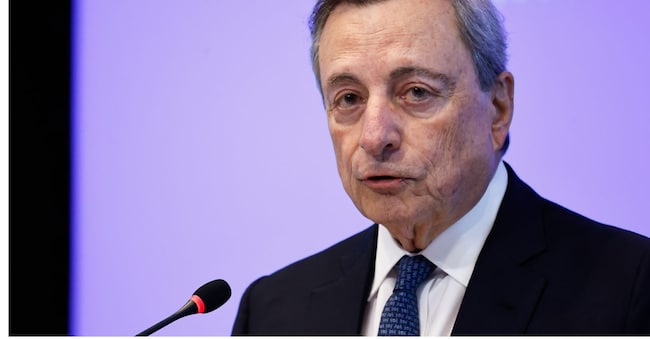
Mario Draghi and Patrick Collison have announced the Rhine Group, a forum for revitalisation. This is a vital initiative. The names, however, are significant: the initiative takes its name from the River Rhine and what the region represents in economic terms. Let us remember that the Mare Nostrum is not some kind of ‘soul supplement’ to be granted to the South for the sake of political balance, but a factor in competitiveness. In the world to come, trust will be the scarcest form of infrastructure. And trust is not generated on a large scale, but through relationships

Key points
The Rhine has its source in a glacier and flows into a delta. In between, over a distance of 1,300 kilometres, flows the Europe we have come to recognise: the locks at Basel, the steelworks of the Ruhr, the refineries at Ludwigshafen, the cranes at Rotterdam. It is a river that works. And around which people work. Hard and well. No other waterway in the world carries so much cargo, and no other has seen so much history settle upon its banks. Hölderlin dedicated a hymn to it, Wagner sank some cursed gold into it, and two nations fought over it for a century before deciding, in 1951, that the coal and steel of its valleys would become the raw materials not of war but of a community. The initiative that Mario Draghi and Patrick Collison have just announced takes its name from that river: the Rhine Group, a forum bringing together economists, entrepreneurs, academics and institutional leaders, with Luis Garicano as its executive director, and with an objective that deserves to be embraced and supported unreservedly. Namely: to move from analysis to implementation, transforming the vision of the Draghi Agenda into operational actions.
A name, a meaning
It must be said straight away, and without diplomatic circumspection: it was necessary. The Report on European Competitiveness by Mario Draghi has been the only document in recent years to have had the courage to tell Europe the truth about its decline. And to point it in a clear, precise, inspiring and forward-looking direction. I have always supported, even publicly, President Draghi’s proposal, whenever I have had the opportunity. And I continue to support it. Precisely for this reason, I would like to raise a point. It concerns the name. The Rhine is not Europe. It is a part of Europe. Calling it Rhine means referring to the Carolingian axis, the corridor that economists call the ‘blue banana’, the backbone stretching from Basel to the Randstad: the exact perimeter of the Europe of the Six, plus the Dutch delta. It is a deliberate choice, if you like. It indicates where the continent’s critical mass of manufacturing and logistics lies today. Then there is a second connotation, perhaps less visible but certainly more insidious. Since 1991, ‘Rhenish’ has been a term that draws attention to a particular form of capitalism; the ‘Rhine model’, in fact, which Michel Albert contrasted with the neo-American model; the model characterised by banks linked to industry, co-management, patient capital, and the enterprise seen as a community of shared destiny rather than merely the sum of its shareholders. The agenda that the new forum inherits – the integration of capital markets, venture capital, scale-ups, and technology leaders – is largely the agenda that Albert situated on the other side of the Atlantic. The name therefore promises a complex synthesis that the programme will have to prove it can achieve. It would be magnificent if that were to happen. It is by no means a foregone conclusion that it will. And then, however, there is what the name leaves unsaid.
What the name Reno leaves unsaid
And this is where my slight concern lies. Because the name Reno (Rheine) makes no mention of the Danube, that is, the Europe that joined the EU in 2004, the one that today forms the eastern border and pays the highest price for its proximity to war. And, still on this subject, it omits a hydrographic detail that serves as a parable: near Immendingen, during the dry months, the Danube sinks into the limestone and re-emerges kilometres further north, secretly feeding the very basin of the Rhine, which bears no trace of that gift in its name. But, furthermore, the name ‘Rhine’ overlooks the Seine, the Po, the Baltic and the Atlantic arc. But above all – and this is where my regret becomes deepest and most profound – it makes no mention of the Mediterranean, which is, first and foremost, the sea from which the continent literally takes its name, if it is true that Europe is the princess of Tyre carried to Crete: the name ‘Europe’ comes from the South and the East, not from the North. The most serious reason for my reflection, therefore, is of a structural nature. I shall try to explain it using a formula that is dear to me. A river is a corridor: it has a source, a direction, a mouth; it is organised around flow, logistics and efficiency. A sea is a basin: it is plural, reciprocal, has no valley, and no one arrives there first. To name the project for Europe’s future ‘a corridor’ implicitly conveys an idea of Europe as a value chain to be made more efficient, whereas what we need is an idea of Europe as a space for relationships to be regenerated. And corridors, as we know, dry up in times of drought: the Rhine did so in 2018 and 2022, bringing barge traffic to a standstill and, with it, part of German production. Basins do not.
The Mediterranean Proposal
I am not proposing an alternative in opposition. I am proposing, with the deepest respect, a complement without which the industrial core that the Rhine Group rightly oversees will remain incomplete. The Mediterranean is not Europe’s past: it is its oldest place of the future. Not out of archaeological nostalgia, but for a verifiable reason. The mathematical system that made European capitalism possible originated there: Leonardo Fibonacci learnt the Indo-Arabic numerals in Bougie, on the Algerian coast, where his father conducted business on behalf of Pisan merchants, and in 1202 he introduced them to the West through the Liber Abaci. Double-entry bookkeeping originated in the Venetian trading houses and was codified by Luca Pacioli in 1494. Maritime law was drawn up in Amalfi. Medicine was taught in Salerno before anywhere else. Whenever Europe has truly innovated, it has done so because someone had crossed that sea and brought something back from the other side. This still holds true today, and in strictly industrial terms. The Mediterranean is where the undersea cables carrying data between three continents come ashore, where gas pipelines run and where those for hydrogen and renewable electricity will run, and where the African population – which, within a generation, will be the planet’s largest reservoir of talent and demand. A Europe that thinks solely along the Basel–Rotterdam axis optimises an existing heritage. A Europe that also thinks along the North–South axis builds a new heritage. But there is a further, and higher, reason, and that is the nature of the times in which we live. We are in the midst of an epochal shift in which the fate of the future is contested by two hegemonic agendas, both immensely powerful, both convinced that they alone are the realistic option. On the one hand, the American-style capitalist techno-right, an accelerationist movement, convinced that the platform can replace the polis, that the market is sufficient to produce the common good as a by-product, and that any regulatory constraint is, by definition, a hindrance to be removed. On the other hand, there is the Sino-Asian-style state-centred techno-left, which sees technology as the perfect tool for an administered order, the promise of harmony planned from above, and the subordination of the individual to the collective design. They diverge on almost everything. They converge on a single, decisive point: in both, the human person is a dependent variable. And the outcome, achieved by opposing paths, risks being the same: despotic in the explicit form of control, or in the mild and seductive form that Tocqueville described almost two centuries ago, when he envisaged a power that does not tyrannise but infantilises, that does not break people’s will but softens it to the point of rendering it superfluous.
The return of Europe’s central role
In this scenario, Europe will not regain its central role by focusing solely on quantity. Not in the short term: the gap in venture capital, scale, computing power and energy cannot be bridged within a single electoral cycle, and it would be illusory to believe otherwise. But there is an asymmetry that works in our favour, and it concerns quality and vision. Europe possesses – uniquely in the world – a tradition that has conceived of the human person not as a function, but as the measure and limit of power. That tradition has three sources, and all three flow into the same sea. Classical humanism, which is Hellenic and Magna Graecian before it is Florentine: Pythagoras in Croton, Parmenides and Elea, and then the line of thought leading from there to the *Oratio de hominis dignitate*, with which Pico della Mirandola, in 1486, established the modern idea of freedom as the self-determination of the individual. The Judeo-Christian tradition, which in the Church’s social teaching has taken the form of economic thought as well as moral thought, from Rerum novarum to Magnifica humanitas – with which, on 15 May this year – the exact 135th anniversary of Leo XIII’s encyclical – Pope Leo XIV made a prophetic gesture: applying social doctrine to artificial intelligence, calling for patents, algorithms, platforms, infrastructure and data be recognised as goods ‘universally intended for all’ and not remain concentrated in a few hands. And finally, liberal-democratic culture, the separation of powers and the rule of law, which has its roots in the Athenian agora and Roman law before bearing fruit in London and Philadelphia.

