
The restaurant that is focusing on a micro-supply chain for oysters to help the ecosystem
The choices made by the Milanese restaurant A’ Riccione in the interests of the environment

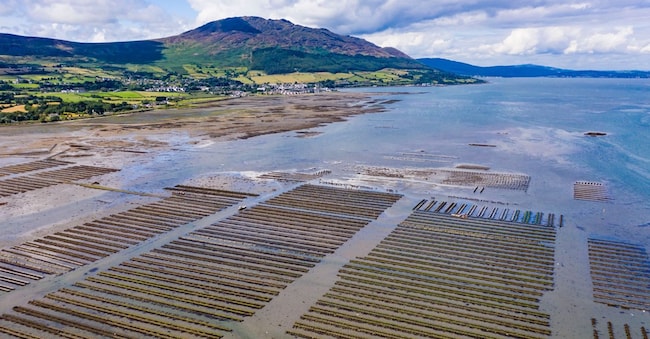
From Riccione to Milan, at the historic restaurant on Via Taramelli, oysters are not a recent trend: they’ve been on the menu since the 1960s. For years, however, for many customers, their vocabulary was limited to just two names, two varieties – Fin de Claire and Belon – associated with the French Riviera. It was in the late 1990s, when they took over the restaurant, that Dante and Giuseppe Di Paolo had a brainwave: to transform the oyster from a niche product into a category worth exploring, highlighting different qualities, types and regions. A decision which, over time, became a catalyst for building expertise and, eventually, a micro-supply chain.
Their training began in the field through trips to various countries: Normandy and Brittany, the Mediterranean and Portugal, right through to sites on the Atlantic coast. From these explorations, the Di Paolo family returned with a very clear understanding of the production principles behind oyster farming: ‘The sea does it all; you just have to learn how to contain them,’ explains Giuseppe Di Paolo, who emphasises that oyster farming is an activity centred more on environmental management: ‘Oysters do not require feed and filter whatever they find in the water,’ he explains. The one constant, however, is the tide: where there are high and low tides, the oyster grows stronger; where there are none, attempts are made to recreate them using mechanical and floating systems.
After several site visits, including some in Italia, Di Paolo identified a recurring factor: the interplay between fresh and salt water, involving currents and springs. And in the end, the choice fell on an Irish bay about an hour’s drive from Dublin: ‘There,’ he says, ‘the water temperature conditions were better than elsewhere, even compared to France.’
Before long, the project became a ‘tailor-made’ micro-supply chain managed remotely: not a facility owned by the company, but a plot cultivated by a local oyster farmer in accordance with an agreed protocol, subject to regular checks. “The system consists of just a few (bags) and steel cables stretched between poles in the sea, fixed at a height of roughly one metre to one and a half metres,’ he explains, ‘where these bags are laid out horizontally, so as to capture the tide and wave motion and transform natural energy into continuous rotation.’
The Irish produce that ends up on the tables of the Di Paolo family’s three Milanese restaurants – in addition to the one in Via Taramelli, there is another in Via Procaccini and one in Via Durini – amounts to around a thousand per week, or roughly 50,000 pieces a year. But the spectre of biological risk is always lurking: ‘More than 50–60 per cent of the production is lost along the way, and it takes around two to three years to reach market size, depending on the water temperature,’ notes Di Paolo. For this reason, the entrepreneur explains, this is not a business with a guaranteed return, precisely because there are so many unforeseen events. But the environmental benefit is also tangible. Here, in fact, sustainability ceases to be an abstract concept and becomes a matter for the entire supply chain. Di Paolo confirms this: “Oysters are like mussels: they help the ecosystem by filtering CO₂ and converting it into oxygen, and this farm has made that bay more sustainable by helping both the marine ecosystem and that of the delta.”

