
The revolution starts in the mountains
Matteo Righetto writes that, against the climate crisis and to safeguard biodiversity, we need slow tourism and the human-nature symbiosis

4' min read
4' min read
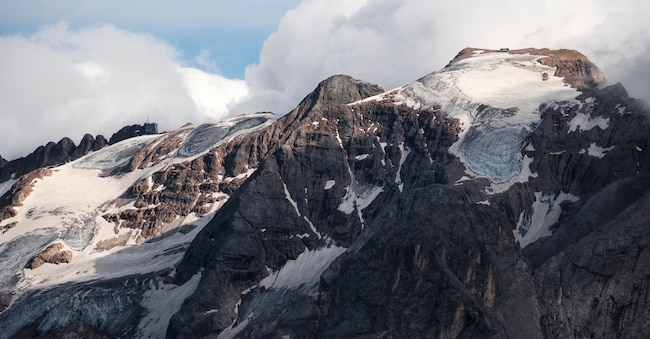
Take a deep breath, get to the end of this sentence and about ten seconds will have already passed. Those that, on 3 July 2022, at 1.30 p.m. on a sunny Sunday, brought down a black wave of ice the size of the San Siro stadium, multiplied by two and about eighty metres high. It ran at three hundred kilometres per hour that avalanche, from an altitude of 3,200 metres to 1,800, also taking eleven lives. And the Marmolada was never the same again. From the ten seconds that devastated the queen of the Dolomites, writer Matteo Righetto set off in search of the Richiamo della montagna, the one that leads to the silences of the peaks and to give a cultural turn to the care of the natural landscape and the environment.
The history of the Marmolada began 250 million years ago and for the Ladin peoples living in the Fassa Valley and Fodòm, but also for the Agordo communities of Val Biois and Val Pettorina, the mountain is the soul that watches over them all. It is summit and life, the vate of the future and the life of transmission of existence. But today its glacier is almost gone. In a century, 90 per cent of the volume has melted away and in the last five years the glacier has lost 70 hectares, the equivalent of 98 football fields, from around 170 hectares in 2019 to 98 in 2023. Tropical weather obliterates the ice and floods the land with water, as in October 2018 with storm Vaia, which scrambled the Agordino. A tragedy for the mountains, the forests drowned in 160 million cubic metres of water, 16 million spruce trees crashed by the wind at 160 kilometres per hour. Temperatures are rising, hell is destroying nature, but, Righetto writes, 'our society suffers first of all from this: the permanent childhood syndrome. What matters is: Fun! Fun! Fun! And then of course the idolatry of Money! Money! Money!'.
The landscape has patches, neglect, year after year, has ruined it, everyone's carelessness is today's catastrophic domino. We do not have the conscience of the Native Americans: 'When a pine needle falls in the forest, the eagle sees it, the deer hears it and the bear sniffs it out'. We do not, we marvel for a moment, one day and then, below, with the new day, the new news, thirsting for emptiness. Only the immediate, the tangible, the materialistic captures our attention, but Mother Nature is slow, she lives for millennia, she builds with patience, she has survival strategies that have always been tested.
The time that devours everything, also burns space: every ten seconds, three hectares of forest in the world are gone, one hectare of which concerns the Amazon forest alone, the lung of the planet; every ten seconds, there are five displaced persons due to the climate crisis; in our country, every ten seconds, twenty square metres of concrete is built, as if there were not enough, especially in certain regions; on the planet, in little more than ten seconds, an animal or plant species becomes extinct. Catastrophes continue and man is so distracted. Marmolada is asking for everyone's commitment: join forces, make my situation known to the world, raise your voice to stand as a symbol of struggle and resistance to climate change. Which can start from a rethinking of mountain tourism, slower, more ecological, cultural and sustainable. As, for example, does the Ski Club of Cardada, in Canton Ticino (Switzerland), which since 2003 has definitively abandoned skiing on the slopes, calling it an anachronistic historical attraction, or as happens in Dobratsch, in Carinthia (Austria), where the ski lifts have been closed, dismantled and sold to make room for ski mountaineers, snowshoers, cross-country skiers and hikers, who flock to the snow, the real snow.
Matteo Righetto proposes his cure because 'the fight against the climate crisis and the safeguard of biodiversity directly affect our greatest yearning, the deepest desire of every human being: happiness, which is the recomposition of harmony between man and Earth, the re-establishment of a universal balance antithetical to the egoisms and suprematisms that govern humanity and tear the planet apart. If we do not want to witness 'Alpicide', it is time to return to the mountains with a different kind of mountaineering, not peaks and conquests, so self-referential, but culture, love for the Alp: the mountain is us. And then listening and patience, sharing time and steps. "You will find more in the woods than in books", wrote Bernard of Clairvaux, and how could we forget St Francis, "sora moon and stars". We need to undertake a 'wild re-education': go back to the woods, without a compass, without a GPS, surrender with trust to the plants, to their magnificence, as taught in the many books by geographer Franco Michieli (above all To find yourself you must first lose yourself and Le vie invisibili).


