
The rich country where poverty is rampant
US citizens are convinced that they live in a society that is much more socially mobile and much less economically unequal than the real one

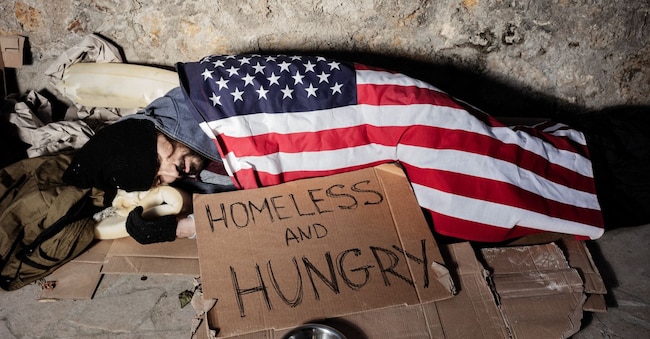
The United States is a nation of paradoxes: it is certainly paradoxical to have both the highest per capita income among the major Western countries and the highest poverty rate. According to the OECD, in 2022, 18.1% of the US population lived in relative poverty; Italy, which certainly does not stand out favourably in this ranking, stops at a more decent 12.2%.
For a European, it is very difficult to understand how such a wealthy nation could agree to leave behind such a large portion of its population. In some ways, when we relate to the United States we tend to think of the same country our ancestors looked to with hope: a country full of resources, with great opportunities for anyone willing to roll up their sleeves.
There is no doubt that the United States was indeed, in the 19th and early 20th century, the promised land for those who, from the overcrowded European continent, chose to pursue their fortunes across the Atlantic. In the early 1900s, an American construction worker earned twice as much as his British equivalent, and about five times as much as an Italian worker. On the other hand, land and natural resources in general abounded in the United States, while labour power was scarce: the exact opposite of old Europe. Not only were workers, even the less skilled, earning good wages, but American society in general was much less unequal than that of Europe.
The United States of the period between the Civil War (1861-65) and the beginning of the twentieth century, therefore, enjoyed the optimal combination of high wages, high social mobility and low inequality. This is the scenario that still lingers in the imaginations of Europeans, and which we think of almost automatically - forgetting that, as confirmed by the OECD, the United States of this early part of the 21st century is by far the most unequal of the great Western nations, has low social mobility (roughly at Italian levels, to be precise) and forces almost a quarter of its workforce to accept starvation wages, or at least very low ones.
If we want to understand the immediate causes of the rampant poverty in the contemporary United States, we certainly have to consider the progressive degradation of the social safety net, largely as a result of the very incomplete (from a European perspective) American welfare state. A very rich country, which could certainly afford to offer help to its weaker citizens, hesitates to do so. Not only that: it cyclically and stubbornly questions what has been achieved by the most socially sensitive administrations, as in the case of the Trump administration's fight against so-called 'Obamacare'.

